

Ocean Floor

Presentation
•
Science, Other Sciences
•
6th - 8th Grade
•
Practice Problem
•
Medium
+2
Standards-aligned

Dieuseul Paul
Used 9+ times
FREE Resource
23 Slides • 14 Questions
1
Ocean Floor and Mapping

2
As you go through the slides,
take notes on your Ocean Floor and Mapping packet.
3
Listen to the audio introduction. Click play.
4
SONAR - a technique of detecting objects underwater using sound waves.
High-frequency sound waves are transmitted through water. The waves bounce off objects and are detected. The distance to an object is determined by measuring the amount of time required for the reflected sound wave to return to the device.
The acronym “SONAR” stands for “SOund NAvigation and Ranging.”
5
Note-taking time
Be sure to copy the SONAR information from the last slide into your notes.
Only take notes on highlighted areas.
6
Using SONAR
Did you ever shout and hear an echo? If you did, that’s because the sound waves bounced off a hard surface and back to you. The same principle explains how sonar works. A ship on the surface sends sound waves down to the ocean floor. The sound waves bounce off the ocean floor and return to the surface, like an echo.

7
Using SONAR
Sonar can be used to measure how deep the ocean is. A device records the time it takes sound waves to travel from the surface to the ocean floor and back again. Sound waves travel through water at a known speed. Once scientists know the travel time of the wave, they can calculate the distance to the ocean floor. They can then combine all of these distances to make a map of the ocean floor.

8
Sea Floor Mapping Vocabulary (take notes)
Coordinates – a set of numbers that describe where something is located. The location of a point on Earth’s surface is specified by its latitude and longitude.
Latitude – a location’s distance north or south of the equator. Latitude is measured in degrees north or south.
Longitude – a location’s distance east or west of the prime meridian. Longitude is measured in degrees east or west.
9
Multiple Choice
When using sonar, the distance to the ocean floor is calculated from the
time it takes sound waves to travel to the ocean floor.
pressure ocean water exerts on the ocean floor.
speed of sound waves through ocean water.
two of the answer choices are correct
10
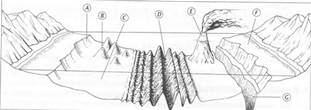
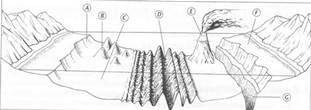
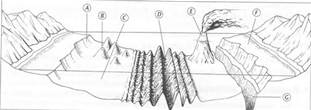
Features on the Ocean Floor
Scientists have learned a lot about the ocean floor. For example, they know that Earth’s tallest mountains and deepest canyons are on the ocean floor. The major features on the ocean floor are described on the next slides. Be sure to take notes in your packet.
11
Ocean Floor Features
The continental shelf is the ocean floor nearest the edges of continents. It has a gentle slope. The water over the continental shelf is shallow.
The continental slope lies between the continental shelf and the abyssal plain. It has a steep slope with a sharp drop to the deep ocean floor.
The continental rise is the area between the continental slope and abyssal plain.
12
Ocean Floor Features
The abyssal plain forms much of the floor under the open ocean.
An oceanic trench is a deep canyon on the ocean floor. Trenches occur where one tectonic plate subducts under another. The deepest trench is the Mariana Trench in the Pacific Ocean.
13
Ocean Floor Features
A seamount is a volcanic mountain on the ocean floor. Seamounts that rise above the water surface are known as islands.
The mid-ocean ridge is a mountain range that runs through all the world’s oceans.
14
15
Multiple Choice
The mid-ocean ridge forms where tectonic plates
slide past one another.
push together.
pull apart.
subduct.
16
17
Multiple Choice
Underwater mountain ranges, canyons, and trenches that extend around the world
Mid Ocean Ridges
Volcanoes
Faults
18
Expanding Seafloor
Ocean floor is made from cooling lava.
Lava comes from the MANTLE at the ridge and cools.
As more lava erupts, the crust moves away from the ridge.
This is called SEAFLOOR SPREADING

19
What about the Old Ocean Floor?
Old ocean floor moves edges of continents
Trenches push ocean floor back to mantle
RECYCLED!
SUBDUCTION: crust pushing down into the mantle

20
21
Multiple Choice
The seafloor is recycled.
True
False
22
Multiple Choice
The crust going back down into the mantle is known as....
Repurposing
Transformation
Subduction
23
24
25
Abyssal plains
•Abyssal plains are flat or very gently sloping areas of the deep ocean basin floor. They generally lie between the foot of a continental rise and a mid-oceanic ridge.

26

27
Continental Rise
A gentle slope with a generally smooth surface, built up by the shedding of sediments from the continental block, and located between the continental slope and the abyssal plain.

28
Mid-Ocean Ridge
A mid-ocean ridge is an underwater mountain range, typically having a valley known as a rift running along its spine, formed by a divergent plate boundary. It is usually an oceanic spreading center, which is responsible for seafloor spreading.

29
Multiple Choice
30
Multiple Choice
31
Multiple Choice
32
Multiple Choice
33
Multiple Choice
34
Multiple Choice
35
Multiple Choice
36
Multiple Choice
37
Multiple Choice
Ocean Floor and Mapping
Show answer
Auto Play
Slide 1 / 37
SLIDE
Similar Resources on Wayground

33 questions
Inclined Planes (A simple Machine) Guided Lesson
Presentation
•
6th - 8th Grade
34 questions
Chromosomes, DNA, and Genes Review
Presentation
•
7th - 8th Grade
31 questions
Natural Selection
Presentation
•
6th - 8th Grade
31 questions
Properties of Visible Light
Presentation
•
6th - 8th Grade
34 questions
WED Notes
Presentation
•
6th - 8th Grade
34 questions
Layers of the Atmosphere Doodle Notes
Presentation
•
6th - 8th Grade
35 questions
Plate Tectonics
Presentation
•
6th - 8th Grade
32 questions
Weather Instruments
Presentation
•
5th - 8th Grade
Popular Resources on Wayground
6 questions
Secondary Safety Quiz
Presentation
•
9th - 12th Grade
10 questions
MyPath Diagnostic Overview
Presentation
•
6th - 8th Grade
20 questions
Lab Safety Quiz

Quiz
•
6th Grade
21 questions
Continents and Oceans
Quiz
•
6th Grade
20 questions
Adding and Subtracting Decimals
Quiz
•
5th Grade
20 questions
Parts of Speech
Quiz
•
5th Grade
16 questions
Subject & Predicate
Quiz
•
5th Grade
21 questions
Lab Safety
Quiz
•
10th Grade
Discover more resources for Science
20 questions
Lab Safety Quiz
Quiz
•
6th Grade
10 questions
Lab Safety
Quiz
•
8th Grade
20 questions
💯4. Quiz: Safety in the Science Lab
Quiz
•
7th Grade
20 questions
Lab Safety
Quiz
•
5th - 8th Grade
10 questions
Independent vs. Dependent Variable Practice
Quiz
•
6th Grade
10 questions
Lab Safety Essentials

Interactive video
•
6th - 10th Grade
20 questions
Scientific Method and Variables
Quiz
•
8th Grade
20 questions
Scientific method and variables
Quiz
•
8th Grade