
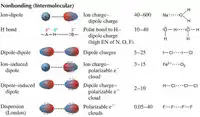
3.1 IMF AP Chem

Presentation
•
Chemistry
•
9th - 12th Grade
•
Medium

Brandi Gremaud
Used 2+ times
FREE Resource
20 Slides • 7 Questions
1

2

3

4

5
Multiple Choice
What type of IMF is found in alcohol, C2H5OH?
dipole-dipole
6
Multiple Choice
Which substance only experiences LDFs?
7

8

9
Multiple Choice
Which substance has the strongest LDFs?
10
Multiple Choice
Which substance is most polarizable?
C3H8
C2H5OH
C6H12O6
CH4
11

12

13

14

15

16

17

18

19

20

21

22
Multiple Choice

Click image
It does not show how hydrogen bonds are constantly forming, breaking, and reforming, which results in a net force of attraction between the molecules.
It does not show how the interactions between ions and the induced molecular dipoles result in a net force of attraction between the molecules.
It does not show how the interacting permanent dipoles of the molecules result in a net force of attraction between the molecules.
It does not show how the temporary fluctuating dipoles of the molecular electron clouds result in a net force of attraction between the molecules.
23
Multiple Choice

Click Image
F2 is soluble in water, whereas HF is insoluble in water.
Liquid F2 has weak dispersion force attractions between its molecules, whereas liquid HF has both weak dispersion force attractions and hydrogen bonding interactions between its molecules.
Liquid F2 has weak dispersion force attractions between its molecules, whereas liquid HF has strong ionic interactions between H+ and F− ions.
The F2 molecule has a greater mass than the HF molecule has.
24
Multiple Choice

The random motion of the particles within the liquids
The structural formula of the molecules of the liquid and vapor in each flask
The strength of the intermolecular forces between the particles in the liquids
The relative speeds of the vapor particles in each flask
25

26

27

Show answer
Auto Play
Slide 1 / 27
SLIDE
Similar Resources on Wayground

19 questions
8.01: Introduction to Chemical Reactions
Presentation
•
9th - 12th Grade
20 questions
Electromagnetic vs. Mechanical Waves Review Lesson
Presentation
•
9th - 12th Grade
20 questions
Physical Education
Presentation
•
9th - 12th Grade
20 questions
Theme
Presentation
•
9th - 12th Grade
20 questions
Atomic Structure Review
Presentation
•
9th - 12th Grade
20 questions
Water, Solubility, Solutions, Molarity
Presentation
•
9th - 12th Grade
20 questions
DLD Performance Final
Presentation
•
9th - 12th Grade
24 questions
History of the Periodic Table
Presentation
•
9th - 12th Grade
Popular Resources on Wayground
10 questions
Safety Day 2026 – Student Review

Quiz
•
9th Grade
21 questions
Continents and Oceans
Quiz
•
6th Grade
20 questions
Parts of Speech
Quiz
•
5th Grade
16 questions
Subject & Predicate
Quiz
•
5th Grade
25 questions
Multiplication Facts
Quiz
•
5th Grade
12 questions
Map Skills
Quiz
•
3rd Grade
22 questions
Continents and Oceans
Quiz
•
5th Grade
15 questions
Rounding Decimals
Quiz
•
5th Grade
Discover more resources for Chemistry
20 questions
electron configurations and orbital notation
Quiz
•
9th - 12th Grade
20 questions
Periodic Table Trends
Quiz
•
11th Grade
25 questions
Writing and Naming Binary Ionic compounds
Quiz
•
10th Grade
20 questions
COUNTING ATOMS
Quiz
•
10th Grade
50 questions
Unit 3: Atomic Assault Summative Review
Quiz
•
11th Grade
20 questions
Physical or Chemical Change/Phases
Quiz
•
8th Grade - University
15 questions
Periodicity Module Exam Practice Quiz
Quiz
•
9th - 12th Grade
20 questions
Naming Ionic Compounds
Quiz
•
10th Grade