

Exploring Forces and Motion

Presentation
•
Science
•
5th Grade
•
Practice Problem
•
Easy
+13
Standards-aligned

Mr. McLellan
Used 7+ times
FREE Resource
11 Slides • 9 Questions
1
Explore the fascinating world of forces and motion, where objects interact and move in response to various forces. Discover the principles behind acceleration, friction, and more as we delve into the mechanics of the physical world.
2
Forces and Motion
Introduction to Forces: Forces are pushes or pulls that can change the motion of an object.
Types of Forces: Examples include gravity, friction, and magnetic forces.
Newton's Laws of Motion: These laws describe how forces affect the motion of objects.
3
Multiple Choice
What is a push or a pull?
force
gravity
friction
inertia
4
Types of Forces
There are different types of forces. Some that we will discuss include:
balanced
unbalanced
contact
non-contact
5
Forces and Motion
6
Multiple Choice
What do balanced forces result in?
Acceleration
Deceleration
No change in motion
Change in motion
7
Multiple Choice
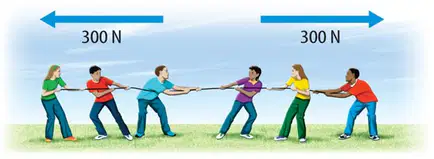
The following forces are being applied. What is the result of the forces?
No movement; the forces are unblanaced
The rope will move to the left because the forces are unbalanced
The rope will move to the right because the forces are unbalanced
No movement; the forces are balanced
8
Balanced Forces
No change in motion occurs when balanced forces are applied. Balanced forces have equal magnitude and opposite direction, resulting in no movement. This means that an object at rest will remain at rest, and an object in motion will continue moving at a constant velocity.
9
Friction: The Opposing Force
Friction is a force that opposes motion.
It occurs when two surfaces rub against each other.
Friction can be helpful or harmful depending on the situation.
It can slow down or stop objects in motion.
Reducing friction can be achieved through using smoother surfaces.
10
Multiple Choice
What is friction?
A force that opposes motion
A force that causes motion
A force that increases motion
A force that has no effect on motion
11
Multiple Choice
Why is it hard for the boy in image B to get down the hill compared to the boy in image A
The friction of the snow is greater
The skis apply more friction
The friction of the grass is greater
The amount of wind resistance
12
Multiple Choice
The diagram shows forces acting on a box.
Which statement best describes what will happen to the box as a result of these forces being applied?
The box will move up
The box will move to the left
The box will move to the right
The box will remain stationary
13
Open Ended
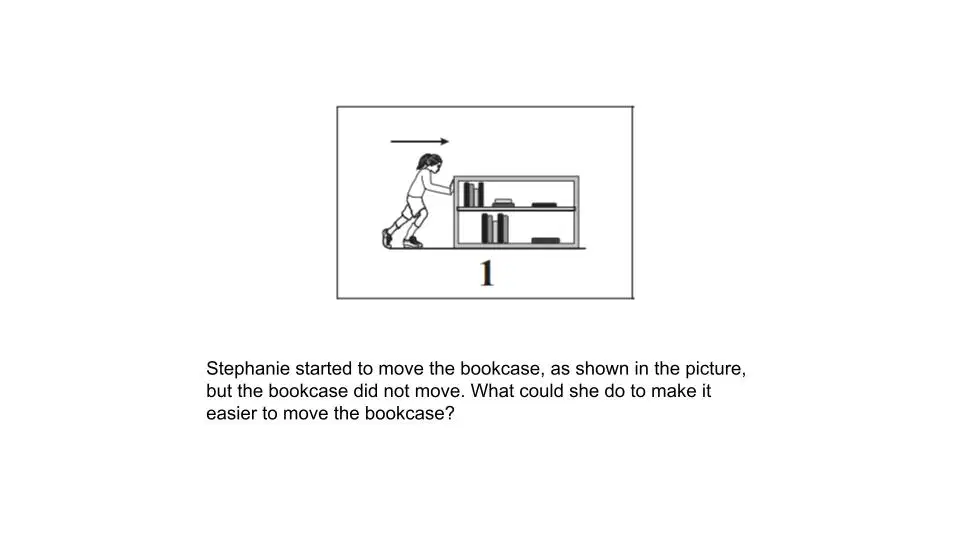
Stephanie started to move the bookcase, as shown in the picture, but the bookcase did not move. What could she do to make it easier to move the bookcase?
14
Friction: A Force That Opposes Motion
Trivia: Friction is a force that acts in the opposite direction of motion. It is caused by the interaction between two surfaces and can be affected by factors such as roughness and weight. Friction plays a crucial role in everyday life, from walking to driving. Without friction, objects would slide or roll uncontrollably!
15
Mass, Force, and Acceleration
16
Multiple Choice
What is the relationship between mass, force, and acceleration?
Mass is the amount of matter in an object.
Force is a push or pull that can change an object's motion.
Acceleration is the rate at which an object's velocity changes.
Mass, force, and acceleration are unrelated.
17
Mass, Force, and Acceleration
Trivia: Mass is the amount of matter in an object. Force is a push or pull that can change an object's motion. Acceleration is the rate at which an object's velocity changes. These three concepts are interconnected and play a crucial role in understanding the dynamics of motion and forces in the physical world.
18
Forces in Real-Life
19
Multiple Choice
Which force opposes motion and can slow down or stop objects?
Gravity
Friction
Applied force
Tension
20
Friction
Friction is the force that opposes motion and can slow down or stop objects. It occurs when two surfaces rub against each other. Friction is essential for many everyday activities, such as walking, driving, and writing. Without friction, objects would slide uncontrollably and life would be very different. Gravity, Applied force, and Tension are not forces that oppose motion like friction does.
Explore the fascinating world of forces and motion, where objects interact and move in response to various forces. Discover the principles behind acceleration, friction, and more as we delve into the mechanics of the physical world.
Show answer
Auto Play
Slide 1 / 20
SLIDE
Similar Resources on Wayground

14 questions
Mixtures & Solutions Investigation 2
Presentation
•
5th Grade
16 questions
Flood Control
Presentation
•
5th Grade
16 questions
Force and Motion Review
Presentation
•
5th Grade
14 questions
Planets
Presentation
•
5th Grade
13 questions
Solid, Liquid and Gas
Presentation
•
5th Grade
14 questions
Animal Adaptations
Presentation
•
5th Grade
16 questions
Traits
Presentation
•
5th Grade
16 questions
Science Review 5.6A
Presentation
•
5th Grade
Popular Resources on Wayground
10 questions
How much do you know about our Portrait of an Eagle?

Quiz
•
10th Grade
10 questions
Fast Food Slogans
Quiz
•
6th - 8th Grade
21 questions
Continents and Oceans
Quiz
•
6th Grade
20 questions
Parts of Speech
Quiz
•
5th Grade
16 questions
Subject & Predicate
Quiz
•
5th Grade
25 questions
Multiplication Facts
Quiz
•
5th Grade
12 questions
Map Skills
Quiz
•
3rd Grade
22 questions
Continents and Oceans
Quiz
•
5th Grade
Discover more resources for Science
9 questions
Properties of matter and Mixtures
Quiz
•
5th Grade
20 questions
Mixtures and Solutions Practice
Quiz
•
5th Grade
20 questions
Food Chains and Food Webs Review
Quiz
•
5th Grade
11 questions
Understanding Light Review 4
Quiz
•
5th Grade
15 questions
Force and Motion
Presentation
•
5th Grade
20 questions
Food Chains & Food Webs
Quiz
•
5th - 7th Grade
20 questions
Weathering, Erosion, & Deposition
Quiz
•
5th Grade
16 questions
Mixture or Solution?
Quiz
•
5th Grade