

Science finals

Presentation
•
Moral Science
•
6th - 8th Grade
•
Medium

Maryam Al Ghamdi
Used 12+ times
FREE Resource
6 Slides • 39 Questions
1
Finals for the science quiz
2
-Maryam Al Ghamdi
" This is just a practice, so it is ok to make mistakes. And DO NOT CHEAT. If you do, you will not learn. Try your best and enjoy! "
3
Multiple Choice
The universe is.....
all matter and all forms of energy and space.
hydrogen and helium held together by gravity
a particle of energy created by nuclear fusion in the core of the sun
4.6 billion years ago there was a cloud of dust and gas
4
Multiple Choice
Example of a dwarf planet
The Sun
Neptune
Mars
Pluto
5
Multiple Select
3 Reasons for the Seasons
2. Earth revolves around the sun.
1. The seasons are caused by the tilt of the Earth.
3. The tilt of earth’s axis as it revlves causes the energy of the sun to hit 3Earth at differnt angles. This reslts in areas getting direct and indirect energy of the sun.
Because the Earth is closer to the sun and that makes summer and if it is far it is winter
2. Beacause of the gravity
6
Fill in the Blanks
Type answer...
7
Multiple Choice
Charateristics of planets
has removed debris and small objects from the area around its orbit
not a satellite (moon) of another object
has enough mass to be round or nearly round
orbits the sun
All of the Above
8
Fill in the Blanks
9
It's going to be harder. Are you ready?
10
Multiple Choice

What moon phase is this?
Waxing crecent
New moon
Waning crecent
Waxing gibbous
11
Fill in the Blanks
Type answer...
12
Multiple Choice
Why don't we see solar and lunar eclipses during every lunar cycle?
The moon's path around Earth is tilted (the plane of the orbit is a difference of about 5 degrees) compared to Earth's orbit around the sun. The only time the eclipses occur is when the sun, Earth and moon line up.
It's because the moon is smaller than the Earth
The moon revolves around Earth. Because of the revolution we see the moon from different angles. The sun's light reflects off the surface of the moon.
when one object in space blocks an observer from seeing another object in space
13
Multiple Choice
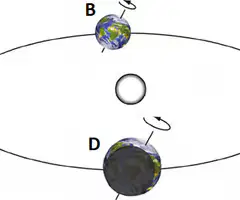
Picture of Earth (Northern Hemisphere) Winter
Letter A
Letter B
Letter C
Letter D
14
Fill in the Blanks
15
Multiple Choice
large clouds of gas or dust in space (potential for form stars, galaxies, and planets) is...
A galaxy
the universe
Gravity
Nebulae
16
Multiple Choice
an object that orbits the Sun and is nearly round in shape, but has not cleared debris and small objects from the area around its orbit is a...
Dwarf planet
Moon
Inner planets
Outer planets
17
Fill in the Blanks
18
Multiple Choice
The tendency of an object to resist a change in motion (Newton's Law of Motion) is....
Mass
Inertia
Gravity
space
19
Multiple Choice
Two factors that affect gravity is...
Mass and weight
Mass and Inertia
Mass and distance
Weight and space
20
Fill in the Blanks
21
Open Ended
Object orbiting another object is...
22
Answer: Revolution
23
Multiple Choice
Day/Night is...
caused by the gravity of the sun and Earth
caused by the revolution of Earth and the sun
caused by rotation of Earth on its axis
24
Multiple Choice

What is this planet?
The moon
Mercury
Pluto
25
Multiple Choice
Why do we see moon phases?
The moon revolves around Earth. Because of the revolution we see the moon from different angles. The sun's light reflects off the surface of the moon.
The moon's path around Earth is tilted (the plane of the orbit is a difference of about 5 degrees) compared to Earth's orbit around the sun. The only time the eclipses occur is when the sun, Earth and moon line up.
26
Multiple Choice
Phase of the moon when a crescent of sunlight is reflected on the right side of the moon
Waxing Crescent
Waning Cresent
27
Fill in the Blanks
28
Multiple Choice
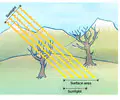
Angle of the sun in the winter
lower angle that causes indirect sunlight; the sun's energy is focused with smaller area; hotter
high angle closer to 90 degrees that causes direct sunlight; the sun's energy is focused with smaller area; hotter
lower angle that causes indirect sunlight; the sun's energy spread out with larger area; colder
high angle that causes direct sunlight; the sun's energy spread out with larger area; colder
29
Multiple Choice
The darkest part of a shadow is the...
Eclipse
Penumbra
Umbra
30
Multiple Choice
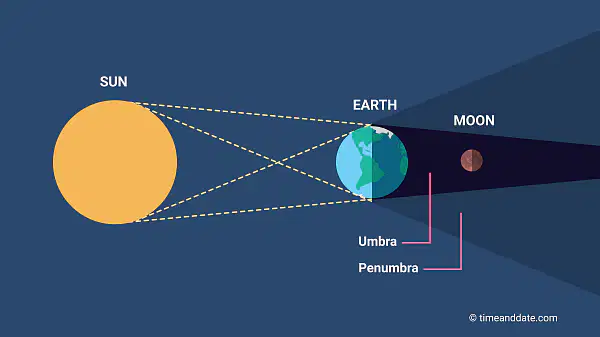
What is this picture?
An eclipse
A solar eclipse
A lunar eclipse
31
Multiple Choice
What is the moon phase during a lunar eclipse?
Full moon
New moon
Waning gibbous
32
Multiple Choice
What is the order of the moon, sun, and Earth during a solar eclipse?
Earth- Sun- Moon
Sun- Earth- Moon
Sun- Moon- Earth
Moon- Sun- Earth
33
Multiple Choice
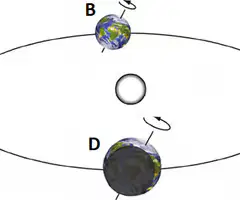
Picture of Earth (Northern Hemisphere) Fall
Letter A
Letter C
Letter D
Letter B
34
Multiple Choice
Phase of the moon when light is visible on the left side of moon's surface (it looks like half of a circle) is a...
Waning gibbuos
First quarter
Third quarter
New moon
35
Multiple Choice
Time it takes for the moon to orbit around Earth
about 24 hours
about 27 days (27.3 days)
about a month
about 29 days
36
Multiple Choice
What is the arrangement of the moon, sun and Earth during a full moon?
Sun- Moon- Earth (in a straight line)
Sun- Earth- Moon (in a straight line)
37
Fill in the Blanks
38
Multiple Choice
What is formation of the Solar System-Step 1
Part of the cloud of dust and gas collapsed
The sun was born and it's gravity pulled in 99.8 percent of the surrounding matter
A flat spinning disk of dust and gas remained
4.6 billion years ago there was a cloud of dust and gas
39
Multiple Choice
Comet is...
a rocky metallic fragment of an asteroid, comet, or planet
An icy body that releases gases at orbits the sun. It has a tail
A streak of light in the sky produced by the burning of a meteoroid in Earth's atmosphere.
a rocky body smaller than a planet that orbits the sun (asteroids are almost always found in the Asteroid Belt located between Mars and Jupiter)
40
Multiple Choice
(of the moon) pertaining to the period during which the visible surface of the moon is getting smaller
Waxing
Waning
41
Multiple Choice
Formation of the Solar System-Step 2
Part of the cloud of dust and gas collapsed
A flat spinning disk of dust and gas remained
42
Multiple Choice
Which planet has the shortest orbit around the sun?
Venus
Mercury
Earth
Mars
43
Opinion question!
44
Poll
Was this practice quizz helpful?
Yes, it was!
No, it's not
45
Thank you!
Sorry it was not all the questions
Finals for the science quiz
Show answer
Auto Play
Slide 1 / 45
SLIDE
Similar Resources on Wayground

38 questions
Newton’s Laws of Motion
Presentation
•
7th - 8th Grade
42 questions
Measuring
Presentation
•
7th - 8th Grade
40 questions
WO Grammar Review 2025
Presentation
•
6th - 8th Grade
40 questions
FANBOYS
Presentation
•
6th - 8th Grade
39 questions
Ecosystems and Biomes
Presentation
•
6th - 8th Grade
38 questions
Rhetorical Appeals and Strategies
Presentation
•
9th Grade
41 questions
Introduction to Poetry
Presentation
•
6th - 7th Grade
38 questions
Dia de accion de gracias
Presentation
•
6th - 8th Grade
Popular Resources on Wayground
10 questions
HCS SCI 03 Summer School Assessment 1

Quiz
•
3rd Grade
15 questions
HCS SCI 05 Summer School Assessment 1 Review
Quiz
•
5th Grade
22 questions
Day 9 Equations and Inequalities Review
Quiz
•
9th Grade
10 questions
Writing and Identifying Ratios Practice
Quiz
•
5th - 6th Grade
7 questions
PYRAMID PERSPECTIVES part 1
Presentation
•
9th - 12th Grade
12 questions
Understanding the Fourth of July
Quiz
•
9th Grade
15 questions
Soccer World Cup Quiz Questions
Quiz
•
7th Grade