
Lesson 2: The Hellenistic Kingdoms

Presentation
•
Social Studies
•
6th Grade
•
Practice Problem
•
Medium

CMS Cyclones
Used 71+ times
FREE Resource
9 Slides • 11 Questions
1
Lesson 2: The Hellenistic Kingdoms
2
Main ideas
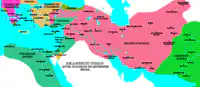
1. Three powerful generals divided Alexander’s empire among themselves, establishing Hellenistic Macedonia, Hellenistic Syria, and Hellenistic Egypt.
2. A uniform system of trade developed throughout the Hellenistic kingdoms, with a common language, culture, and coinage.
3
Key People
1) Antigonus: a powerful general of Alexander’s who became the king of Macedonia
2) Seleucus: a powerful general who seized most of Alexander’s Asian conquests
3) Ptolemy: a powerful general of Alexander’s who ruled Egypt and whose dynasty became the most powerful and wealthiest of Hellenistic kingdoms
4) Cleopatra VII: the last and most famous Ptolemaic ruler of Egypt
4
Three Hellenistic Kingdoms
After Alexander died, there was no obvious heir to his kingdom. So his generals fought for power. The empire was divided among three generals.
Antigonus became the king of Alexander’s homeland, Macedonia, which included Greece. It had the weakest government. Macedonia had trouble defending itself from the many revolts of the Greeks. Rome’s armies conquered the Antigonid dynasty in the mid-100s BC.
5
Multiple Choice
Alexander's son became the heir to his kingdom.
True
False
6
Open Ended
Why were Rome’s armies able to conquer the Antigonid dynasty?
7
Seleucus seized control of most of Alexander’s Asian conquests, including Persia. This empire was larger than Macedonia and was difficult to control. It was spread out and was home to many different people with different customs. The capital was far from some parts of the kingdom, so people ignored the king. Seleucid rulers were eventually conquered by Rome in the 60s BC.
8
Multiple Choice
____________seized control of most of Alexander’s Asian conquests, including Persia.
Cleopatra VII
Seleucus
Alexander the Great
Phillip II
9
Open Ended
What problems existed in the Seleucid kingdom?
10
Ptolemy became ruler of Egypt. His dynasty, the Ptolemaic, was the most powerful and wealthiest of the Hellenistic kingdoms. He was called “pharaoh” to gain him the support of the Egyptians. He ruled from Alexandria, one of the ancient world’s greatest cities. It had the world’s largest library and the Museum, a place for scholars and artists. Even this stable and prosperous kingdom, though, came into conflict with other powers, especially Rome. It lasted longer than the other kingdoms. But after the death of the last and most famous Ptolemaic ruler, Cleopatra VII, the Romans took control of Egypt.
11
Multiple Choice
Ptolemy was called "pharaoh" to gain him the support of the ___________.
Persians
Chinese
Syrians
Macedonians
Egyptians
12
Open Ended
Why was Alexandria considered a great city?
13
Fill in the Blanks
But after the death of the last and most famous Ptolemaic ruler,
Type answer...
14
GOVERNMENT AND ECONOMY
Alexander had ruled without limits on his power, as did the Hellenistic rulers. Rule passed down within their families. Only men could be kings in Macedonia and the Seleucid kingdom. A few women became pharaohs in Egypt, such as Cleopatra VII.
15
Open Ended
How was rule in Egypt different from rule in Macedonia and the Seleucid kingdom?
16
Hellenistic rulers relied on Greek advisors. Together, they strengthened their economies, built and repaired roads and irrigation systems, promoted manufacturing and trade, and supported the arts. Large cities grew as kings became wealthy from the taxes.
17
Draw
Draw a picture of something that was strengthened when rulers relied on Greek advisors.
18
Throughout the Hellenistic region, the people followed a uniform system of trade. They shared a common culture and used a form of Greek as their common language. They continued to use standard coins from Alexander’s time. They built trade networks with other civilizations. For example, China could send silk to the Hellenistic kingdoms, and they could send other goods back to China.
19
Fill in the Blanks
Throughout the Hellenistic region, the people followed a uniform system of
Type answer...
20
Open Ended
What made trade so successful throughout the Hellenistic region?
Lesson 2: The Hellenistic Kingdoms
Show answer
Auto Play
Slide 1 / 20
SLIDE
Similar Resources on Wayground

13 questions
Confucianism and Taoism
Presentation
•
6th Grade
17 questions
Africa and Middle East Culture
Presentation
•
6th Grade
13 questions
Economic systems
Presentation
•
6th Grade
17 questions
ASIA
Presentation
•
6th Grade
14 questions
Geography of Ancient China
Presentation
•
6th Grade
14 questions
Quebec's Independence Movement
Presentation
•
6th Grade
16 questions
Ancient Greece Geography
Presentation
•
6th Grade
14 questions
RUSSIA'S PEOPLE, NATURE, & GOVERNMENT
Presentation
•
6th Grade
Popular Resources on Wayground
10 questions
How much do you know about our Portrait of an Eagle?

Quiz
•
10th Grade
10 questions
Fast Food Slogans
Quiz
•
6th - 8th Grade
21 questions
Continents and Oceans
Quiz
•
6th Grade
20 questions
Parts of Speech
Quiz
•
5th Grade
16 questions
Subject & Predicate
Quiz
•
5th Grade
25 questions
Multiplication Facts
Quiz
•
5th Grade
12 questions
Map Skills
Quiz
•
3rd Grade
22 questions
Continents and Oceans
Quiz
•
5th Grade
Discover more resources for Social Studies
10 questions
Exploring the Age of Exploration: Key Events and Figures

Interactive video
•
6th - 10th Grade
13 questions
13 Colonies Map Quiz
Quiz
•
6th - 8th Grade
12 questions
7 Continents and 5 Major Oceans
Quiz
•
6th Grade
10 questions
Pillars of Free Enterprise
Quiz
•
6th - 8th Grade
26 questions
QA 1 Review
Quiz
•
6th - 8th Grade
8 questions
Geography of Mesopotamia
Presentation
•
6th Grade
10 questions
Exploring the 13 Colonies Regions
Interactive video
•
6th - 10th Grade
20 questions
Latitude and Longitude Practice
Quiz
•
6th Grade