

NOTES PROCUREMENT CHAPTER 5

Presentation
•
Other
•
University
•
Practice Problem
•
Hard

Iqbal Ukail
FREE Resource
16 Slides • 0 Questions
1

CHAPTER 5: PRICING DETERMINATION
Definition Price:
• Price is determined by what (1) a buyer is willing to pay, (2) a seller is willing to accept and (3) the
competition is allowing to be charged.
• With product, promotion and place of marketing mix, it is one of the business variables over which
organizations can exercise some degree of control.
What is Price Determination?
• Refered to the interaction of the free market forces of demand and supply to establish the general
level of price for a good or service.
2

Different between Price Taker and Price Maker
Price Taker
• A person or company that has no control to dictate price for a good and service.
• In the trading world, a price taker is a trader who does not affect the price of the stock if they buy or sell the product.
• A price taker situation commonly arises when there are many competitors, so the buyer has many alternative to choose.
Price Maker
• An individual or company who are influent to affect the
price of an item.
• Someone who is hold a large majority of a stock if they bought or sold it.
• The term is often applied to companies those who monopoly in their market.
Example
Example
3
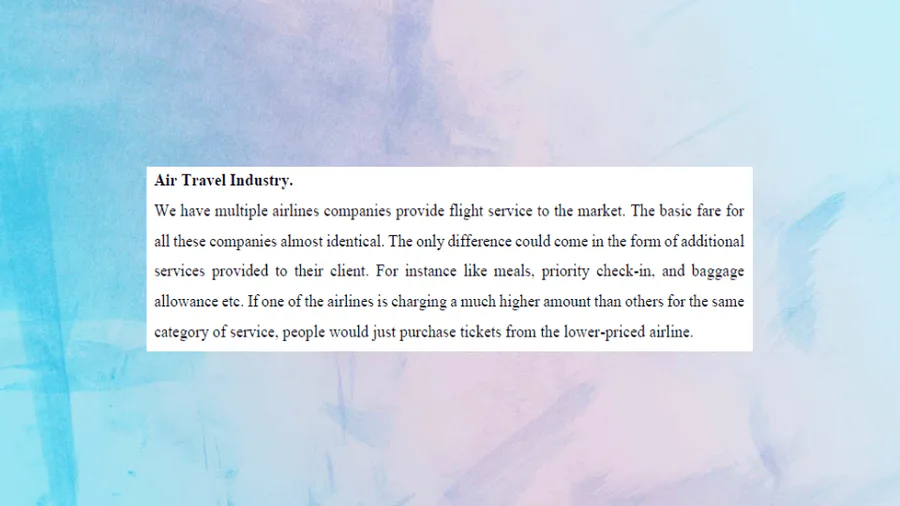
Example of “Price Taker”
4
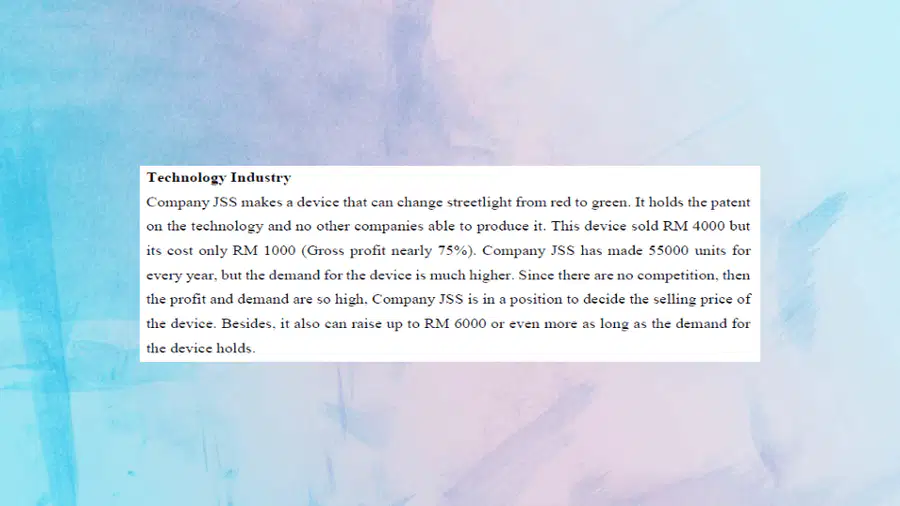
Example of “Price Maker”
5

Price analysis techniques
i. Comparison of Competitive Bids
• One of the best means for validating price.
• Three or more supplier of their prices for the same product, we can determine if a particular price is reasonable.
• However, this does not preclude total cost analysis.
• The lowest bid may not always represent the lowest cost.
• The total cost of acquisition must be analyzed.
• There may be cost of early replacement or the cost of redesign and/or testing required to make the lower cost
product applicable.
ii. Comparison of Prior Quotations
• In some circumstances, it may be most effective to compare recent (with the past 24 months) quotation for the
same product or service to determine the viability of the current quotation.
• This is particularly helpful when timing of the acquisition is critical and solicitation of the competitive quotes would
delay the procurement.
6

iii. Comparison of Published Price
• Used for materials that are sufficiently similar to items or services are available to the general public and whose price
would appear in a published price list.
• However, when comparing these price lists, it is important to consider standard industry discounts for the items or
services.
• As an example, most electrical supply houses will offer standard discounts to purchasers doing a particular dollar or
quantity volume.
• Such discounts must be considered when comparing list prices and noted in the procurement documentation.
iv. Prices set by Law or Regulations
• Sometimes, prices are set by a law or regulation.
• When this occurs, there is usually a ‘pronouncement’ of some form type that references the pricing structure.
• This must be referenced when procuring such items.
v. Similar Item Comparison
• When an item or service is fairly unique, it is possible to compare items that are similar to those being purchased.
• A statement as to why the common item will not meet the specification should accompany the price comparison.
7

vi. Rough Yardstick Comparison
• This technique uses a rough comparison between like items based on measurable similarities such as price per
pound, cost per horsepower or price per test sample.
• Many times, it is difficult to find comparable items or services.
• In these situations, it may be necessary to rely on a technical analysis.
• While time consuming, this is the best method to use when validating price for complicated sole source items.
• In this analysis, the supplier of the goods or services is asked to provide:-
List of materials and their cost.
Number and kinds of labor hours required.
Any special tooling and facilities proposed.
A reasonable plan for use and disposal of scrap.
Any other cost, including profit, relevant to the cost of providing the service or item.
• Each item on the supplier’s bill of materials is then analyzed using the above noted techniques.
• Negotiation of variables such as overhead and profit can occur as well.
• Again the exercise must be documented.
8

Two basic approach to price determination
A. Cost-based pricing approach
• The price maker adds together all the unit cost items.
• These unit costs include raw material, direct and indirect labor wages, machine time, factory overhead, warehousing,
sales, advertising, transportation, office costs, general overhead and profit.
• Then the price maker will make up using percentage to the cost in order to set the price or a formula of doubling the
raw materials and direct labor costs may be used.
• Including all costs in calculations will ensure the cost-based pricing will be more accurate.
• One costs are calculated, use one of these three cost-based pricing methods to set up the market price to the product
and service.
9

i. Mark-up pricing
• This approach is favored by business with several products because it is simple to calculate.
• The profit level is expressed as a percentage and is added to the production cost to set the product price.
ii. Cost-plus pricing
• This methods is similar to mark-up pricing, but the profit added is a set dollar amount rather than a percentage.
• This method is used when buyers and sellers agree on a price, while the cost of production is unknown or may
fluctuate.
• Even if production prices go up or down, you still have a consistent profit.
Example
•Wild Blue Preserves makes 15 different jams and jellies and sells at a local farmers market.
•A jar of wild blueberry jelly costs $4.00 per 250 ml jar to produce.
•The jar of jam will have a retail price of $5.60.
Example
•You are a co-packer packaging and distributing low fat energy bars for a start-up snack food
business.
•As a co-packer, you purchase ingredients through your suppliers, but do not know your
exact input costs.
•You sign a contract with the snack food business to pay for your input/material costs, plus a
guaranteed processing cost of $40 per case.
10

iii. Planned-profit pricing
• This approach ensures you earn a total profit for the business.
• Planned-profit pricing combines per-unit costs with output projections to calculate the product price.
• A break-even analysis is used to calculate planned-profit pricing.
• Planned-profit pricing allows a manufacturer to consider how increasing levels of output affect the product price.
Example
•A special order cake business sets prices by considering the size of the orders they receive
from various customers.
•A price break is given to customers who order 10 or more cakes at one time.
Break-even analysis
• A break-even analysis is a calculation of the point at which revenues equal expenses.
• In securities trading, the break-even point is the point at which gains equal losses.
• The purpose of doing a break-even analysis is to determine exactly when you can
expect your business to cover all expenses and start generating a profit - which is a
crucial milestone in the early days of any company.
• Formula: Break-even point = Fixed cost / (Unit Selling Point - Variable Cost)
11

B. Market-oriented / Competition-based pricing approach
• It’s a pricing method in which a seller uses prices competing products as a benchmark instead of considering
own cots or customer demand.
• This is most common approach to market-oriented / competition-based pricing is the reactive strategy
technique known as follow the leader.
• With competition pricing, a frim will base what they charge on what other firms are charging.
• This means that marketers will set prices depending on the results from their research.
• For instance, if the competition are pricing their products at a lower price, then it’s up to them to either price
their goods at a higher or lower price, all depending on what the company wants to achieve.
12

Purchase Decision
A. Bid management
• Bidding will allow you to verify that the pricing provided by the supplier is competitive.
• Once you have identified all of the variables, they are used to form a legally binding contract.
• There are a number of resources available to engage that include colleagues, trade manuals, the procurement team
and the supplier themselves.
• Five (5) steps to the bidding process:-
Specification
Bidding
Award For
The Contract
Request for Bids
Reviewing
The Bids
13

Tips on preparing a bid
Allow sufficient time to
prepare and evaluate the
bids
All supplier should
receive should receive
identical copies of your
bid documents and any
subsequent changes.
Whenever practical, every
effort should be made to
include our internal shops
and departments in the
bidding process.
Specify a deadline for
receipt of bids.
If the bid is quite
complicated it may
generate a lot of questions
or require a site visit from
the supplier before they
can bid.
Make sure the person who
is submitting the response
is appropriate
All bids are confidential
and should not be used as
a bargaining tool among
suppliers
14

Tips on evaluating bid
Take the time to review the bids
carefully.
Narrow the field by determining
which vendors are responsive. A
responsive bid will include all the
information needed to procure the
product or service up front.
Look carefully at the proposed prices. Be wary of suppliers who substantially underbid others. It might mean the supplier misunderstood the requirements or is low balling the bid. In this case, the product or service might suffer.
Consider the supplier’s past performance, after sale support and services, technology and other criteria that might separate one supplier form another.
Always compare total acquisition
and life cycle cost. This includes
shipping, consumable supplies,
service agreements, potential
repair parts and other after
purchase cost
15

B. Bid negotiation
• There are times when the bid process cannot be used. When this happens, prices must be negotiated.
• Negotiation should be used when:-
The purchase involves a significant amount of money or requires an ongoing effort. In these
situations, negotiation may be used in conjunction with a bid.
The number of suppliers available is too limited to create competition via a bid.
New technologies or processes are required for which a selling price has yet to be determined.
The supplier is required to make a substantial financial investment or other resources.
There is not enough time available to seek competitive bids.
• When negotiating a price, it is important to consider all of the opportunities that exist.
• Be sure you understand your requirement fully and how these might affect prices.
• Develop your own strategy for the negotiation and try to anticipate the strategy of the supplier.
• Finally, remember that a successful negotiation is a win-win for both parties.
16
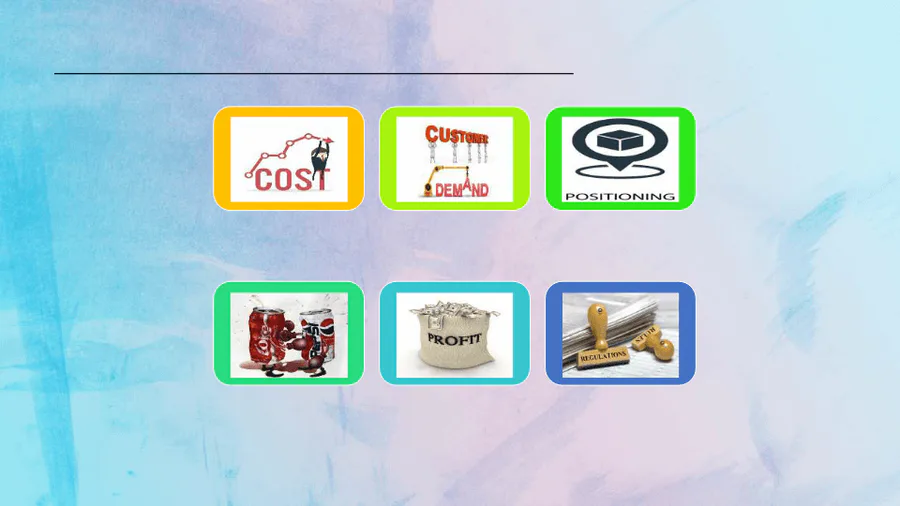
Factors should be considered before determining the price
Cost
Customer
demand
Product
positioning
Competitors and
its product
Profit
Government and
legal regulations
CHAPTER 5: PRICING DETERMINATION
Definition Price:
• Price is determined by what (1) a buyer is willing to pay, (2) a seller is willing to accept and (3) the
competition is allowing to be charged.
• With product, promotion and place of marketing mix, it is one of the business variables over which
organizations can exercise some degree of control.
What is Price Determination?
• Refered to the interaction of the free market forces of demand and supply to establish the general
level of price for a good or service.
Show answer
Auto Play
Slide 1 / 16
SLIDE
Similar Resources on Wayground

11 questions
Introduction to Precision Agriculture
Presentation
•
University
11 questions
Maria i Walenty Gąsiorowscy
Presentation
•
KG
12 questions
Pre Assessment 1° Parcial
Presentation
•
University
12 questions
POSITIVE PSYCHOLOGY- GROUP 1 ACTIVITY
Presentation
•
University
12 questions
Supporting Question 1
Presentation
•
KG
10 questions
HW
Presentation
•
University
11 questions
Teenager 5 Session 22: Pronunciation & Speaking
Presentation
•
KG
11 questions
Number the Stars Chapter 13
Presentation
•
KG - University
Popular Resources on Wayground
10 questions
Safety Day 2026 – Student Review

Quiz
•
9th Grade
21 questions
Continents and Oceans
Quiz
•
6th Grade
20 questions
Parts of Speech
Quiz
•
5th Grade
16 questions
Subject & Predicate
Quiz
•
5th Grade
25 questions
Multiplication Facts
Quiz
•
5th Grade
12 questions
Map Skills
Quiz
•
3rd Grade
22 questions
Continents and Oceans
Quiz
•
5th Grade
15 questions
Rounding Decimals
Quiz
•
5th Grade
Discover more resources for Other
20 questions
Disney Trivia
Quiz
•
University
10 questions
Spanish Greetings and Goodbyes!
Presentation
•
6th Grade - University
20 questions
Physical or Chemical Change/Phases
Quiz
•
8th Grade - University
39 questions
Unit 7 Key Terms
Quiz
•
11th Grade - University
25 questions
SER and Subject Pronouns
Quiz
•
8th Grade - University
38 questions
Unit 6 Key Terms
Quiz
•
11th Grade - University
19 questions
Key Concepts in Buddhism
Quiz
•
University
0 questions
Cell Domain Basic Review (Biology)
Quiz
•
University