

nov 8 23 ad

Presentation
•
Social Studies
•
9th - 12th Grade
•
Medium

BENJAMIN V
Used 1+ times
FREE Resource
37 Slides • 12 Questions
1
Science Sections 3 & 4
senses and whatever
2
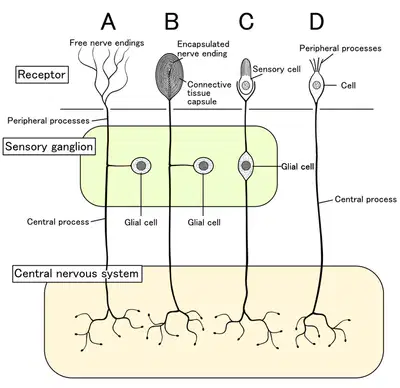
touch + pain + pressure + temperature, etc.
somatosensation
3
Multiple Choice
vision is part of somatosensation
true
false
4

sense of balance and position
vestibular system
5
Multiple Choice
which applies the most: riding a bike involves the ___________
vestibular system
smell
parasympathetic nervous system
6
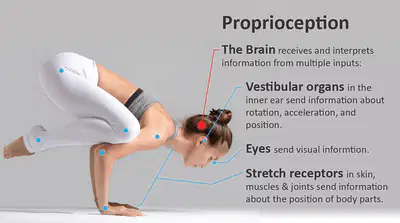
CLOSE YOUR EYES
HOLD OUT YOU HAND TO THE SIDE
TOUCH YOUR NOSE
TOUCH YOUR EAR
that's proprioception: your body knows where it is and where its parts are
proprioception
7

sensory nerves turn stimuli into chemicals (remember section 2?) => nerve signals
sensory transduction
8
Multiple Choice
Sensory transduction...
is how your body remembers the position of its limbs, joints, and how they are moving
is how your body turns light, sound, pressure, temperature, and other stimuli into chemical signals
is how signals travel across the synaptic cleft
9

- turn external signals into neural signals
- input is called "receptive field"
- There is "local processing" done near the sight of transduction that eliminates extra signals
sensory receptor
10
Labelling
what are these
receptive field
soma
11
Match
Match the following
Receptive Field
Vestibular System
Proprioception
stimulus => chemical signal
Part of neuron that recognizes stimulus
Sense of balance/position
Sense of relative location of body parts
stimulus => chemical signal
Part of neuron that recognizes stimulus
Sense of balance/position
Sense of relative location of body parts
12
Multiple Choice
Are you aware of all stimuli that your sensory receptors transduce?
Yes; sensory signals are only excited, not inhibited by local processing.
Yes; after sensory transduction, signals are locally processed before being sent to the central nervous system.
No; sensory signals are only excited, not inhibited by local processing.
No; after sensory transduction, signals are locally processed before being sent to the central nervous system.
13

Opposite direction of senses
cerebral cortex
v
spine
v
muscles
Motor systems
14
VISUAL SYSTEM
yes, like your eyes
15
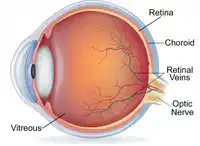


Back part of the eye that performs sensory transduction (turns light into neural signal)
Retina
Front part of the eye that refracts (bends) light. This is the part that is altered during Lasik.
Cornea
You prob (hopefully) know what this is already, the iris is the color part, the pupil is the hole that can change size to let in more/less light
Iris / Pupil
16
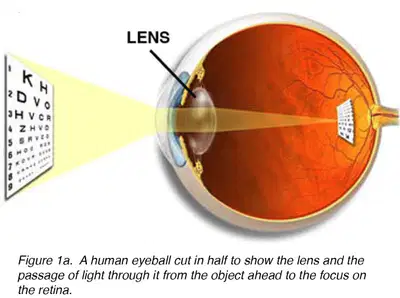

An actual lens... refracts light to focus it onto the retina.
Lens
Light from one point ends up in one point (it would be bad if all the light from an object ended up on more than one point on the retina)
Focusing

myopia (nearsightedness) - light is focused in front of the eye, so blurry
17
Multiple Choice

What is this, then?
Nearsightedness
Myopia
Farsightedness
Perfect Vision
18

arranged "inside out"
- connecting neurons
- to brain
- photoreceptors
- transduce light
- pigmented epithelium
- absorb excess light
- choroid
- feed retina
Retina
19

Made up of disks which sense light
Rods -
- have more disks, sense in lower light levels
- peripheral/night vision
Cones -
- color vision in bright light
- clustered in the center
Photoreceptors
20
Labelling
label
Soma
Disks
Axon
Good in bright
Good in dark
21
Pigments called opsins
- absorb different colors
- color = wavelength
- rods have rhodopsin
- 3 types of cones =
3 types of color opsins
Light causes LESS neurotransmitter to be released (opposite of normal)
Light Transduction
22

3 different cones (opsins) respond differently to different colors (wavelengths). your brain interprets the different signals and merges them into a single color. Some animals have more types of cones
Trichromatism
23
photoreceptor releases glutamate
bipolar cells are activated
they synapse retinal ganglion cells
goes to the brain through the optic nerve (you have a blindspot there!)
Circuitry
24
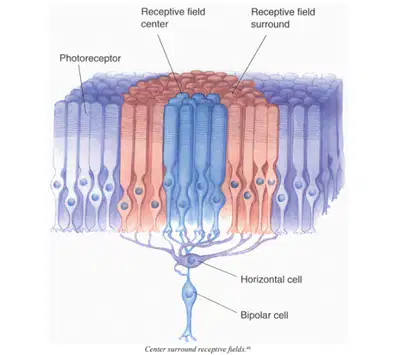
horizontal cells inhibit other photoreceptors
bipolar cells either flip or don't flip signals from a receptive field of photoreceptors
their receptive field is "center-surround" which helps sense contrast and sharp edges
Circuitry
25
Dropdown
26
Fill in the Blanks
27

retino - retina
fugal - leave
how signals leave the retina
nerves cross in the optic chiasm (decussation)
get mixed to make the optic tract
allows for depth perception and binocular vision
Retinofugal pathway
28

retino - retina
fugal - leave
how signals leave the retina
nerves cross in the optic chiasm (decussation)
get mixed to make the optic tract
allows for depth perception and binocular vision
Retinofugal pathway
29
Categorize
Cone Cells
Rod Cells
Bipolar Cells
Horizontal Cells
Optic Nerve
Optic Chiasm
Optic Tract
LGN
Pigmented Epithelium
Choroid
30
AUDITORY SYSTEM
yes, like your ears
31

Pinna - external
Sound goes down the auditory canal
vibrates tympanic membrane (ear drum)
Ear anatomy
32
After the ear drum is the middle ear
Vibrated ossicles (smallest bones in the human body, act as a lever)
- malleus (hammer)
- incus (anvil)
-stapes (stirrup)
convert eardrum vibration into inner ear fluid vibration
Ear anatomy
33
After the ossicles are the inner ear: Cochlea (sound transduction) and semicircular canals (movement of the head)
enters through the only flexible membrane of the cochlea, the oval window
Ear anatomy
34
travels down the spiral cochlea and pressure is relieved at the round window
Ear anatomy
35

cochlea has three chambers
- scala vestibuli
- scala media
- scala tympani
(top to bottom VMT vomit)
Basilar membrane separates scala tympani from scala media
Ear anatomy
36
Organ of Corti is above Basilar membrane is where auditory transduction takes place (turning sound into electrochemical signals)
Basilar membrane is stiffer on the outside and floppier on the inside of the spiral => different frequencies of sound
Ear anatomy
37
Tectorial membrane goes along Organ of Corti but does not move -- hair cells in OoC get shifted back and forth by the unmoving tectorial membrane
Hair cells have stereocilia (look like hairs) which sense vibrations
Ear anatomy
38

When the stereocilia of INNER HAIR CELLS move they open the hatch for K+ to go in (normal neurons would let Na+ go in; this is abnormal)
Auditory transduction
39
- Name of Author
Outer hair cells receive signals that cause them to move the tectorial membrane up and down, sharpening or dampening certain pitches
40
Chemical Senses
taste, smell
41

42
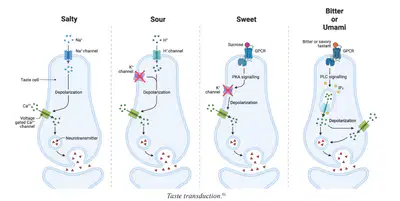
sweet - sugars
umami - proteins
sour - vitamins/minerals
bitter - toxins
salty - ...salt
Replace this with a header
43
salt and sour depolarize the cells themselves;
Na+ and H+ are both positive AND are the targets of taste
Replace this with a header
44

Cranial nerves are the nerves from the mouth and face that don't go through the spinal cord
#7, 9, 10
Goes to the thalamus and then to the primary gustatory cortex
Pathways
45
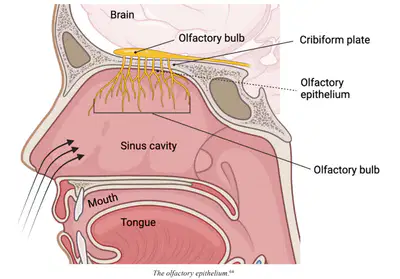
olfactory epithelium - consists of structural cells + receptors lining nasal cavity
humans - ~12million receptors
rabbits - ~100million
dog - ~1 billion
bloodhound - ~4billion
Smell
46
thousands of different genes that code for different types of olfaction
each neuron only has one receptor on it
signals travel through the cribriform plate and synapse in the olfactory bulb
Smell
47
glomeruli are where the receptors terminate onto the next neuron in the olfactory bulb
cranial nerve 1 goes to the brain
any given smell activates many receptors, encoding smell data over many values
Smell
48
Categorize
cranial nerve 7
cranial nerve 9
cranial nerve 10
cranial nerve 1
tastant
odorant
olfactory blub
cribiform plate
49
Today we skipped...
Lateral Geniculate Nucleus, Visual Cortex, Dorsal Extrastriate Pathway,
Ventral Extrastriate Pathway
Auditory Pathway, Auditory Cortex
Somatosensory system
Motor system
Memory and neuroplasticity
Section V
Science Sections 3 & 4
senses and whatever
Show answer
Auto Play
Slide 1 / 49
SLIDE
Similar Resources on Wayground

42 questions
Canada Map 1
Presentation
•
9th - 12th Grade
42 questions
Fossil Fuels
Presentation
•
9th - 12th Grade
44 questions
Figurative Language & Songs: Personification, Similes, Metaphors
Presentation
•
9th - 12th Grade
43 questions
Graphs and Graphing
Presentation
•
9th - 12th Grade
45 questions
Rhetorical Devices
Presentation
•
9th - 12th Grade
43 questions
Day 2 2026 Semester 2
Presentation
•
9th - 12th Grade
42 questions
Pickleball Basics
Presentation
•
9th - 12th Grade
43 questions
WHI 2.01 and 2.02
Presentation
•
9th - 12th Grade
Popular Resources on Wayground
24 questions
PBIS-HGMS Day 10

Quiz
•
6th - 8th Grade
10 questions
HCS SCI 03 Summer School Review 3
Quiz
•
3rd Grade
11 questions
Home Scope
Quiz
•
7th - 8th Grade
15 questions
HCS SCI 05 Summer School Assessment 3 Review
Quiz
•
5th Grade
35 questions
Lufkin Road Middle School Student Handbook & Policies Assessment
Quiz
•
7th Grade
18 questions
Geo 11.3 Area of Circles and Sectors
Quiz
•
9th - 11th Grade