
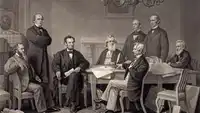
Exploring the Emancipation Proclamation

Presentation
•
English
•
9th - 12th Grade
•
Hard
+32
Standards-aligned

Emerald Williams
FREE Resource
2 Slides • 42 Questions
1
Exploring the Emancipation Proclamation
January 1, 1863
A Transcription
By the President of the United States of America:
A Proclamation.
Whereas, on the twenty-second day of September, in the year of our Lord one thousand eight hundred and sixty-two, a proclamation was issued by the President of the United States, containing, among other things, the following, to wit:
"That on the first day of January, in the year of our Lord one thousand eight hundred and sixty-three, all persons held as slaves within any State or designated part of a State, the people whereof shall then be in rebellion against the United States, shall be then, thenceforward, and forever free; and the Executive Government of the United States, including the military and naval authority thereof, will recognize and maintain the freedom of such persons, and will do no act or acts to repress such persons, or any of them, in any efforts they may make for their actual freedom.
"That the Executive will, on the first day of January aforesaid, by proclamation, designate the States and parts of States, if any, in which the people thereof, respectively, shall then be in rebellion against the United States; and the fact that any State, or the people thereof, shall on that day be, in good faith, represented in the Congress of the United States by members chosen thereto at elections wherein a majority of the qualified voters of such State shall have participated, shall, in the absence of strong countervailing testimony, be deemed conclusive evidence that such State, and the people thereof, are not then in rebellion against the United States."
2
Now, therefore I, Abraham Lincoln, President of the United States, by virtue of the power in me vested as Commander-in-Chief, of the Army and Navy of the United States in time of actual armed rebellion against the authority and government of the United States, and as a fit and necessary war measure for suppressing said rebellion, do, on this first day of January, in the year of our Lord one thousand eight hundred and sixty-three, and in accordance with my purpose so to do publicly proclaimed for the full period of one hundred days, from the day first above mentioned, order and designate as the States and parts of States wherein the people thereof respectively, are this day in rebellion against the United States, the following, to wit:
Arkansas, Texas, Louisiana, (except the Parishes of St. Bernard, Plaquemines, Jefferson, St. John, St. Charles, St. James Ascension, Assumption, Terrebonne, Lafourche, St. Mary, St. Martin, and Orleans, including the City of New Orleans) Mississippi, Alabama, Florida, Georgia, South Carolina, North Carolina, and Virginia, (except the forty-eight counties designated as West Virginia, and also the counties of Berkley, Accomac, Northampton, Elizabeth City, York, Princess Ann, and Norfolk, including the cities of Norfolk and Portsmouth[)], and which excepted parts, are for the present, left precisely as if this proclamation were not issued.
And by virtue of the power, and for the purpose aforesaid, I do order and declare that all persons held as slaves within said designated States, and parts of States, are, and henceforward shall be free; and that the Executive government of the United States, including the military and naval authorities thereof, will recognize and maintain the freedom of said persons.
And I hereby enjoin upon the people so declared to be free to abstain from all violence, unless in necessary self-defence; and I recommend to them that, in all cases when allowed, they labor faithfully for reasonable wages.
And I further declare and make known, that such persons of suitable condition, will be received into the armed service of the United States to garrison forts, positions, stations, and other places, and to man vessels of all sorts in said service.
And upon this act, sincerely believed to be an act of justice, warranted by the Constitution, upon military necessity, I invoke the considerate judgment of mankind, and the gracious favor of Almighty God.
In witness whereof, I have hereunto set my hand and caused the seal of the United States to be affixed.
Done at the City of Washington, this first day of January, in the year of our Lord one thousand eight hundred and sixty three, and of the Independence of the United States of America the eighty-seventh.
By the President: ABRAHAM LINCOLN
WILLIAM H. SEWARD, Secretary of State.
3
Multiple Choice
What was the purpose of the Emancipation Proclamation during the Civil War?
To free enslaved people in Confederate states
To end the Civil War
To establish equal rights for all citizens
To expand the territory of the Union
4
Multiple Choice
What did the Emancipation Proclamation do?
Declared all slaves in Confederate territory to be forever free
Ended the Civil War
Issued by President Abraham Lincoln on January 1, 1863
Set the stage for the 13th Amendment, which abolished slavery
5
Multiple Choice
What was the purpose of the Emancipation Proclamation?
To declare the end of the American Civil War
To establish President Abraham Lincoln's authority
To grant voting rights to enslaved people
To free enslaved people in Confederate territory
6
Multiple Choice
Lincoln believes that victory in the war will result in
a full measure of devotion.
a new birth of freedom.
an altogether fitting and proper memorial.
all men being created equal.
7
Multiple Choice
What was the Emancipation Proclamation?
A document that declared the end of the Civil War
A law that abolished slavery in the United States
A speech given by Abraham Lincoln
A treaty signed between the Union and the Confederacy
8
Multiple Choice
Lincoln ends by stating his commitment “that government of the people, by the people, for the people,
shall not perish from the earth.” What ideal is he expressing?
equality
immortality
liberty
democracy
9
Multiple Choice
Who was pushing for Lincoln to issue the Emancipation Proclamation?
Abolitionists
Confederate leaders
British politicians
Northern Democrats
10
Multiple Choice
To detract means to
take away from.
tear down.
not follow.
derail.
11
Multiple Choice
Why did Lincoln believe he had the power to issue the Emancipation Proclamation?
The Constitution granted him the authority
He was the commander-in-chief of the military
He had the support of the cabinet
The public demanded it
12
Multiple Choice
What does perish mean?
continue
liberate
spoil
die
13
Multiple Choice
When did Lincoln announce his plan to issue the Emancipation Proclamation?
After the Battle of Antietam
Before the Battle of Antietam
During the Battle of Antietam
After the midterm elections
14
Multiple Choice

True or False: The Emancipation Proclamation immediately set all the slaves in the United States free?
TRUE
FALSE
15
Multiple Choice
What was the initial reaction to the Emancipation Proclamation?
Support and celebration
Indifference and apathy
Anger and opposition
Confusion and disbelief
16
Multiple Choice
17
Multiple Choice
What did some people fear would happen as a result of the Emancipation Proclamation?
The war would end too quickly
The South would surrender
The North would lose support
The war would be prolonged
18
Multiple Choice
19
Multiple Choice
What did Lincoln say about signing the Emancipation Proclamation?
He hesitated before signing
He signed with a shaking hand
He signed with a bold and clear hand
He asked someone else to sign for him
20
Multiple Choice
Which of the following did the Emancipation Proclamation do?
Freed all slaves in the Confederate states that were not currently under Union control.
Laid the groundwork for a future constitutional amendment to outlaw slavery.
Allowed for African American men to fight in the Union army.
All of the above
21
Multiple Choice
What was the significance of the Emancipation Proclamation?
It ended the Civil War
It abolished slavery in the Confederate states
It granted voting rights to African Americans
It established equal rights for all citizens
22
Multiple Choice
What was Lincoln’s primary purpose for delivering the Gettysburg Address?
to commemorate a great Union victory
to dedicate a cemetery
to launch his reelection campaign
to consecrate the ground
23
Multiple Choice
Who celebrated the signing of the Emancipation Proclamation?
Abraham Lincoln
Frederick Douglass
Confederate leaders
British politicians
24
Multiple Choice
"Fourscore and seven years ago our fathers brought forth, on this continent, a new nation, conceived in liberty, and dedicated to the proposition that all men are created equal.
...that this nation, under God, shall have a new birth of freedom, and that government of the people, by the people, for the people, shall not perish from the earth."
The Gettysburg address
The Constitution of the U.S.
Declaration of Independence
Emancipation Proclamation
25
Multiple Choice
What impact did the Emancipation Proclamation have on the balance of the war?
It shifted the advantage to the Confederacy
It had no significant impact
It helped the Union gain an advantage
It led to a stalemate
26
Multiple Choice
What does the word proclamation mean?
the act of relaxing
firmness or purpose
power to capture attention
an official public announcement
27
Multiple Choice
True or False: The Emancipation Proclamation immediately set all the slaves in the United States free?
TRUE
FALSE
28
Multiple Choice
Reread this quote from the selection.
I never, in my life, felt more certain that I was doing
right, than I do in the signing this paper. My whole
soul is in it.
What paper was President Lincoln referring to in
this quote?
the Constitution
a story from the Bible
Gettysburg Address
Emancipation Proclamation
29
Multiple Choice
Which of the following did the Emancipation Proclamation do?
Freed all slaves in the Confederate states that were not currently under Union control.
Laid the groundwork for a future constitutional amendment to outlaw slavery.
Allowed for African American men to fight in the Union army.
All of the above
30
Multiple Choice
What is the MAIN idea of the Gettysburg Address?
We must help one another
Our country will only survive when slavery is eliminated
For those who have died, we must continue to fight for a new freedom
We must continue to fight against those from other countries who threaten our liberties
31
Multiple Choice

The Emancipation Proclamation paved the way for what constitutional amendment to outlaw slavery in the United States?
The thirteenth amendment
The fifth amendment
The first amendment
The twenty-first amendment
32
Multiple Choice
33
Multiple Choice
What does it mean to "emancipate" someone?
To enslave
To abolish
To free
To vote
34
Multiple Choice
35
Multiple Choice
What does it mean to "proclaim" something?
To vote
To announce
To debate
To choose
36
Multiple Choice
37
Multiple Choice
Why did Lincoln exclude the Border States from the Emancipation Proclamation?
Slavery was already illegal in the Border States
Lincoln didn't have any power the in the Border States
He didn't want to give them a reason to side with the South
38
Multiple Choice
39
Multiple Choice
At the beginning of the Civil War, why were some northerners unhappy with Lincoln?
He wasn't doing enough to end slavery
He was reluctant to make decisions in war
He thought slavery should be abolished in the west
He let the south secede
40
Multiple Choice

What president gave the order for the Emancipation Proclamation?
Abraham Lincoln
George Washington
Thomas Jefferson
Confederate president Jefferson Davis
Andrew Johnson
41
Multiple Choice
What was the main goal of the Emancipation Proclamation?
To end the Civil War
To free all slaves in the United States
To weaken the Confederate states
To gain international support for the Union
42
Multiple Choice
What was one effect of the Emancipation Proclamation?
More African Americans (slave and free) joined the Confederates
More African Americans (slave and free) joined the Union
Many southern soldiers joined the North
Some of the northern states lost faith in Lincoln
43
Multiple Choice
How did the Emancipation Proclamation affect the Union army?
It decreased the number of soldiers
It allowed African American men to enlist
It caused a decrease in morale
It had no effect
44
Multiple Choice
What was the public's perception of Lincoln after the Emancipation Proclamation?
He was seen as a hero
He was seen as a traitor
He was seen as a weak leader
He was seen as a strong leader
Exploring the Emancipation Proclamation
January 1, 1863
A Transcription
By the President of the United States of America:
A Proclamation.
Whereas, on the twenty-second day of September, in the year of our Lord one thousand eight hundred and sixty-two, a proclamation was issued by the President of the United States, containing, among other things, the following, to wit:
"That on the first day of January, in the year of our Lord one thousand eight hundred and sixty-three, all persons held as slaves within any State or designated part of a State, the people whereof shall then be in rebellion against the United States, shall be then, thenceforward, and forever free; and the Executive Government of the United States, including the military and naval authority thereof, will recognize and maintain the freedom of such persons, and will do no act or acts to repress such persons, or any of them, in any efforts they may make for their actual freedom.
"That the Executive will, on the first day of January aforesaid, by proclamation, designate the States and parts of States, if any, in which the people thereof, respectively, shall then be in rebellion against the United States; and the fact that any State, or the people thereof, shall on that day be, in good faith, represented in the Congress of the United States by members chosen thereto at elections wherein a majority of the qualified voters of such State shall have participated, shall, in the absence of strong countervailing testimony, be deemed conclusive evidence that such State, and the people thereof, are not then in rebellion against the United States."
Show answer
Auto Play
Slide 1 / 44
SLIDE
Similar Resources on Wayground

40 questions
Young Goodman Brown/ Allegory-Symbolism-Setting-Theme
Presentation
•
9th - 12th Grade
41 questions
Prepositional phrases
Presentation
•
9th - 12th Grade
40 questions
Two Hero's Journeys: The Matrix & Siddhartha
Presentation
•
9th - 12th Grade
39 questions
Unit 4.3 Travel and Tourism
Presentation
•
9th - 12th Grade
38 questions
Resiliency lesson 3
Presentation
•
9th - 12th Grade
36 questions
Figurative Language Review
Presentation
•
9th - 12th Grade
39 questions
Figurative Language 1
Presentation
•
9th - 12th Grade
37 questions
Preterite Vs. Imperfect Introduction
Presentation
•
9th - 12th Grade
Popular Resources on Wayground
6 questions
Secondary Safety Quiz
Presentation
•
9th - 12th Grade
10 questions
MyPath Diagnostic Overview
Presentation
•
6th - 8th Grade
20 questions
Lab Safety Quiz

Quiz
•
6th Grade
21 questions
Continents and Oceans
Quiz
•
6th Grade
20 questions
Adding and Subtracting Decimals
Quiz
•
5th Grade
20 questions
Parts of Speech
Quiz
•
5th Grade
16 questions
Subject & Predicate
Quiz
•
5th Grade
21 questions
Lab Safety
Quiz
•
10th Grade
Discover more resources for English
20 questions
Bloom Day School Community Quiz
Quiz
•
10th Grade
20 questions
Parts of Speech
Quiz
•
12th Grade
10 questions
Differentiating Primary and Secondary Sources in History

Interactive video
•
6th - 10th Grade
20 questions
Parts of Speech Review
Quiz
•
9th Grade
20 questions
Sadlier Level E Unit 1
Quiz
•
10th Grade
10 questions
Exploring the Eight Parts of Speech
Interactive video
•
6th - 10th Grade
7 questions
Parts of Speech
Presentation
•
1st - 12th Grade
10 questions
Identifying Common and Proper Nouns
Interactive video
•
6th - 10th Grade