Separation Techniques
Presentation
•
Chemistry
•
•
Practice Problem
•
Medium
Manisha Dogra
Used 7+ times
FREE Resource
0 Slides • 29 Questions
1
Multiple Choice
What is the method suitable to obtain pure water from seawater.
Simple distillation
Fractional distillation
Filtration
Evaporation to dryness
2
Multiple Choice
3
Multiple Choice
4
Multiple Choice
5
Multiple Choice
6
Multiple Choice
True or false: Magnets can be used to separate iron filings from sand
True
False
7
Multiple Choice
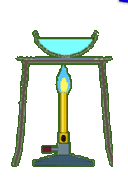
Name the separation technique
Filtration
Evaporation
Distillation
Separation
8
Multiple Choice
Filtration can be used to separate...
an insoluble solid from a solution
a soluble solid from a solution
a dissolved solid from a solution
9
Multiple Choice
The change of a liquid to a gas to remove solvent and collect solute is called
Decantation
Filtration
Evaporation
Centrifuge
10
Multiple Choice
Decanting is used to separate...
an insoluble solid from a solution.
a soluble solid from a solution.
11
Multiple Choice
12
Multiple Choice
A substance will expand when it is...
heated
cooled
13
Multiple Choice
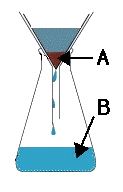
What method is shown in the picture?
Filtration
Evaporation
Chromatography
Sieving
14
Multiple Choice
Sand is...
soluble (can dissolve)
insoluble (can't dissolve)
15
Multiple Choice
A gas looses energy and turns to a liquid. What is this called?
melting
freezing
condensation
evaporation
16
Multiple Choice
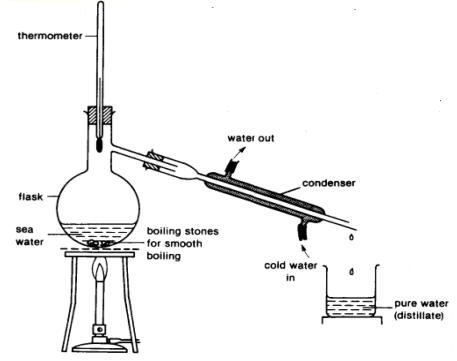
What is the name of this separation technique?
Simple distillation
Fractional distillation
Boiling
Evaporation
17
Multiple Choice
Which of the following statements tells us that a sample of liquid is pure water?
It is colourless.
It leaves no residue when filtered.
It boils at 100oC.
It is odourless.
18
Multiple Choice
What is the physical property on which fractional distillation depends?
different boiling points
different melting points
different solubilities
different densities
19
Multiple Choice
For paper chromatography to work,
the dyes must have different boiling points.
the dyes must have different solubilities in the solvent.
the starting line on the chromatogram must be drawn using pen.
The starting line must be below the level of the solvent.
20
Multiple Choice
Which separation technique is used to obtain salt from seawater?
Simple distillation
Filtration
Chromatography
Evaporation
21
Multiple Choice
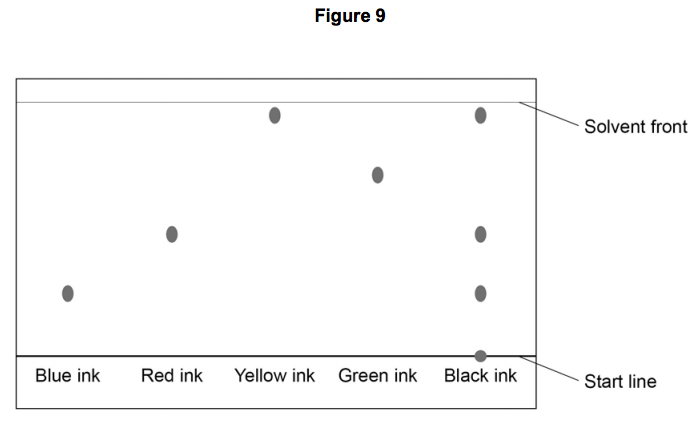
Which ink is a mixture?
Blue
Red
Yellow
Black
22
Multiple Choice
Dyes in water soluble markers may be separated by means of
Simple distillation
Crystallisation
Chromatography
Filtration
23
Multiple Choice
The image shows a mixture of concrete nails and saw dusts. What technique is best to use to separate the nails from the saw dusts?
sieving
chromatography
decantation
magnetic separation
24
Multiple Choice
Which tool could you use to separate large and small particles?
A sieve
A distillation flask
Chromatography
Evaporating basin
25
Multiple Choice
Solutions are made up of...?
Solutes and insolubles
Solubles and solutes
Solutes and solvents
Solubles and solvents
26
Multiple Choice
Which part of a filtration is the "filtrate"?
The filter paper
The solid material left in the funnel
The liquid that has gone through
The conical flask
27
Multiple Select
What is mixture?
A mixture is a physical combination of two or more substances.
A mixture is a chemical combination of only one substance.
In it the substances retain their individual properties and can be separated by physical means.
In it the substances do not retain their individual properties and can be separated by chemical means.
28
Multiple Select
What are homogenous mixtures?
In homogenous mixtures the components are evenly distributed.
In homogenous mixtures the components are not evenly distributed.
They are distinguishable from each other.
They are not distinguishable from each other.
29
Multiple Choice
In a heterogeneous mixture, the components are not uniformly distributed throughout and they remain distinct.
True
False
What is the method suitable to obtain pure water from seawater.
Simple distillation
Fractional distillation
Filtration
Evaporation to dryness
Show answer
Auto Play
Slide 1 / 29
MULTIPLE CHOICE

Similar Resources on Wayground
22 questions
Solutions Lesson Part 1
Presentation
•
9th - 12th Grade
23 questions
Naming Covalent Compounds
Presentation
•
10th Grade
23 questions
Stock System - Naming Ionic Compounds
Presentation
•
10th - 12th Grade
21 questions
LESSON - Classifying and Balancing Reactions
Presentation
•
9th - 12th Grade
21 questions
Changes of Matter (feat. Law of Conservation)
Presentation
•
6th - 8th Grade
24 questions
Metric System
Presentation
•
9th - 12th Grade
20 questions
Boyle's Law and Charles' Law
Presentation
•
10th Grade
20 questions
Atoms
Presentation
•
7th - 12th Grade
Popular Resources on Wayground
10 questions
HCS SCI 03 Summer School Review 4
Quiz
•
3rd Grade
11 questions
HSMS - Standard Response Protocol
Quiz
•
6th - 8th Grade
16 questions
1.1-1.2 Quiz Review
Quiz
•
9th - 12th Grade
12 questions
Exponent Expressions
Quiz
•
6th Grade
20 questions
Adding and Subtracting Integers
Quiz
•
6th - 7th Grade
11 questions
Northeast States
Quiz
•
3rd - 4th Grade
10 questions
Characterization
Quiz
•
3rd - 7th Grade
10 questions
Common Denominators
Quiz
•
5th Grade
Discover more resources for Chemistry
10 questions
HCS SCI 03 Summer School Review 4
Quiz
•
3rd Grade
11 questions
HSMS - Standard Response Protocol
Quiz
•
6th - 8th Grade
16 questions
1.1-1.2 Quiz Review
Quiz
•
9th - 12th Grade
12 questions
Exponent Expressions
Quiz
•
6th Grade
20 questions
Adding and Subtracting Integers
Quiz
•
6th - 7th Grade
11 questions
Northeast States
Quiz
•
3rd - 4th Grade
10 questions
Characterization
Quiz
•
3rd - 7th Grade
10 questions
Common Denominators
Quiz
•
5th Grade