Unit 3
Presentation
•
Biology
•
9th Grade
•
Practice Problem
•
Medium
Fabiano Souza
Used 21+ times
FREE Resource
0 Slides • 29 Questions
1
Multiple Choice
Mia has four aquatic plants of the same size and species. She submerges each plant in a separate beaker filled with 200 mL of water. She then sets each beaker under a different intensity of light. Mia observes that, of the four plants, the plant in the beaker under the most intense light gives off the most gas bubbles in a 20 min period.
Which of the following statements best explains Mia's observation?
Hint: ONE SINGLE ANSWER IS CORRECT
Cells decompose most quickly under the most intense light.
Water evaporates from plants faster under the most intense light.
Gases in the leaves of the plants expand most under the most intense light.
2
Multiple Choice
The two diagrams below represent a sugar molecule and a fat molecule that are used by living organisms.
Which statement best describes these two molecules?
Hint: ONE SINGLE ANSWER IS CORRECT
Sugar molecules are inorganic and fat molecules are organic.
Sugar molecules are organic and fat molecules are inorganic.
Energy for life processes can be stored within the chemical bonds of both molecules.
Energy for life processes can be stored within the chemical bonds of sugar molecules, only.
3
Fill in the Blanks
Type answer...
4
Multiple Choice
Which type of environment does pepsin work best in?
HINT: ONE single correct answer
Acidic only
Basic, only
Neutral
Sometimes acidic, sometimes basic
5
Multiple Choice
Which statement best describes the enzyme represented in the graphs?
HINT: ONE single correct answer
This enzyme works best at a temperature above
Temperature and pH have no effect on the action
50°C and a pH above 12.
This enzyme works best at a temperature of 50°C and a pH of 12.
of this enzyme.
This enzyme works best at a temperature of 35°C and a pH of 8.
6
Multiple Choice
An amoeba is a single-celled, heterotrophic organism. In order to meet its energy needs, it relies directly on the interaction of which cell structures?
Hint: ONE alternative is correct
Chloroplasts and the cell membrane
The cell membrane and mitochondria
Nucleus and ribosomes
Vacuoles and the nucleus
7
Multiple Choice
Experiments revealed the following information about a certain molecule:
It can be broken down into amino acids.
It can break down proteins into amino acids.
It is found in high concentrations in the small intestine of humans.
This molecule is most likely ___.
an inorganic compound
an enzyme
a lipid
a carbohydrate
8
Multiple Choice
There are over 2000 kinds of edible insects in the world, and they are becoming an increasingly popular source of protein. One cup of cricket flour contains over 28 grams of protein. The building blocks of the protein in cricket flour are _____.
hint: ONE answer is correct
amino acids
water
simple sugars
carbohydrates
9
Multiple Choice
The diagram illustrates the movement of glucose across a cell membrane.
Which two processes are most directly represented by this diagram?
Hint: ONE answer is correct
ATP synthesis and the diffusion of water
Molecule transport and energy use
Homeostasis and ATP synthesis
Homeostasis and the diffusion of water
10
Multiple Choice
It may be harmful when people compete to see who can hold their breath the longest under water. Without oxygen, brain cells _____.
Hint: ONE answer is the correct
Have too few mitochondria
cannot make enough ATP
make too many enzymes
have too much water
11
Multiple Select
What happens to the glucose made in photosynthesis in the plant?
Hint: Pick up to 2 answers.
It is released as a by-product.
It is used in cellular respiration.
It is stored as glycogen.
It is stored as starch.
12
Multiple Choice
In which direction do particles in a solution move during diffusion?
Hint: ONE answer is the correct
From left to right.
From lower to higher areas of concentration.
From higher to lower areas of concentration.
From right to left.
13
Multiple Select
Text: 'Starch and Glucose'
"Starch (amylose) and glucose are both carbohydrates that contain carbon, hydrogen, and oxygen atoms. They are energy sources in biological systems. However, starch is a long-chain polysaccharide, making it a complex carbohydrate, while glucose is a single-unit monosaccharide, which is a simple sugar. While both can be found in plants, glucose is also present in animal blood, whereas starch is stored as energy in plant cells. Glucose is soluble and sweet-tasting, in contrast to starch, which is less soluble in water and not sweet."
Which answers could help you discuss the similarities and differences between starch amylose and glucose?
PICK at least 2 differences
Both are carbohydrates containing carbon, hydrogen, and oxygen.
Starch is a polysaccharide (complex carbohydrate), while glucose is a monosaccharide (simple sugar).
Both serve as energy sources in biological systems.
Glucose is soluble and sweet, while starch is less soluble and not sweet.
14
Multiple Select
Text: 'Starch and Glucose'
"Starch (amylose) and glucose are both carbohydrates that contain carbon, hydrogen, and oxygen atoms. They are energy sources in biological systems. However, starch is a long-chain polysaccharide, making it a complex carbohydrate, while glucose is a single-unit monosaccharide, which is a simple sugar. While both can be found in plants, glucose is also present in animal blood, whereas starch is stored as energy in plant cells. Glucose is soluble and sweet-tasting, in contrast to starch, which is less soluble in water and not sweet."
Which answers could help you discuss the similarities and differences between starch amylose and glucose?
PICK at least 2 similarities in your answer.
Both are carbohydrates containing carbon, hydrogen, and oxygen.
Starch is a polysaccharide (complex carbohydrate), while glucose is a monosaccharide (simple sugar).
Both serve as energy sources in biological systems.
Glucose is soluble and sweet, while starch is less soluble and not sweet.
15
Match
Match the following"Organize the following statements into the correct categories based on the digestion times of amylose (starch) and glucose."
Amylose is a large polysaccharide and must be broken down into glucose units.
Amylose requires enzymes to break glycosidic bonds, a time-consuming process.
Glucose is already in its simplest form and can be absorbed directly.
Reasons Amylose Digests Slowly
Reasons Glucose Digests Quickly
Reasons Amylose Digests Slowly
Reasons Glucose Digests Quickly
16
Match
Match each example of a function with the correct macromolecule.
Stores and processes information that determines traits.
Includes most enzymes as well as the components of structures such as hair, claws and skin.
Used to store energy for later use and makes up most of cell membranes
Provides energy that is quickly available
nucleic acids
protein
lipids
carbohydrate
nucleic acids
protein
lipids
carbohydrate
17
Multiple Choice
Substances X and Y are examples of which kind of molecule?
Hint: ONE answer is the correct
Simple sugar
Aminoacid
Fat
Hormone
18
Multiple Choice
Which set of terms best identifies the letters in the diagram?
Hint: ONE answer is the correct
1
2
3
4
19
Multiple Choice
Cells in the stomach produce pepsin, an enzyme, to help digest food. Pepsin works best at a pH of 2.
Which of these graphs most likely shows what will happen to the activity of pepsin as the pH of the stomach is increased?
Hint: ONE answer is the correct
Graph A
Graph B
Graph C
Graph D
20
Multiple Choice
Text:
Catalase
Catalase is an enzyme found in plant and animal cells. Hydrogen peroxide is a harmful substance found in cells. Catalase causes hydrogen peroxide to break down into water and oxygen.
A student conducted an experiment to determine whether plant and animal cells have the same amount of catalase. She used liver and potato tissues in the experiment. The student followed the procedures below.
What type of molecule is catalase?
A lipid
A protein
A nucleic acid
A carbohydrate
21
Multiple Choice
The student conducted a second experiment. She boiled the liver tissue completely and added it to the hydrogen peroxide solution. She observed that little to no oxygen was released in the second experiment.
Which of these statements best supports the student’s observations?
Exposing catalase to high temperatures makes it inactive
Exposing catalase to high temperatures changes it into a different enzyme.
Boiling liver breaks down hydrogen peroxide faster.
Boiling removes oxygen from the liver
22
Multiple Choice
A student-designed an experiment to see if plants grow better when watered with a sugar solution. He divided the plants into six groups, measured the initial height of each plant, and calculated the average height for each group. At the end of two months, he measured the final height of each plant and calculated the average height for each group. The student’s data are shown in the table below.
Which of these statements explains why the plants in Groups E and F died?
Hint: ONE answer is the correct.
The high sugar content caused too much water to move out of the root cells.
The high sugar content caused too much water to move into the root cells.
The high sugar content prevented the plant from capturing energy.
The high sugar content clogged the pores in the cell membranes.
23
Multiple Choice
Protein pumps actively transport ions across a cell membrane.
What molecule directly supplies the energy required for this transport?
Hint: ONE answer is correct.
ATP
Cholesterol
Oxygen
RNA
24
Multiple Choice
Text:
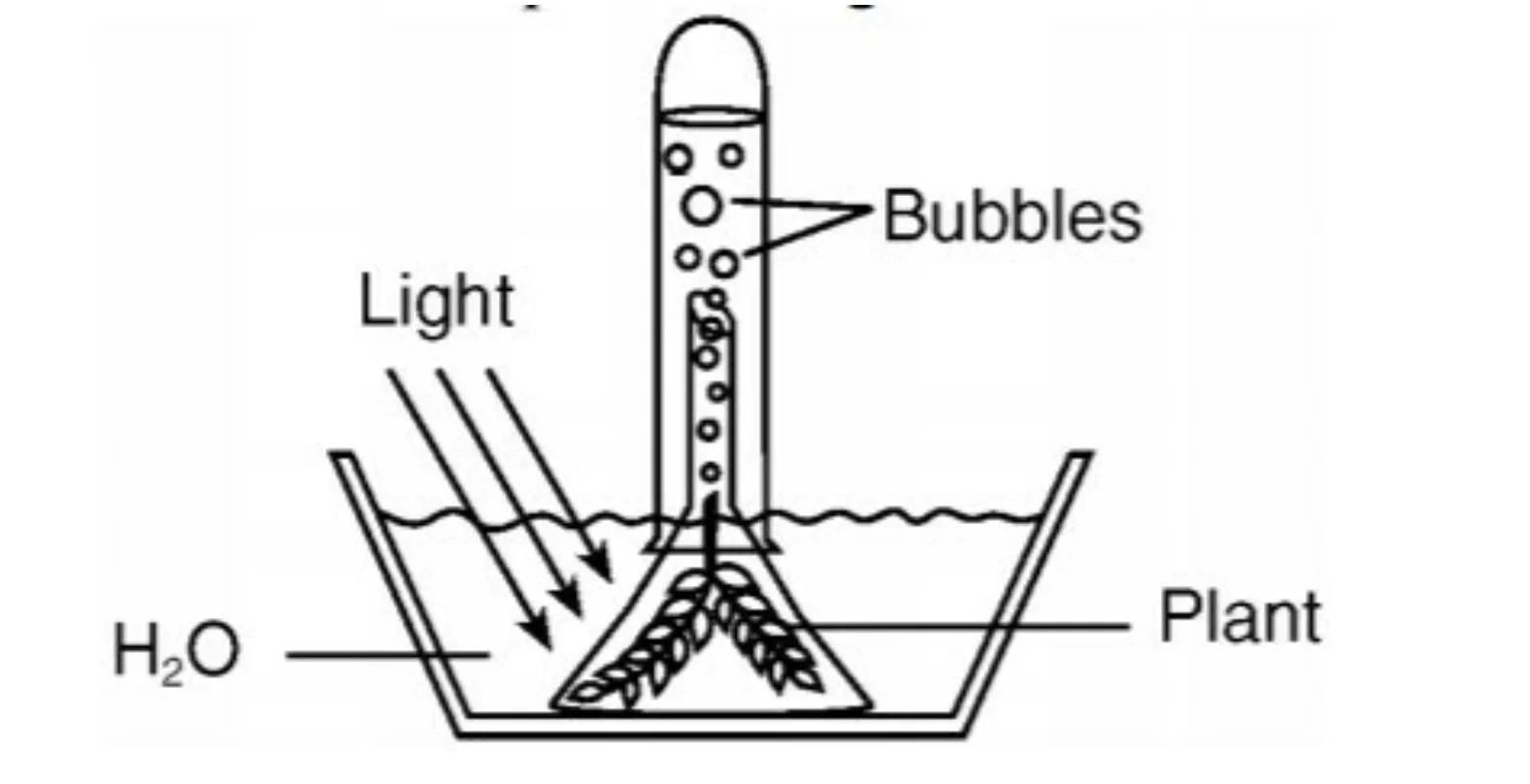
The green aquatic plant in the diagram was exposed to light for several hours.
Question: Which gas would most likely be found in the greatest amount in the bubbles?
Hint: ONE answer is the correct
Oxygen
Nitrogen
Ozone
Carbon dioxide
25
Multiple Choice
Which of the following diagrams represents the correct cycling of gases?
Hint: ONE diagram is the correct answer
Diagram A
Diagram B
Diagram C
Diagram D
26
Multiple Choice
The diagram below shows the glucose (. ) inside of the small intestine and moving to the bloodstream.
Analyze each model and the text, then answer the question below.
In Image A, the concentration of glucose will go through the process of _________ in order to reach equilibrium that takes place in Image B.
The process of ___________ begins to occur in Image C to ensure all the glucose is absorbed from the small intestine.
Pick the OPTION that best fits the fill-out phrase above
In Image A, the concentration of glucose will go through the process of osmosis in order to reach equilibrium that takes place in Image B.
The process of facilitated diffusion begins to occur in Image C, to ensure all the glucose is absorbed from the small intestine.
In Image A, the concentration of glucose will go through the process of facilitated diffusion in order to reach equilibrium that takes place in Image B.
The process of osmosis begins to occur in Image C, to ensure all the glucose is absorbed from the small intestine.
In Image A, the concentration of glucose will go through the process of diffusion in order to reach equilibrium that takes place in Image B.
The process of active transport begins to occur in Image C, to ensure all the glucose is absorbed from the small intestine.
In Image A, the concentration of glucose will go through the process of osmosis in order to reach equilibrium that takes place in Image B.
The process of facilitated diffusion begins to occur in Image C, to ensure all the glucose is absorbed from the small intestine.
27
Multiple Choice
Text:
Transport Across the Cell Membrane
The diagram represents three sections of a cell membrane showing three different methods involved in the transport of various molecules across the membrane.
Question:
Methods A and B are classified as methods of passive transport because
they do not require ____.
HInt: ONE answer is the correct
ATP
Carbon dioxide
Light
DNA
28
Multiple Choice
Using information from the diagram, which statement best explains why the movement of molecules in Method C represents active transport?
ATP The molecules move from a low concentration to a high concentration using ATP.
I do not know
I need to study
I need help
29
Open Ended
Using information from the diagram, state one reason why the movement of molecules in Method C represents active transport.
Question
Why the movement of molecules in Method C represents active transport.
Hint:
One reason why the movement of molecules in Method C represents active transport is that it involves the use of transport proteins that require energy, often in the form of ATP, to move molecules against their concentration gradient. This is indicated by the arrow showing movement from a lower concentration outside the cell to a higher concentration inside the cell, which is contrary to what is expected in passive transport where molecules move along the gradient.
Mia has four aquatic plants of the same size and species. She submerges each plant in a separate beaker filled with 200 mL of water. She then sets each beaker under a different intensity of light. Mia observes that, of the four plants, the plant in the beaker under the most intense light gives off the most gas bubbles in a 20 min period.
Which of the following statements best explains Mia's observation?
Hint: ONE SINGLE ANSWER IS CORRECT
Cells decompose most quickly under the most intense light.
Water evaporates from plants faster under the most intense light.
Gases in the leaves of the plants expand most under the most intense light.
Show answer
Auto Play
Slide 1 / 29
MULTIPLE CHOICE

Similar Resources on Wayground
22 questions
Biogeochemical Cycles Lesson
Presentation
•
9th Grade
22 questions
Mutations
Presentation
•
9th Grade
24 questions
Biotechnology Test Review
Presentation
•
9th Grade
20 questions
G9 Chap 2.2 - Flow of Energy in an Ecosystem
Presentation
•
9th Grade
20 questions
13.1 Identifying the Substance of the Gene
Presentation
•
9th Grade
20 questions
Invasive/Keystone Review
Presentation
•
9th Grade
20 questions
6E: Mutations
Presentation
•
9th Grade
22 questions
Cell Cycle, DNA Replication, and Cancer
Presentation
•
9th Grade
Popular Resources on Wayground
20 questions
"What is the question asking??" Grades 3-5
Quiz
•
1st - 5th Grade
20 questions
“What is the question asking??” Grades 6-8
Quiz
•
6th - 8th Grade
10 questions
Fire Safety Quiz
Quiz
•
12th Grade
20 questions
Equivalent Fractions
Quiz
•
3rd Grade
34 questions
STAAR Review 6th - 8th grade Reading Part 1
Quiz
•
6th - 8th Grade
20 questions
“What is the question asking??” English I-II
Quiz
•
9th - 12th Grade
20 questions
Main Idea and Details
Quiz
•
5th Grade
47 questions
8th Grade Reading STAAR Ultimate Review!
Quiz
•
8th Grade
Discover more resources for Biology
24 questions
BIOLOGY STAAR REVIEW
Quiz
•
9th Grade
30 questions
Biology STAAR Review #3
Quiz
•
9th Grade
16 questions
AP Biology: Unit 1 Review (CED)
Quiz
•
9th - 12th Grade
50 questions
Biology EOC Review
Quiz
•
9th Grade
25 questions
photosynthesis and cellular respiration
Quiz
•
9th Grade
20 questions
AP Biology: Unit 3 Review (CED)
Quiz
•
9th - 12th Grade
20 questions
Enzymes
Quiz
•
9th Grade
20 questions
Food Chains and Food Webs
Quiz
•
7th - 12th Grade