

Unleashing the Power: Exploring Nuclear Chemistry

Presentation
•
Chemistry
•
University
•
Hard
+4
Standards-aligned

Luis Bello
Used 2+ times
FREE Resource
26 Slides • 17 Questions
1
Exploring the power and potential of nuclear chemistry to revolutionize energy and medicine.
2
Introduction to Nuclear Chemistry
3
Nuclear Chemistry
The study of the chemical and physical properties of nuclear reactions and radioactive substances.
Nuclear chemistry plays a crucial role in various fields, including energy production, medicine, and environmental monitoring. It involves the study of nuclear reactions, radioactivity, and the behavior of atomic nuclei.
Understanding nuclear chemistry is essential for advancements in nuclear power, cancer treatment, and radiocarbon dating.
4
Nuclear Power
Explore the world of nuclear chemistry, where nuclear reactions and radioactivity hold immense power.
Learn about the fundamentals of nuclear reactions, the types of radioactivity, and their applications. Discover the wonders and challenges of harnessing nuclear energy.
Understand nuclear reactions
Explore different types of radioactivity
Learn about applications of nuclear chemistry
5

6


7
The mass defect of a nucleus is the difference between the total mass of a nucleus and the sum of the masses of all its constituent nucleons.
It arises due to the conversion of mass into energy when a nucleus is formed.
The nuclear binding energy is the energy required to break down a nucleus into its component nucleons.
8

9

10
The stability of nuclei is influenced by several factors, including the number of protons, neutrons, and the arrangement of these particles within the nucleus.
Understanding these trends is crucial in nuclear physics and has implications for nuclear reactions, such as fission and fusion.
11
Neutron-to-proton ratio (N/Z ratio):
As the number of protons in the nucleus increases, the N/Z ratio must also increase to maintain stability.
This is because the repulsive electromagnetic forces between protons become stronger with increasing proton numbers.
The additional neutrons help to counteract these repulsive forces and stabilize the nucleus.
12
Even-numbered nuclei:
Nuclei with even numbers of both protons and neutrons are generally more stable than those with odd numbers.
This is due to the pairing effect of nucleons, where pairs of protons or neutrons with opposite spins interact more strongly, providing additional stability.
13
Magic numbers:
Certain numbers of protons or neutrons, known as magic numbers, lead to particularly stable nuclei.
These magic numbers correspond to the filling of complete shells within the nucleus, similar to the electron shells in atoms.
Examples of magic numbers include 2, 8, 20, 28, 50, 82, and 126.
14

15
16


17

Beta Decay
18
Nuclear reactions are changes in the composition of atomic nuclei.
They can be either natural or induced.
Natural nuclear reactions occur spontaneously in radioactive nuclei, while induced nuclear reactions require an external energy source to initiate the reaction.
19

20

Gamma Decay
A∗ is the excited atom
A is a relaxed state of the initial excited atom
γ is the released gamma ray photon
21

22

23

Nuclear fission is the splitting of a heavy nucleus into two lighter nuclei, releasing a large amount of energy. This is the principle behind nuclear power plants.
24
Nuclear fusion is the combination of two lighter nuclei to form a heavier nucleus, also releasing a large amount of energy. This is the process that powers the sun and other stars.

25

26
Applications of Nuclear Chemistry
Nuclear chemistry has a wide range of applications in various fields, including:
Nuclear power: Nuclear power plants generate electricity using nuclear fission.
Medical imaging: Radioactive isotopes are used in medical imaging techniques such as PET scans and SPECT scans to diagnose and treat diseases.
Radiotherapy: Radioactive isotopes are used in radiotherapy to treat cancer.
Material science: Nuclear chemistry is used to study the properties of materials and develop new materials with improved properties.
Environmental science: Nuclear chemistry is used to study and remediate environmental contamination.
27
Multiple Choice
Which reaction releases more energy?
Fission
chain reaction
Fusion
Photosynthesis
28
Multiple Choice
_____is the joining of atomic nuclei
Fusion
chain reaction
Photosynthesis
Fission
29
Multiple Choice
_______is the splitting of atomic nuclei
Fission
nuclear reaction
Fusion
bayler reaction
30
Multiple Choice
Which process occurs naturally in the centre of stars like the Sun
Bi-multiple reaction
Fission
chemical
fusion
31
Multiple Choice
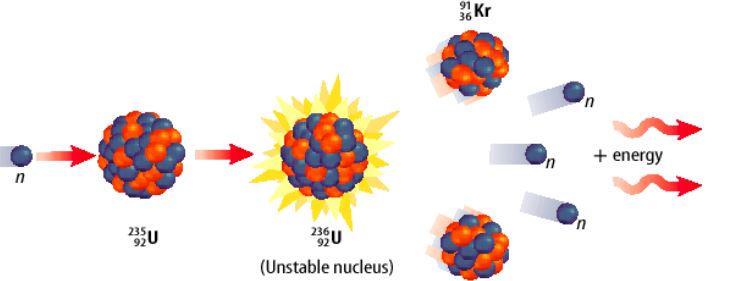
32
Multiple Choice
2 marshmallows
2 small Hydrogen atoms
2 huge uranium atoms
2 carbon atoms
nobody can tell because it is too hot
33
Multiple Choice

What type of decay does this symbol represent?
beta decay
alpha decay
fission
fusion
34
Multiple Choice

Solve the nuclear decay reaction:
35
Multiple Choice

36
Multiple Choice
In a correctly written symbol what would be located in the "Z" position?
number of neutrons
atomic number
number of electrons
mass number
37
Multiple Choice
The most penetrating/dangerous type of radiation is the ____.
alpha particle
gamma ray
beta particle
uranium
38
Multiple Choice
The three types of nuclear radiation in increasing order of danger are ____.
alpha, beta, gamma
X ray, beta, gamma
alpha, gamma, beta
X ray, gamma, beta
39
Multiple Choice
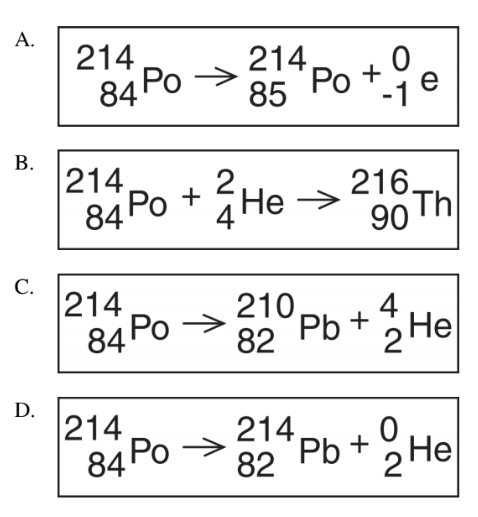
Which equation correctly represents the alpha decay of polonium-214?
A
B
C
D
40
Multiple Choice
20985At -->20583Bi + 42He
This is an example of....
a chemical reaction
a nuclear reaction
a physical change
no reaction or change
41
Multiple Choice
2H2 + O2 --> 2H2O
This is an example of....
a chemical reaction
a nuclear reaction
a physical change
no reaction or change
42
Multiple Choice
H2O (s) --> H2O (l)
ice --> liquid water
This is an example of....
a chemical reaction
a nuclear reaction
a physical change
no reaction or change
43
Multiple Choice
614C = ___ + -10e
410Be
714N
714Si
613C
514B
Exploring the power and potential of nuclear chemistry to revolutionize energy and medicine.
Show answer
Auto Play
Slide 1 / 43
SLIDE
Similar Resources on Wayground

41 questions
Shopping, Restaurant and Direction
Presentation
•
University
38 questions
REPORTED SPEECH
Presentation
•
University
36 questions
Frasa dan Klausa
Presentation
•
University
34 questions
A DEEP DIVE : GRAMMAR COVERED
Presentation
•
University
35 questions
Phase Changes and Phase Diagrams
Presentation
•
University
39 questions
6. Phase Diagrams
Presentation
•
12th Grade
37 questions
BBB3013 Punctuation Marks
Presentation
•
University
38 questions
10.1 Graphing Quadratic Equations
Presentation
•
KG - University
Popular Resources on Wayground
10 questions
Safety Day 2026 – Student Review

Quiz
•
9th Grade
21 questions
Continents and Oceans
Quiz
•
6th Grade
20 questions
Parts of Speech
Quiz
•
5th Grade
16 questions
Subject & Predicate
Quiz
•
5th Grade
25 questions
Multiplication Facts
Quiz
•
5th Grade
12 questions
Map Skills
Quiz
•
3rd Grade
22 questions
Continents and Oceans
Quiz
•
5th Grade
15 questions
Rounding Decimals
Quiz
•
5th Grade