
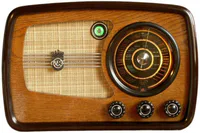
History of Radio

Presentation
•
History
•
10th Grade
•
Hard

TERRENCE KRUGER
Used 2+ times
FREE Resource
8 Slides • 30 Questions
1
A journey through the history of radio
2
3
The Birth of Radio Broadcasting
Radio broadcasting is the transmission of audio signals through radio waves.
It began in the early 20th century with the development of AM (Amplitude Modulation) technology.
The first radio broadcast was made by Reginald Fessenden on December 24, 1906.
Radio broadcasting revolutionized communication, entertainment, and news dissemination, becoming a popular medium worldwide.
4
Multiple Choice
When was the first radio broadcast made?
December 24, 1906
January 1, 1920
March 15, 1935
May 10, 1945
5
First Radio Broadcast
Trivia: The first radio broadcast was made on December 24, 1906. It was conducted by Reginald Fessenden, who transmitted a program of music and speech from Brant Rock, Massachusetts. This historic event marked the beginning of a new era in communication and entertainment.
It was the first time that voice and music were transmitted over the airwaves.
Fessenden's broadcast reached ships at sea and was heard as far as 50 miles away.
His pioneering work laid the foundation for the development of modern radio broadcasting.
6
Early Radio Pioneers
Guglielmo Marconi: Italian inventor known for his work on long-distance radio transmission.
Reginald Fessenden: Canadian inventor who made significant contributions to radio broadcasting.
Lee de Forest: American inventor who developed the Audion vacuum tube, a key component of early radios.
7
Multiple Choice
Who developed the Audion vacuum tube, a key component of early radios?
Guglielmo Marconi
Reginald Fessenden
Lee de Forest
Nikola Tesla
8
Lee de Forest-Audion vacuum tube
Trivia: Lee de Forest developed the Audion vacuum tube, a key component of early radios.
This invention allowed for the amplification of weak radio signals, revolutionizing the field of wireless communication.
De Forest's work laid the foundation for modern radio technology.

9
The Golden Age of Radio
The Golden Age of Radio refers to a period from the 1920s to the 1950s when radio broadcasting was the dominant form of entertainment.
It was a time of innovation and creativity, with popular shows like 'The War of the Worlds' and 'The Lone Ranger' captivating audiences across the nation.
Radio became a powerful medium for news, music, drama, and comedy, shaping the cultural landscape of the time.
During this era, radio played a crucial role in bringing people together and providing a shared experience for millions of listeners.
10
Multiple Choice
What era is referred to as the Golden Age of Radio?
1920s to 1950s
1960s to 1980s
1900s to 1920s
1950s to 1970s
11
Golden Age of Radio
Trivia: The Golden Age of Radio refers to the period from the 1920s to 1950s when radio broadcasting was the dominant form of entertainment.
It was a time when families gathered around the radio to listen to popular shows like The War of the Worlds and The Lone Ranger.
This era saw the rise of iconic radio personalities and the birth of classic radio dramas.
12
Multiple Choice
What term combines "iPod" and "broadcast," reflecting the origin of podcasting?
Podstream
Castpod
AudioSync
Podcast
13
Multiple Choice
Which medium played a critical role in providing news and morale during World War II?
Television
Radio
Newspaper
Movies
14
Multiple Choice
Name an iconic radio program from the "Golden Age of Radio."
The Lone Wanderer
The Silver Swordsman
The Shadow
The War of Worlds
15
Multiple Choice
Which show demonstrated the immersive power of radio drama?
The Space Odyssey
The Sound Experiment
The War of Worlds
The Enigma
16
Multiple Choice
Who is credited with sending the first wireless telegraph message across the Atlantic Ocean in 1901?
Guglielmo Marconi
Alexander Graham Bell
Thomas Edison
Nikola Tesla
17
Multiple Choice
In the mid-20th century, which new medium was perceived as a potential threat to radio's relevance?
Internet
Television
Newspapers
Telephone
18
Multiple Choice
What term is used to describe the phenomenon of Orson Welles' radio broadcast that caused panic and mass hysteria in 1938?
The Broadcast Panic
The Radio Chaos
The Hysterical Outbreak
The War of Worlds Panic
19
Multiple Choice
What is the main advantage of podcasting over traditional radio in terms of content consumption?
Visual components
On-demand consumption
Geographical restrictions
Live streaming capability
20
Multiple Choice
How did radio prove its resilience in the face of the rise of television in the mid-20th century?
By focusing on visual content
By adapting to new formats and strengths
By directly competing with television shows
By decreasing broadcasting hours
21
Multiple Choice
In what way did radio's ability to transcend geographical boundaries become particularly apparent during World War II?
Radio broadcasts reached outer space
Radio was used to communicate with extraterrestrial life
Radio was used to broadcast news and morale to occupied regions
Radio stations were established on enemy territory
22
Multiple Choice
Early radio sets used these
Vacuum Tubes
Crystal sets
Glass Tubes
Electronic diodes
23
Multiple Choice
AM in terms of radio stands for
Ante Meridiem
Amplification Modulation
Artificial Movement
Aural Memory
24
Multiple Choice
By the early ________ people were using radio technology.
1700s
2000s
1900s
25
Multiple Choice
Answer true or false.
Radio waves are all around us.
True
False
26
Multiple Choice
In the past, many families listened to the radio as we watch television today.
True
False
27
Multiple Choice
The radio was also a way for families to hear about news.
True
False
28
Multiple Choice
During World War II people was able to know what was happening because_______________________
People used internet
They watched on Youtube
Radio stations reported what was happening.
29
Multiple Choice
The shows that told dramatic stories about families were called__________________________
Series
Comics
Soaps
30
Multiple Choice
Nowadays people do not use the radio anymore.
True
False
31
Multiple Choice
What year did regular radio broadcasts begin?
1926
1920
1930
1942
32
Multiple Select
What types of programming dominated early radio broadcasting? Check all that apply.
Live music
Phonograph records
Talk shows
Comedies and dramas
33
Multiple Choice
The early days of radio are similar to the early days of the internet.
True
False
34
Multiple Choice
Most people listened to the radio
in the car
in their home
at work
walking around
35
Multiple Choice
Everyone in the family had their own radio in their room.
True
False
36
Multiple Choice
Radio shows used what to make their programs sound more realistic?
Musical instruments
Live sound effects
Prerecorded sounds
None of the above
37
Multiple Choice

Who is credited for the creation of radio?
Marconi
Einstein
Tesla
Lumière
38
Multiple Choice
BBC has always stood for British Broadcasting Company
True
False
A journey through the history of radio
Show answer
Auto Play
Slide 1 / 38
SLIDE
Similar Resources on Wayground

35 questions
CHAPTER 18 LESSON 1
Presentation
•
10th Grade
37 questions
Enlightenment Philosophers
Presentation
•
10th Grade
31 questions
Cell terms part 2 - 2023
Presentation
•
10th Grade
36 questions
SSWH10 Age of Exploration
Presentation
•
10th Grade
38 questions
The Crusades
Presentation
•
10th Grade
30 questions
World War I
Presentation
•
10th Grade
30 questions
The Molecules of Life
Presentation
•
10th Grade
31 questions
Absolute Value Inequalities
Presentation
•
10th Grade
Popular Resources on Wayground
10 questions
Safety Day 2026 – Student Review

Quiz
•
9th Grade
21 questions
Continents and Oceans
Quiz
•
6th Grade
20 questions
Parts of Speech
Quiz
•
5th Grade
16 questions
Subject & Predicate
Quiz
•
5th Grade
25 questions
Multiplication Facts
Quiz
•
5th Grade
12 questions
Map Skills
Quiz
•
3rd Grade
22 questions
Continents and Oceans
Quiz
•
5th Grade
15 questions
Rounding Decimals
Quiz
•
5th Grade
Discover more resources for History
25 questions
The American Revolution
Quiz
•
7th - 10th Grade
15 questions
The Bill of Rights
Quiz
•
8th - 12th Grade
15 questions
Ancient Rome
Quiz
•
7th - 10th Grade
16 questions
Students of Civics Unit 2: The Constitution
Quiz
•
7th - 11th Grade
10 questions
Exploring the 7 Principles of the Constitution

Interactive video
•
6th - 10th Grade
10 questions
Significance of the Declaration of Independence
Interactive video
•
6th - 10th Grade
10 questions
Exploring the Age of Exploration
Interactive video
•
6th - 10th Grade
10 questions
French and Indian War
Interactive video
•
9th - 10th Grade