
5.3 Segregation and Discrimination

Presentation
•
History
•
10th Grade
•
Practice Problem
•
Medium

GARY NEAL
Used 4+ times
FREE Resource
17 Slides • 17 Questions
1

2

3

4

5

6

7

8

9
Multiple Choice
What were Jim Crow Laws?
Laws that promoted racial equality
Laws that enforced racial segregation
Laws that promoted political equality
Laws that protected all citizens
10
Multiple Choice
What was the purpose of the grandfather clause?
To allow women to vote
To exempt certain people from voting restrictions
To promote racial equality
To enforce segregation
11
Multiple Choice
What did W.E.B. Du Bois advocate for in terms of racial equality?
Gradual improvement
Immediate social and economic equality
Segregation
None of the choices
12
Multiple Choice
What is 'de facto' segregation?
Segregation enforced by law
Segregation that occurs in practice but not by law
Segregation in schools only
Segregation that ended in the 1800s
13
Multiple Choice
What is the formal process of becoming a United States citizen called?
Immigration
Naturalization
Assimilation
Emigration
14

15

16

17

18

19

20
21
Multiple Choice
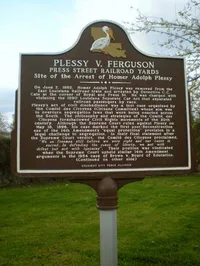
What was Homer Plessy attempting to challenge by boarding a white passenger car?
The right to travel freely
The 14th Amendment's promise of equal protection
Local segregation laws
Federal transportation regulations
22
Multiple Choice
Why was Homer Plessy chosen for this civil disobedience act?
He was a well-known activist
His complexion made him look white
He had experience with the law
He was a popular public figure
23
Multiple Choice
What was the outcome of the Supreme Court's decision regarding Plessy's case?
They ruled in favor of Plessy
They upheld Louisiana's segregation law
They declared segregation unconstitutional
They postponed the decision
24
Multiple Choice
What did the phrase "separate but equal" signify in the context of the ruling?
Segregation was allowed but required equal facilities
All races should be treated equally
Integration was mandated by law
The law was colorblind
25
Multiple Choice
What was Booker T. Washington's stance on African Americans' advancement?
They should leave the South
They needed to pursue political rights immediately
Economic strength should be prioritized
Education was unnecessary
26
Multiple Choice
Who co-founded the NAACP?
Booker T. Washington
William Edward Burghardt Du Bois
Homer Plessy
Frederick Douglass
27
Multiple Choice
What was Du Bois's concept of the "talented tenth"?
The need for all African Americans to leave the South
The belief that educated leaders should guide the masses
The idea that economic independence was essential
The notion that black artists should focus on literature
28

29

30
Multiple Choice
The Committee of Citizens in New Orleans planned to challenge the Separate Car Act by:
Organizing a boycott of the railway companies
Holding public protests and rallies
Filing a lawsuit against the state of Louisiana
Petitioning the federal government for intervention
31
Multiple Choice
What arguments did Plessy use to claim that the Louisiana law violated the Equal Protection Clause of the 14th Amendment?
The law enforced racial segregation, which Plessy argued was inherently unequal.
The law provided equal facilities for all races, thus not violating the clause.
The law was not enforced equally among different racial groups.
The law was a necessary measure to maintain public order.
32
Multiple Choice
The Supreme Court's decision in the Plessy v. Ferguson case gave rise to which doctrine?
Separate but equal
Manifest destiny
Judicial review
Checks and balances
33
Multiple Choice
What did Homer Plessy do that got him arrested?
Sat in the white only part of the bus.
Sat at a white only section of a lunch counter.
Took a seat in the white only car of a train.
None of the answer choices
34
Multiple Choice
True or False: The “Separate Car Act” required “separate but equal” train cars for Blacks and Whites.
True
False
Show answer
Auto Play
Slide 1 / 34
SLIDE
Similar Resources on Wayground

27 questions
Crusades
Presentation
•
10th Grade
22 questions
Review of the Renaissance
Presentation
•
10th Grade
29 questions
Asexual Reproduction
Presentation
•
10th Grade
25 questions
The Industrial Mind - The Isms
Presentation
•
10th Grade
27 questions
Sept 29 WH WWII
Presentation
•
10th Grade
26 questions
1.3 AP World Southeast Asia
Presentation
•
10th Grade
26 questions
Modernity in the United States
Presentation
•
10th Grade
27 questions
Subatomic Particles
Presentation
•
10th Grade
Popular Resources on Wayground
6 questions
PRIDE Always and Everywhere
Presentation
•
12th Grade
20 questions
Lab Safety Quiz

Quiz
•
6th Grade
26 questions
KOR Review Kahoot Questions
Quiz
•
8th Grade
21 questions
Continents and Oceans
Quiz
•
6th Grade
12 questions
Unit Zero lesson 2 cafeteria
Presentation
•
9th - 12th Grade
20 questions
Parts of Speech
Quiz
•
5th Grade
10 questions
Riddles Riddles fun Riddles
Quiz
•
6th - 12th Grade
16 questions
Subject & Predicate
Quiz
•
5th Grade
Discover more resources for History
10 questions
Exploring the Journey of Early Humans

Interactive video
•
6th - 10th Grade
10 questions
Exploring the Gilded Age: Key Events and Figures
Interactive video
•
6th - 10th Grade
10 questions
Exploring the Life of Early Humans
Interactive video
•
6th - 10th Grade
10 questions
The Journey Through Atomic Theory
Interactive video
•
6th - 10th Grade
10 questions
Exploring Types of Government
Interactive video
•
6th - 10th Grade
29 questions
Eastern Classical Civilizations
Quiz
•
10th Grade
50 questions
Georgia Government Test
Quiz
•
7th - 11th Grade
50 questions
US History - Unit 2 American Revolution 2023
Quiz
•
9th - 12th Grade