
Canaan and the Development of the Israelites

Presentation
•
Social Studies
•
6th Grade
•
Practice Problem
•
Medium

Jacquelyn Osby
Used 14+ times
FREE Resource
16 Slides • 38 Questions
1

2
Multiple Choice
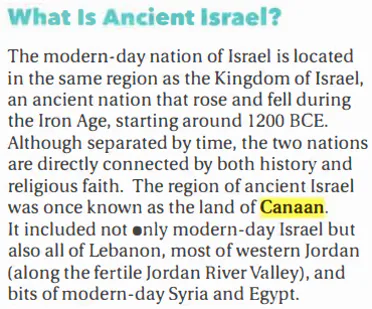
The land of Israel was once known as ___________.
3
Multiple Choice
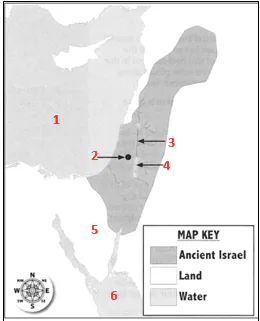
Which body of water does number 1 identify?
Dead Sea
Red Sea
Black Sea
4
Multiple Choice
Which body of water does number 4 identify?
Dead Sea
Red Sea
Caspian Sea
5
Multiple Choice
Which body of water does number 6 identify?
Dead Sea
Red Sea
Black Sea
6
Multiple Choice
Which body of water does number 3 identify?
Nile River
Euphrates River
Tigris River
Jordan River
7
Multiple Choice
Which geographical region does number 5 identify?
Italian Peninsula
Sinai Peninsula
Balkan Peninsula
Arabian Peninsula
8
Multiple Choice
Number 2 identifies this capital city of Israel.
Jerusalem
Saudi Arabia
Jericho
Lebanon
9
You probably have heard of the religion of Judaism (JOO•dee•ih•zuhm). You may not know, however, that it is both an ancient and modern religion. Many ancient societies worshipped many Deities, or Gods. The worship of more than one God is called polytheism.
A group of people in Southwest Asia known as the Israelites (IHZ•ree•ah•lites) were different. Unlike other cultures of the day, they were monotheistic and worshipped only one God. The practice of monotheism made Judaism unique among ancient religions.


10
Multiple Choice
The worship of only one god is called ______________.
polytheism
monotheism
nontheism
atheism
11
Multiple Choice
the religion of the Israelites is ______________.
12
The Israelites recorded their beliefs and history. These writings became known as the Hebrew Bible or Tanakh (TAH•nahk). Through the Hebrew Bible, the beliefs and faith of the ancient Israelites lived on to become the religion of Judaism. The Hebrew Bible (Tanakh) is the sacred text of Judaism. The followers of Judaism are today known as Jews.
Although the original Israelite population was small, their influence was great. Judaism played an important part in the development of two other major monotheistic religions— Christianity and Islam.
Christians call the Hebrew Bible the Old Testament. Christianity grew directly out of Judaism. Islam also accepted many of Judaism's beliefs and practices.
*Sacred-connected with God or a god; considered to be holy
13
Multiple Choice
The ____________________ is a record of the the history and beliefs of the Israelites.
10 Commandments
Ark of the Covenant
Dead Sea Scrolls
Hebrew Bible or Tanakh
14
Multiple Choice
Which of the following is the definition of sacred?
Something that is considered ordinary
connected with God or a god; considered to be holy
15
Multiple Select
Which of the following is the sacred text of Judaism?
Choose 2 answers.
Tanakh
Hebrew Bible
16
Multiple Choice
Judaism impacted the development of which two religions?
17
Multiple Choice
The followers of Judaism are known as _______________.
Jews
Christians
Canaanites
18
Monotheism: There is only one God.
Ten Commandments: These ten rules about how to worship and behave are to be revered and followed.
Individual Worth: Each person has value and worth because each person was created in the image of God.
Personal Responsibility: Individuals have the responsibility to act righteously, to be honest, and to help those in need.
19
Multiple Select
Which basic beliefs of Judaism are missing from the list below? (Choose 2 answers.)
Basic Beliefs of Judaism
1. Monotheism: There is only one God.
2. Ten Commandments: These ten rules about how to worship and behave are to be revered and followed; God's Laws.
3. ____________________
4. ____________________
Individual worth: Each person has value and worth because each person
was created in the image of God.
Personal responsibility: Individuals have the responsibility to act
righteously, to be honest, and to help those in need.
Eight Fold Path: Follow the teaching of Buddha's teachings and the eight fold path to enlightenment
Four Noble Truths: Adhere to the four noble truths to escape suffering in this life and be reincarnated
20
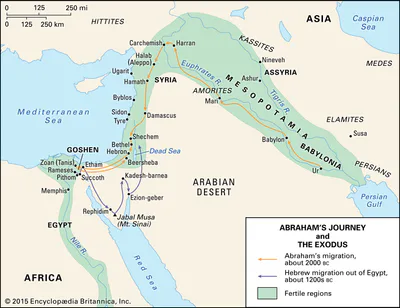
According to Jewish belief, the ancestors of the ancient Israelites were a man named Abraham and his family.
The Hebrew Bible states that God told Abraham to journey to Canaan, which would belong to Abraham and his descendants forever.
According to the Hebrew Bible, Abraham, his wife Sarah, and their entire household accepted God’s promise and settled in Canaan. Canaan is often called the Promised Land because of God’s promise to Abraham.
21
Fill in the Blanks
22
Multiple Choice
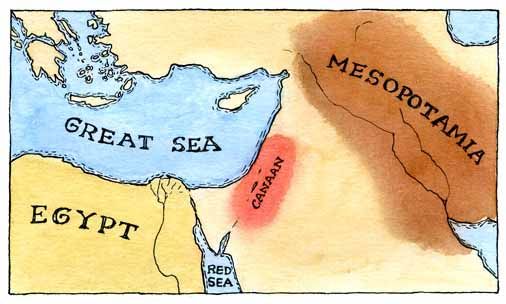
Abraham and his family left Mesopotamia and moved to _____________.
Egypt
Mesopotamia
Canaan
23
Multiple Choice
Why did Abraham and his family move to Canaan?
24
Multiple Choice
Jews call the land of Canaan the ___________ because the God's promise to Abraham.
Land of Milk and Wheat
Judah
25
After Abraham died, his son Isaac and later his grandson Jacob headed the family.
According to the Hebrew Bible, an angel gave Jacob the new name of Israel, which means “one who struggles with God.” Later Jacob’s descendants were called “Israelites.” As stated in the Hebrew Bible, Jacob’s 12 sons became the leaders of 12 Tribes of Israel.
A tribe is a family group.
26
Multiple Choice
The name, Israel originates with Abraham's son _____________.
27
Multiple Choice
Descendants of Abraham and and his grandson Jacob became known as __________.
A descendant is a person who is related to you and who lives after you, such as your child or grandchild.
Babylonians
Israelites
28
Multiple Choice
Jacob's (Israel's) 12 sons became the leaders of the _________________.
twelve tribes of Egypt
twelve tribes of Judah
twelve tribes of Israel
29
After living in Canaan for many years, Jacob’s family left because of a famine. They migrated to Egypt and lived there in peace for several generations. As the Israelite population increased, however, the Egyptian pharaoh grew uneasy. He feared that one day the Israelites would rebel and take control. To prevent this, the Egyptian pharaoh forced the Israelites into slavery.
Famine- Little to no food; scarcity of food
Scarce- not enough to meet demands
Migrate-to move from one part of the world to another
30
Fill in the Blanks
31
Fill in the Blanks
32
Fill in the Blanks
33
Multiple Choice
Why did the Israelites leave Canaan?
Famine
Natural disaster
34
Multiple Choice
Why did the Egyptian pharaoh force the Israelites into slavery?
Fear of their growing population and possible threat to his power
To assert his power over a conquered people
To use their labor for economic gain
35
The Israelites were forced to work at hard labor, so they prayed to God to be set free.
According to the Hebrew Bible, an Israelite prophet named Moses turned out to be their deliverer.
According to the Hebrew Bible, Moses was born in Egypt to an Israelite woman enslaved by the pharaoh.
After the pharaoh demanded all newborn Israelite boys be killed, Moses’s mother hid him in a basket and floated him down the Nile River.
The pharaoh’s daughter rescued him and adopted him
*prophet-a person sent by God to teach the people and give them messages from God
36
Multiple Choice
According to the Hebrew Bible, who did God send to deliver the Israelites from slavery in Egypt?
Moses
David
37
While tending sheep in the wilderness outside Egypt, Moses saw a bush in flames. God called to Moses from the burning bush. He told Moses to tell the pharaoh to let the Israelites go.
38
Multiple Choice
What message did God tell Moses to take to the Egyptian pharaoh?
39
Moses went before the pharaoh to demand the release of the Israelites. When the pharaoh refused, the Hebrew Bible says that God sent 10 plagues upon Egypt. These plagues were events that caused problems for the Egyptians, such as locusts devouring the fields or outbreaks of disease. The plagues convinced the pharaoh to free the Israelites. After the Israelites left Egypt for Canaan, the pharaoh decided to send his army to pursue them.
40
Multiple Choice
According to the Hebrew Bible, how did God punish the pharaoh for refusing to let the Israelites go free?
Turned the Nile River into blood
Sent ten plagues to Egypt
41
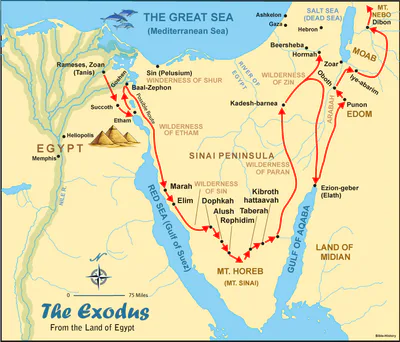
When Moses and the Israelites reached the Red Sea, there was no way to cross the waters.
According to the Hebrew Bible, God parted the Red Sea to let his people cross to the other side. When the pharaoh’s army tried to follow, the waters flooded back and drowned them.
The departure of the Israelites out of slavery in Egypt is known as the Exodus (EHK•suh•duhs). Jews celebrate a holiday called Passover to remember their journey from slavery to freedom.
42
Multiple Choice
The departures of the Israelites out of slavery in Egypt is called the ___________.
Escape
Exodus
43
Multiple Choice
Who was Moses?
A Greek philosopher known for his teachings on ethics
A prophet who led the Israelites out of slavery in Egypt
44
On their way from Egypt, according to the Hebrew Bible, the Israelites received a covenant (KUHV•uh•nuhnt), or agreement with God.
In this covenant, God promised to make the Israelites his special people if they would obey his teachings.
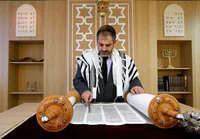
Moses climbed to the top of Mount Sinai (SY•ny). There, as God’s chosen leader, he received teachings from God. Known as the Torah (TAWR•uh), these teachings later became part of the Hebrew Bible.
*covenant-a promise to somebody, or agreement
45
Multiple Choice
Where was Moses when he received the Torah ?
46
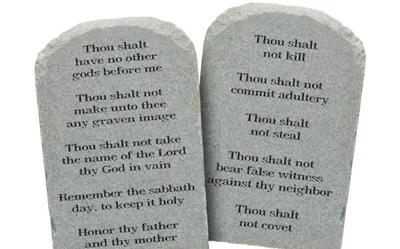
The Torah made clear what God considered to be right and wrong. One important part of the Torah is the Ten Commandments (kuh•MAND•muhnts).
The Ten Commandments are God's laws that were written on stone tablets and handed down to Moses on Mount Sinai.
47
Multiple Choice
What are the 10 Commandments?
God's laws that were handed down to Moses on Mount Sinai.
48
The Hebrew Bible states that Moses died before the Israelites reached the land God had promised them.
A new leader named Joshua guided the Israelites into Canaan, but they found other people living there. These peoples included the Canaanites (KAY•nuh•NYTS) and—somewhat later —the Philistines (FIH•luh•STEENS).
Unlike the Israelites, these people of Canaan worshipped many Gods and Goddesses. They also had different ways of life.
49
Multiple Choice
Where did the Israelites go when they left Egypt?
50
Because other groups such as the Canaanites lived in the region, the Israelites faced a challenge establishing Canaan as their new homeland.
They believed, however, that it was God's will that they claim the land. Joshua led them in a series of battles to conquer Canaan.
51
Multiple Choice
What challenges did the Israelites face when returning to Canaan and establishing it as their homeland?
Conquering the Canaanites and other people who lived there in a series of battles
Converting the Canaanites to their religion
Harsh weather conditions and a lack of support from neighboring countries
famine and a lack of natural resources
52
Multiple Choice
Why did the Israelites feel justified in conquering the people who lived in Canaan?
Because they believed that God had promised them the land of Canaan
53
The Hebrew Bible tells about the battle at the city of Jericho.
There, Joshua told the Israelites to march around the city walls.
For six days, they marched while priests blew their trumpets. On the seventh day, according to the account: The Israelites took control of the city after the walls of Jericho crumbled.
According to the Hebrew Bible, Joshua led the Israelites in other battles. Any land they seized was divided among the 12 tribes.
*seize-to take control of a place or situation, often suddenly and violently
Return to Canaan

54
Multiple Choice
What did the Israelites do with the land they seized (took control of)?
Show answer
Auto Play
Slide 1 / 54
SLIDE
Similar Resources on Wayground

50 questions
Classification of Organisms
Presentation
•
6th Grade
48 questions
Europe Culture
Presentation
•
6th Grade
51 questions
Social Studies 6 Q1 (Weeks 1 & 2)
Presentation
•
6th Grade
46 questions
Absolute Value Review
Presentation
•
6th Grade
47 questions
Exploring Europe: Nations, Landscapes, and Economies
Presentation
•
6th Grade
48 questions
History Chapter 1
Presentation
•
7th Grade
49 questions
Egyptian Mummification
Presentation
•
6th Grade
49 questions
Unit 2.2 Civics Review
Presentation
•
7th Grade
Popular Resources on Wayground
10 questions
Safety Day 2026 – Student Review

Quiz
•
9th Grade
21 questions
Continents and Oceans
Quiz
•
6th Grade
20 questions
Parts of Speech
Quiz
•
5th Grade
16 questions
Subject & Predicate
Quiz
•
5th Grade
25 questions
Multiplication Facts
Quiz
•
5th Grade
12 questions
Map Skills
Quiz
•
3rd Grade
22 questions
Continents and Oceans
Quiz
•
5th Grade
15 questions
Rounding Decimals
Quiz
•
5th Grade
Discover more resources for Social Studies
19 questions
Foundations of America
Quiz
•
6th - 8th Grade
5 questions
Mesopotamia Video Quiz

Interactive video
•
6th Grade
10 questions
Exploring the Age of Exploration: Key Events and Figures
Interactive video
•
6th - 10th Grade
15 questions
Middle Ages of the Middle East Vocab List (CFA #2)
Quiz
•
6th - 8th Grade
13 questions
Ancient Egypt
Interactive video
•
6th Grade
17 questions
Timelines
Quiz
•
6th Grade
11 questions
SWANA Unit test
Quiz
•
6th Grade
13 questions
Canada Map
Quiz
•
6th Grade