
Exploring Matter and Its Properties

Presentation
•
Science
•
5th Grade
•
Practice Problem
•
Medium
+12
Standards-aligned

Paisley Simmons
Used 30+ times
FREE Resource
11 Slides • 5 Questions
1
Exploring Matter and Its Properties
An exploration of the fundamental nature of matter and its properties, including its composition, structure, and behavior. Discover the building blocks of the universe and how they interact to create the world around us. Dive into the fascinating world of atoms, molecules, and the physical and chemical properties that define matter.
2
Properties of Matter
Matter: Anything that has mass and takes up space
Physical Properties: Characteristics that can be observed or measured without changing the substance
Chemical Properties: Characteristics that describe how a substance interacts with other substances
States of Matter: Solid, liquid, gas, and plasma
Properties of Solids, Liquids, and Gases: color, odor, temperature, mass
3
Multiple Choice
Which of the following is a characteristic that can be observed or measured without changing the substance?
Density
Viscosity
Compressibility
Mass
4
Characteristics of Mass
Mass is a characteristic that can be observed or measured without changing the substance. It is the amount of matter in an object. Mass is different from weight, as it remains the same regardless of the of how much an object weighs. Mass is measured using a balance or scale.
5
States of Matter
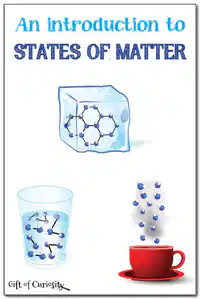
~ Matter exists in three main states: solid, liquid, and gas.
~ Solids have a fixed shape and volume, liquids have a fixed volume but take the shape of their container, and gases have neither a fixed shape nor volume.
~ Understanding these states is crucial in studying the properties and behavior of matter.
6
Multiple Choice
What are the three main states of matter?
Solid, liquid, gas
Solid, liquid, plasma
Solid, gas, plasma
Liquid, gas, plasma
7
States of Matter
~ Solid, liquid, gas are the three main states of matter.
~ In solids, particles are tightly packed, while in liquids, they can move around.
~ Gases have particles that are far apart and move freely. Plasma, not mentioned in the question, is a fourth state found in extreme conditions, like lightning and stars.
8
Exploring Matter
~ Matter can undergo physical changes, such as changes in shape or state, without altering its composition.
~ Chemical changes, on the other hand, involve the formation of new substances with different properties.
~ Let's explore the fascinating world of matter and its transformations.
Physical changes: Changes in shape, state, or size without altering composition.
Chemical changes: Formation of new substances with different properties.
9
Multiple Choice
What are physical changes?
Changes in shape, state, or size without altering composition
Formation of new substances with different properties
Changes in temperature without altering composition
Changes in color without altering composition
10
Physical Changes
Physical changes refer to changes in shape, state, or size without altering composition. They do not involve the formation of new substances. Examples include melting ice, tearing paper, and boiling water. Physical changes can be reversible or irreversible.
11
Exploring Mixtures and Solutions
Mixtures: Combination of two or more substances that are not chemically bonded
Solutions: Homogeneous mixtures where one substance dissolves in another
Properties: Mixtures can be separated by physical means, while solutions are uniform throughout
Examples: Salad dressing (mixture), Saltwater (solution)
12
Multiple Choice
What is the difference between mixtures and solutions?
Mixtures are chemically bonded while solutions are not
Mixtures are uniform throughout while solutions can be separated by physical means
Solutions are homogeneous mixtures while mixtures are not
Mixtures can be separated by physical means while solutions are uniform throughout
13
Solutions vs Mixtures
Solutions are homogeneous mixtures, meaning they have a uniform composition throughout. On the other hand, mixtures are not uniform and can be separated by physical means. Solutions are commonly used in everyday life, such as saltwater, while mixtures like trail mix showcase the distinct components.
14
Atoms and Molecules
Atoms are the basic building blocks of matter.
Molecules are formed when two or more atoms combine.
Atoms are made up of protons, neutrons, and electrons.
Molecules can be made up of the same or different types of atoms.
Chemical reactions involve the rearrangement of atoms to form new molecules.
15
Multiple Choice
What are the basic building blocks of matter?
Protons, neutrons, and electrons
Atoms
Molecules
Chemical reactions
16
Molecules
Molecules are the basic building blocks of matter. They are made up of atoms bonded together. Chemical reactions occur when molecules interact with each other, forming new substances. Examples of molecules include water (H2O) and carbon dioxide (CO2).
Exploring Matter and Its Properties
An exploration of the fundamental nature of matter and its properties, including its composition, structure, and behavior. Discover the building blocks of the universe and how they interact to create the world around us. Dive into the fascinating world of atoms, molecules, and the physical and chemical properties that define matter.
Show answer
Auto Play
Slide 1 / 16
SLIDE
Similar Resources on Wayground

12 questions
Cloud Types
Presentation
•
5th Grade
10 questions
Water Cycle
Presentation
•
5th Grade
13 questions
Ilmu Pengetahuan Alam
Presentation
•
KG
14 questions
Force & Motion Review
Presentation
•
5th Grade
10 questions
FCAT Speedbag - Nature of Science
Presentation
•
5th Grade
14 questions
Review of Scientific Method
Presentation
•
5th Grade
15 questions
Vertebrates
Presentation
•
5th Grade
11 questions
Food Webs
Presentation
•
5th Grade
Popular Resources on Wayground
6 questions
PRIDE Always and Everywhere
Presentation
•
12th Grade
20 questions
Lab Safety Quiz

Quiz
•
6th Grade
26 questions
KOR Review Kahoot Questions
Quiz
•
8th Grade
21 questions
Continents and Oceans
Quiz
•
6th Grade
12 questions
Unit Zero lesson 2 cafeteria
Presentation
•
9th - 12th Grade
20 questions
Parts of Speech
Quiz
•
5th Grade
10 questions
Riddles Riddles fun Riddles
Quiz
•
6th - 12th Grade
16 questions
Subject & Predicate
Quiz
•
5th Grade
Discover more resources for Science
20 questions
Lab Safety
Quiz
•
5th - 8th Grade
20 questions
Mixtures and Solutions Practice
Quiz
•
5th Grade
10 questions
States and Properties of Matter

Interactive video
•
3rd - 5th Grade
20 questions
SOL 4.1 and 5.1 Scientific Investigation
Quiz
•
4th - 5th Grade
20 questions
Scientific Method
Quiz
•
5th Grade
23 questions
Comparing and Ordering Decimals
Quiz
•
5th Grade
16 questions
Mixture or Solution?
Quiz
•
5th Grade
10 questions
Relative Density
Quiz
•
5th Grade