

Plate Tectonics Notes Part 1

Presentation
•
Science
•
6th Grade
•
Easy
+15
Standards-aligned

Levorn Miller
Used 3+ times
FREE Resource
42 Slides • 12 Questions
1

Plate Tectonic Theory
Evidence for
Plate Tectonics
2
Unveiling the Secrets of Continental Drift and Plate Tectonics
3
The Puzzle of Continental Drift
4


•Alfred Wegener in the early
1900’s proposed the hypothesis
that continents were once joined
together in a single large land
mass he called Pangea (meaning
“all land” in Greek).
• He proposed that Pangea had
split apart and the continents had
moved gradually to their present
positions - a process that became
known as continental drift.
CONTINENTAL DRIFT
5


CONTINENTAL DRIFT
According to the hypothesis of
continental drift, continents
have moved slowly to their
current locations.
6


Pangaea about 200 million years ago, before it began breaking up.
Wegener named the southern portion of Pangaea Gondwana, and
the northern portion Laurasia.
7


The continents about 70 million years ago. Notice that the breakup
of Pangea formed the Atlantic Ocean. India’s eventual collision
with Eurasia would form the Himalayan Mountains.
8


The position of the continents today. The continents are still
slowly moving, at about the speed your fingernails grow. Satellite
measurements have confirmed that every year the Atlantic Ocean
gets a few inches wider!
9
10
Impacts of Continental Drift
Formation of Mountains: Continental drift leads to the collision of tectonic plates, resulting in the formation of mountains like the Himalayas.
Volcanic Activity: Plate tectonics cause volcanic eruptions, releasing gases and creating new landforms.
Climate Change: Shifting continents affect ocean currents, leading to changes in climate patterns.
Biological Evolution: Separation and merging of landmasses influence the evolution and distribution of species.
11
12
Multiple Choice
Which scientist proposed the theory of continental drift?
Alfred Wegener
Isaac Newton
Albert Einstein
Charles Darwin
13


Continents fit together
like a puzzle….e.g. the
Atlantic coastlines of
Africa and South
America.
The Best fit includes the
continental shelves (the
continental edges under
water.)
Wegener’s Evidence for
Continental Drift
Picture from
http://www.sci.csuhayward.edu/~lstrayer/geol2101/2101_Ch19_03.pdf
14


Wegener’s Evidence for
Continental Drift
Fossils of plants and animals of the
same species found on different
continents.
Picture from
http://volcano.und.edu
/vwdocs/vwlessons/pla
te_tectonics/part3.ht
ml
15


Wegener’s Evidence for
Continental Drift
• Rock sequences (meaning
he looked at the order of
rock layers) in South
America, Africa, India,
Antarctica, and Australia
show remarkable
similarities.
• Wegener showed that the
same three layers occur
at each of these places.
•
Picture from
http://volcano.und.edu/vwdocs/vwlessons/plate_tectonics/p
art4.html
16


Wegener’s Evidence for
Continental Drift
• The same three layers are
in the same order in areas
now separated by oceans.
• Wegener proposed that
the rock layers were made
when all the continents
were part of Pangaea.
• He proposed that they
formed in a smaller small
joined land mass that was
later broken and drifted
apart.
Picture from
http://volcano.und.edu/vwdocs/vwlessons/plate_tectonics/p
art4.html
17
18
Multiple Choice
Which evidence supports the idea of continental drift?
Matching fossils found on different continents
Similar rock formations and mountain ranges
Ancient climate indicators
The jigsaw-like fit of continents
19
Multiple Choice
What is one of the effects of continental drift and plate tectonics?
Formation of mountains
Formation of oceans
Formation of deserts
Formation of forests
20

Seafloor Spreading
• Everyone agreed that Wegener’s evidence was
compelling. But wouldn’t we feel the
movement?
• Also, wouldn’t there be evidence to show that
the continents were still moving today?
• Wegenerwas a meteorologist and his theory
was not well accepted. (He died on an
expedition in Greenland collecting ice samples)
21

Wegener

What was the problem?
Wegener couldn't explain WHY or HOW the continents moved!
The scientific community needed more than what Wegener had.
Later, Harry Hess made a discovery that helped!

22

23
24


Seafloor Spreading
• Hess proposed that hot,
less dense material
below Earth’s crust rises
toward the surface at
the mid-ocean ridges.
• Then, it flows sideways,
carrying the seafloor
away from the ridge in
both directions.
Picture from http://library.thinkquest.org/17457/platetectonics/4.php
25


Seafloor Spreading
• As the seafloor spreads apart at a
mid-ocean ridge, new seafloor is created.
• The older seafloor moves away from the
ridge in opposite directions.
• This helped explain how the crust could
move—something that the continental
drift hypothesis could not do.
Picture from
http://www.pbs.org/wgbh/aso/tryit/tectonics/divergent.html
26
27

Crust, where we live. Broken in pieces called "tectonic plates"
Two types of crust: Oceanic and Continental.
Oceanic
Crust
Continental
Crust
Inside of your notes:
What is the difference between the continental crust and oceanic crust?
Continental crust is LESS DENSE, the oceanic crust is MORE DENSER.
28
The hottest layer of the Earth is the core. It heats the mantle above it. When the magma heats up, it rises.
What effect might this have on the crust?
Oceanic
Crust
Continental
Crust
Inside of your notes:
Inner
Core
Outer
Core
Mantle

29
30

What are
convection currents?
• one of 3 ways that
energy is transferred
from one object to
another.
• Heat transferred by
movement of a
heated fluid
31
Hot magma rises, cold magma falls.
What do we call this process of hot rising and cold falling/sinking?


32

33
Multiple Choice

The hypothesis that land masses spread apart from each other and have done so in the past is known as
Seafloor Spreading
Continental Drift Theory
Uplift of the crust
Continental Spreading
34
Multiple Choice

Where does sea-floor spreading take place?
Convergent Boundaries
Transform Boundaries
Land Boundaries
Mid-Oceanic Ridges
35
Multiple Choice

What is the thinnest layer of the Earth?
Crust
Mantle
Outer Core
Inner Core
36
Multiple Choice
What is the thickest layer of the Earth?
Crust
Mantle
Outer Core
Inner Core
37


Plate Tectonic Theory
• Both Hess’s discovery of
seafloor spreading and
Wegner’s continental drift
theory combined into what
scientists now call the Plate
Tectonic Theory.
• Theory of plate tectonics:
• The Earth’s crust and part of the
upper mantle are broken into
sections, called plates which
move on a plastic-like layer of
the mantle
38

Plate Tectonic Theory
• Plate Tectonics explains
– Earthquakes
– Mountain formation
– Volcanoes
– Why continents move
39

What are Plate Tectonics?
•
Definition - geological theory that
explains formation, movement, and
subduction of Earth’s plates
•
So exactly what does this mean?
•
3 things
1.
Lithosphere is in constant motion (1-10 cm/year)
2.
Motion is slow
3.
Caused by convection currents
40


41

What is a plate?
• The cracks in the lithosphere section it off
into 14 different plates
• Move very slowly (1-10 cm a year)
• These plates carry
– Continents
– Oceans
– Some carry both continents and oceans
42


43

14 Lithospheric Plates
• Ocean plates (Pacific, Nazca)
• Ocean/Continent Plates (Eurasian,
Indo-Australian, Antarctic, North American,
South American, Caribbean, African,
Filipino, Scotia, Arabian, Cocos, Juan de
Fuca)
44

Divergent
Convergent
Transform
45

46

47
48
49
50
Multiple Choice
51
Multiple Choice
Alfred Wegener thought which 2 continents looked like puzzle pieces that could fit together?
Antarctica and Asia
South America and Africa
South America and Australia
Africa and Pangaea
52
Multiple Choice
What geologic feature will form at a hot spot?
volcano
folded mountain
deep sea trench
rift valley
53
Multiple Choice
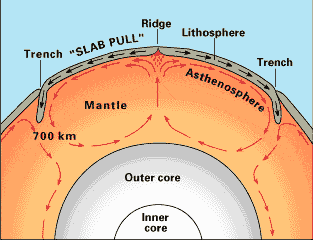
What is the source of energy that drives plate movement?
the subducton of the sea floor
the different densities of the oceanic and crustal plates
convection currents in the asthenosphere
the friction force between the plates that move past each other
54
Audio Response
Provide an audio summary about what you learned today. In your summary you should include information about continental drift, plate tectonics, earthquakes, and volcanoes.

Plate Tectonic Theory
Evidence for
Plate Tectonics
Show answer
Auto Play
Slide 1 / 54
SLIDE
Similar Resources on Wayground

48 questions
Chapter 7 Test Review
Presentation
•
6th Grade
48 questions
Nervous System Notes
Presentation
•
7th Grade
50 questions
Semester Test 1 - Test Day
Presentation
•
7th Grade
47 questions
Elkhorn History Images
Presentation
•
KG
48 questions
Classifying Matter
Presentation
•
6th Grade
48 questions
Science 6 Adaptations
Presentation
•
6th Grade
52 questions
Introduction to the Holocaust
Presentation
•
6th Grade
Popular Resources on Wayground
10 questions
Safety Day 2026 – Student Review

Quiz
•
9th Grade
21 questions
Continents and Oceans
Quiz
•
6th Grade
20 questions
Parts of Speech
Quiz
•
5th Grade
16 questions
Subject & Predicate
Quiz
•
5th Grade
25 questions
Multiplication Facts
Quiz
•
5th Grade
12 questions
Map Skills
Quiz
•
3rd Grade
22 questions
Continents and Oceans
Quiz
•
5th Grade
15 questions
Rounding Decimals
Quiz
•
5th Grade
Discover more resources for Science
20 questions
Elements, compounds, and mixtures
Quiz
•
6th Grade
10 questions
6.6D - Relative Density Review
Quiz
•
6th Grade
10 questions
Exploring Chemical and Physical Changes

Interactive video
•
6th - 10th Grade
20 questions
CONDUCTION,CONVECTION AND RADIATION
Quiz
•
6th Grade
20 questions
Rocks and The Rock Cycle
Quiz
•
6th Grade
19 questions
Describing and Classifying Matter
Presentation
•
6th Grade
21 questions
Waves and Wave Properties
Quiz
•
6th - 8th Grade
20 questions
Phases of the Moon
Quiz
•
6th Grade