
Non-Mendelian Inheritance
Presentation
•
Biology
•
9th Grade
•
Medium
Standards-aligned
Christine Ruberti
Used 24+ times
FREE Resource
18 Slides • 20 Questions
1
Unit 6A Pt4 -
Non-Mendelian Inheritance Patterns
HS-LS1-1: Construct an explanation based on evidence for how the structure of DNA determines the structure of proteins which carry out the essential functions of life through systems of specialized cells.
HS-LS3-1: Ask questions to clarify relationships about the role of DNA and chromosomes in coding the instructions for characteristic traits passed from parents to offspring.
2
3
Multiple Choice
Why do they call non-mendelian genetics patterns "rule breakers"?
They use RNA not DNA
Having a dominant allele doesn't necessarily mean that trait will show
There are no dominant alleles, only recessive ones in these patterns
They defy the laws of nature.
4
Multiple Choice
What happens in codominance?
the dominant allele isn't completely expressed when the recessive one is present.
both alleles are considered dominants, so both traits show up.
more than one gene works together to determine a trait
1 gene depends on another to be expressed.
5
Multiple Choice
An example of a epistasis is ...
Heterozygote snapdragons are pink, not red or white
Heterozygote chickens are black AND white, not just one or the other
The three alleles that affect height
The gene that controls whether llama wool color will be expressed
6
GENETICS - EXAMPLES OF NON-MENDELIAN
INCOMPLETE DOMINANCE
CODOMINANCE
MULTIPLE ALLELES
EPISTASIS
POLYGENIC TRAITS
7
Mendelian Genetics
Remember:
Homo = same (TT ...tt ... RR ... aa)
Since homozygous is same, we have to clarify,
is it dominant (AA) or recessive (aa)
AA= homozygous dominant
aa= homozygous recessive
8
Mendelian Genetics
Hetero = different (Tt ... Rr ... Aa)
Heterozygous means you inherited one of each allele.
But heterozygous gives the same phenotype as homozygous dominant.
The only way to show
the recessive trait is to
have TWO recessive
alleles (bb)
9
Non-Mendelian Genetics
Some traits don’t follow the simple dominant/recessive rules that Mendel first applied to genetics.
Traits can be controlled by more than one gene.
Some alleles are codominant.
Some alleles are neither dominant nor recessive.
10
Non-Mendelian Genetics
Incomplete Dominance
One allele is not completely
dominant over another.
The heterozygous phenotype is an
intermediate form of the two homozygous phenotypes.
Example: Four o’ Clock Flowers
rr = red ww = white rw = pink
Example: 'Blue' Chicken
CB = black CW = white CBCW = 'blue'
11
12
13
Multiple Choice
When red snapdragons are crossed with white snapdragons, the offspring produce pink flowers. This is an example of:
complete dominance
incomplete dominance
codominance
polygenic inheritance
multiple alleles
14
Multiple Choice
If a dark brown horse and a white horse are bred, the offspring are palomino (tan). This is an example of:
complete dominance
incomplete dominance
codominance
polygenic inheritance
multiple alleles
15
16
Multiple Select
Which of the following alleles is recessive?
IA
IB
IA and IB
i
17
Multiple Choice
Which of the following alleles are codominant?
IA and i
IB and i
IA and IB
i
18
Non-Mendelian Genetics
Codominance
Two alleles are equally dominant and are both expressed in the phenotype.
Ex: Coat color in cows & Checkered feathers in chickens
RR: Red
WW: White
RW: Roan, white with red spots
19
Incomplete dominance vs. Codominance
Incomplete dominance mixes like paint.
Red + White = pink (in between phenotype)
Codominance mixes like marbles.
Red + white = distinct patches of red and white (both phenotypes)
20
Multiple Choice
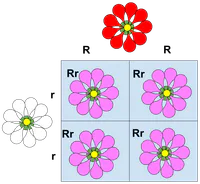
What type of inheritance pattern does the diagram represent?
Incomplete Dominance
Codominance
Multiple Alleles
Polygenic Inheritance
21
Multiple Choice
This flower is produced by crossing a pink-flowering plant and a white-flowering plant. This is an example of:
complete dominance
incomplete dominance
codominance
polygenic inheritance
multiple alleles
22
Multiple Choice
When red cows are crossed with white cow, the offspring have a mix of red hair and white hair. These cows are called roan. This is an example of:
complete dominance
incomplete dominance
codominance
polygenic inheritance
multiple alleles
23
Multiple alleles and Codominance -
BLOOD TYPES
Two alleles are equally dominant and are both expressed in the phenotype.
Human blood has three alleles.
A and B are both codominant.
(IA and IB) and o is recessive (i)
Individuals can be type A, type B, type AB, or type O (recessive).
24
Multiple Choice
The gene for human blood type has three alleles, A, B and O. This is an example of:
complete dominance
incomplete dominance
codominance
polygenic inheritance
multiple alleles
25
26
Universal Donor
Can donate to all types
can only receive from type O
Type O
Universal Receiver
Can receive blood from all types
Type AB
27
Multiple Choice
All of these are examples of type B blood
28
Match
IAIA or IAi
ii or IoIo
IAIB
IBIB or IBi
Type A
Type O
Type AB
Type B
Type A
Type O
Type AB
Type B
29
Multiple Choice
Which of the following is true about blood type O?
It contains antigen A only.
It contains antigen B only.
It contains both antigen A and antigen B.
It doesn’t contain antigen A or antigen B.
30
31
32
33
Multiple Choice
Checkered chickens have an allele for black feathers and an allele for white feathers. This is an example of:
complete dominance
incomplete dominance
codominance
34
Multiple Choice
Mom was black. Dad was white. What is the most likely explanation?
complete dominance
incomplete dominance
codominance
35
Multiple Choice
Mom and dad are star belly sneeches. Baby does not have a star. What is the best explanation for this?
complete dominance
incomplete dominance
codominance
36
Multiple Choice
Mom was white. Dad was black. What is the most likely explanation for this?
complete dominance
incomplete dominance
codominance
37
Multiple Choice
The color gene for labrador retriever comes in 2 alleles, black and brown. The black allele completely masks the brown allele. This is an example of:
complete dominance
incomplete dominance
codominance
38
Match
ABO BLOOD
BLUE CHICKEN
ROAN COW
MULTIPLE ALLELE
INCOMPLETE DOMINANCE
CODOMINANCE
MULTIPLE ALLELE
INCOMPLETE DOMINANCE
CODOMINANCE
Unit 6A Pt4 -
Non-Mendelian Inheritance Patterns
HS-LS1-1: Construct an explanation based on evidence for how the structure of DNA determines the structure of proteins which carry out the essential functions of life through systems of specialized cells.
HS-LS3-1: Ask questions to clarify relationships about the role of DNA and chromosomes in coding the instructions for characteristic traits passed from parents to offspring.
Show answer
Auto Play
Slide 1 / 38
SLIDE

Similar Resources on Wayground
30 questions
STAAR Review Day 1
Presentation
•
9th Grade
29 questions
Intro to Genetics
Presentation
•
9th - 10th Grade
34 questions
10BT2 Pathogens & Disease
Presentation
•
10th Grade
27 questions
14.1 Part 1
Presentation
•
9th Grade
31 questions
Intro to Genetics Lesson
Presentation
•
10th Grade
32 questions
6E/6G/6F -Quizizz Lesson
Presentation
•
9th Grade
38 questions
Genetics Terms part 2
Presentation
•
9th - 10th Grade
39 questions
Intro to Genetics
Presentation
•
9th Grade
Popular Resources on Wayground
15 questions
Grade 3 Simulation Assessment 1
Quiz
•
3rd Grade
22 questions
HCS Grade 4 Simulation Assessment_1 2526sy
Quiz
•
4th Grade
16 questions
Grade 3 Simulation Assessment 2
Quiz
•
3rd Grade
19 questions
HCS Grade 5 Simulation Assessment_1 2526sy
Quiz
•
5th Grade
17 questions
HCS Grade 4 Simulation Assessment_2 2526sy
Quiz
•
4th Grade
20 questions
Equivalent Fractions
Quiz
•
3rd Grade
24 questions
HCS Grade 5 Simulation Assessment_2 2526sy
Quiz
•
5th Grade
20 questions
Math Review
Quiz
•
3rd Grade
Discover more resources for Biology
35 questions
Biology EOC Review
Quiz
•
9th Grade
16 questions
AP Biology: Unit 1 Review (CED)
Quiz
•
9th - 12th Grade
50 questions
Biology EOC Review
Quiz
•
9th Grade
20 questions
AP Biology: Unit 3 Review (CED)
Quiz
•
9th - 12th Grade
21 questions
AP Biology: Unit 6 Review (CED)
Quiz
•
9th - 12th Grade
14 questions
AP Biology: Unit 4 Review (CED)
Quiz
•
9th - 12th Grade
20 questions
Food Chains and Food Webs
Quiz
•
7th - 12th Grade
20 questions
Transcription and Translation (Protein Synthesis)
Quiz
•
9th Grade