

Earthquake Basics Review

Presentation
•
Science
•
12th Grade
•
Medium

Kurt Trout
Used 1+ times
FREE Resource
14 Slides • 32 Questions
1
Earthquakes are caused by plate movement
The waves that carry energy in a earthquake are call seismic waves

2
They happen at plate boundaries or faults
Most earthquakes occur at convergent or transform boundaries

3
Tectonic plates move and release energy
The focus is the place where the energy is released
Epicenter - location on surface directly above the focus
Energy travels as seismic waves out from the focus

4

5

6

7

8

9

10
How is an Epicenter Located?
Seismic Waves help identify an epicenter
Thousands of Seismographs all over the world record the effects of different waves
Comparing where the most energy is recoded helps to find which ares is closest to the epicenter
Data from at least 3 Seismographs are needed
Graphs of P and S Waves can get even more specific
The closer P and S waves are on a graph, the closer that spot is to the epicenter
Grade 8 Ohio| Lesson 4.1

11
Seismographs are located all over the world
If the earthquake is really strong, seismograph stations all over the world can record the same earthquake

12
The point where the earthquake occurs is called the FOCUS.
It can be shallow or deep in the earth.

13
The point on the earth’s surface directly above the focus is called the EPICENTER
This is the place you usually hear about when there has been an earthquake.

14
Multiple Choice
Both P and S waves travel through solids.
True
False
15
Multiple Choice
Which waves will reach a seismic station first?
P waves
S waves
Both reach at the same time
16
Multiple Choice
17
Multiple Choice
18
Multiple Choice
Which type of wave arrives first during an earthquake because it is the fastest?
Primary (p-wave) waves
Secondary (s-wave) waves
Rayleigh Waves
Love Waves
19
Multiple Choice
20
Multiple Choice
21
Multiple Choice
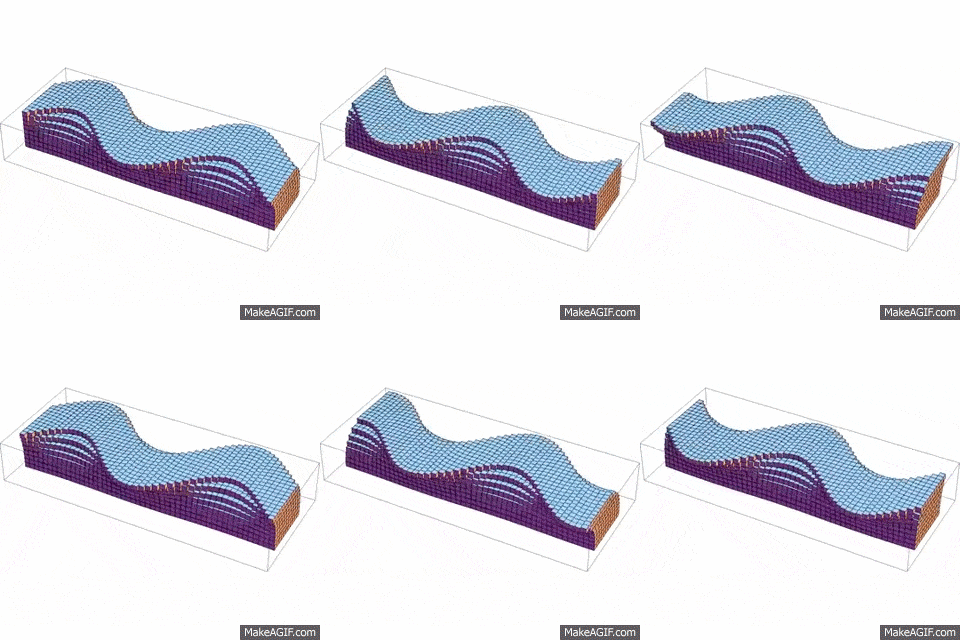
Which Seismic Wave is pictured?
P-Wave
S-Wave
Surface Wave
22
Multiple Choice
Which is the strength of an earthquake?
Plate boundaries
Magnitude
Fault
Seismic
23
Multiple Choice
The point beneath the Earth's surface where the earthquake begins.
epicenter
fault
focus
magnitude
24
Multiple Choice
Which is a fracture in Earth's crust?
Plate boundaries
Magnitude
Fault
Seismic
25
Multiple Choice
All plate boundaries are ____, but not all ____ happen at plate boundaries.
boundaries/earthquakes
faults/earthquakes
epicenters/faults
focus/earthquakes
26
Dropdown
27
Multiple Choice
28
Multiple Choice
29
Multiple Choice
30
Multiple Choice
31
Multiple Choice
Because of plates pushing hard against each other, usually _____ cause the strongest earthquakes
Divergent
Transform
Convergent
Celtic
32
Multiple Select
A seismic wave is simply a means of transferring energy from one spot to another within the earth through vibrations or shock waves. What are the two types of seismic waves?
P-Waves
Light Waves
S-Waves
T-Waves
Radio Waves
33
Multiple Choice
What wave is recorded first? The p-wave or the s-wave?
S-Wave
P-wave
Ocean Wave
34
Multiple Choice
p waves can travel through
liquid and solid
solid
liquid
35
Multiple Choice
s waves can travel through
solid and liquid
liquid
solid
36
Multiple Choice
P waves travel faster than S waves
True
False
37
Multiple Choice

38

39
Multiple Choice
These waves move side to side and can only pass through solids.
P-waves
S-waves
40
Multiple Choice
These waves travel slowly. They are the most destructive.
Seismic Waves
Primary Waves
Secondary Waves
Surface Waves
41
Multiple Choice
42
Multiple Choice
43
Multiple Choice
How do scientists find where earthquake begins?
Scientists read seismographs from at least 3 different locations to find the epicenter of an earthquake.
Scientists read news reports about earthquakes.
Scientists read a seismograms.
44
Multiple Choice
45
Multiple Choice
46
Drag and Drop
Weakest Earthquakes happen at
Earthquakes are caused by plate movement
The waves that carry energy in a earthquake are call seismic waves
Show answer
Auto Play
Slide 1 / 46
SLIDE
Similar Resources on Wayground

43 questions
2 - Climate History and Natural Climate Change
Presentation
•
12th Grade
38 questions
Narrative Tenses
Presentation
•
12th Grade
44 questions
Intro - Cell Cycle Control System (4.2)
Presentation
•
12th Grade
39 questions
Energy, Power, & Work
Presentation
•
12th Grade
42 questions
Introduction to Medical Terminology
Presentation
•
12th Grade
41 questions
12 Enviro Science Revision - U3 Sustainable Development
Presentation
•
12th Grade
39 questions
Epithelial Tissues
Presentation
•
11th - 12th Grade
40 questions
World War I
Presentation
•
11th - 12th Grade
Popular Resources on Wayground
10 questions
How much do you know about our Portrait of an Eagle?

Quiz
•
10th Grade
10 questions
Fast Food Slogans
Quiz
•
6th - 8th Grade
21 questions
Continents and Oceans
Quiz
•
6th Grade
20 questions
Parts of Speech
Quiz
•
5th Grade
16 questions
Subject & Predicate
Quiz
•
5th Grade
25 questions
Multiplication Facts
Quiz
•
5th Grade
12 questions
Map Skills
Quiz
•
3rd Grade
22 questions
Continents and Oceans
Quiz
•
5th Grade
Discover more resources for Science
22 questions
Periodic Table Review
Quiz
•
9th - 12th Grade
7 questions
Newton's Laws Video Quiz

Interactive video
•
9th - 12th Grade
17 questions
Unit 3A: Cells Vocab
Quiz
•
9th - 12th Grade
89 questions
Unit 1 (Ch 2 & 3) Test Review - Water/Ocean Currents
Quiz
•
9th - 12th Grade
58 questions
Biomolecule Test Corrections
Quiz
•
9th - 12th Grade
20 questions
Unit 2: Cell Energy Review
Quiz
•
9th - 12th Grade
17 questions
Explore Newton's Laws of Motion
Quiz
•
8th - 12th Grade
35 questions
Directional Terms, Body Cavities, Body Planes
Quiz
•
11th - 12th Grade