

The Search for El Dorado: Spanish Exploration of New Mexico

Presentation
•
History
•
7th Grade
•
Practice Problem
•
Hard

Jennifer Duran
Used 3+ times
FREE Resource
9 Slides • 6 Questions
1
Spanish exploration of New Mexico
2
Spanish Exploration of New Mexico
In 1536, Cabeza de Vaca arrived in New Mexico. Native Americans told him about the myth of Seven Cities of Gold. In 1598, Juan Oñate claimed the Southwest region for Spain and established the first Spanish colony in New Mexico.
3
Multiple Choice
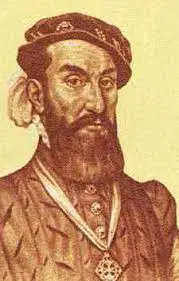
Which Spanish explorer was told about the Cities of Gold?
Cabeza de Vaca
4
Multiple Choice
Who claimed the Southwest region for Spain and established the first Spanish colony in New Mexico?
Cabeza de Vaca
Juan Oñate
Native Americans
Seven Cities of Gold
5
Juan Oñate
Juan Oñate claimed the Southwest region for Spain and established the first Spanish colony in New Mexico. He was a Spanish conquistador and explorer. Oñate is known for leading expeditions and establishing settlements in the region. His actions had a significant impact on the history and culture of the Southwest.
6
The Spanish Colonization of New Mexico
The Spanish exploration of New Mexico, led by Juan de Oñate, reached as far as Kansas in 1601 and the Gulf of California in 1604. However, Oñate's absence from the colony resulted in its failure to prosper. The Pueblo tribes in New Mexico were mistreated by the Spanish colonists, being forced to work long hours, pay taxes, and endure beatings and starvation. Pedro de Peralta later built a successful settlement in Santa Fe.
7
Multiple Choice
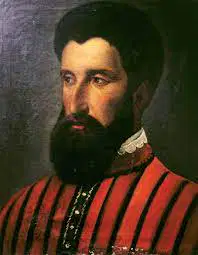
Who led the Spanish exploration of New Mexico?
Juan de Oñate
Pedro de Peralta
Hernando de Soto
Francisco Vázquez de Coronado
8
Multiple Choice
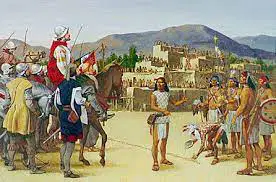
How were the Pueblo Indians treated by the Spanish?
They were treated like guests.
They were treated with respect.
They were treated with indifference.
They were treated horribly.
9
Juan de Oñate
Juan de Oñate led the Spanish exploration of New Mexico. He established the first permanent European settlement in the region, called San Juan de los Caballeros. Oñate's expedition faced challenges, including conflicts with Native American tribes and harsh environmental conditions. Despite these difficulties, his exploration paved the way for Spanish colonization in the area.
10
The Impact of Spanish Colonization
11
Multiple Choice
What were the main tactics used by Spanish missionaries to assimilate Native Americans in New Mexico?
Suppression of Native American customs and languages
Destruction of Pueblo kivas and religious artifacts
Aim to make Native Americans allies and potential fighters in wars
Spread of epidemic diseases like smallpox
12
Destruction of Pueblo Kivas
Trivia: Spanish missionaries in New Mexico destroyed Pueblo kivas, which were sacred underground chambers used for religious ceremonies. This act aimed to suppress Native American customs and religious practices, forcing assimilation into Spanish culture. The destruction of these religious artifacts had a profound impact on the Native American communities.
13
The Spanish Exploration of New Mexico
In the 1650s, a drought devastated New Mexico, leading to crop failure and starvation among Native Americans. The Pueblo blamed Spanish missionaries for prohibiting their rainmaking ceremonies. After a war, severe punishments were inflicted on the Pueblo, including amputation and slavery. Today, only 19 Pueblo villages remain, compared to over 100 before Spanish arrival.
14
Multiple Choice
What was the main cause of the conflict between the Pueblo and Spanish missionaries in the 1650s?
Crop failure due to drought
Prohibition of rainmaking ceremonies
Spanish arrival in New Mexico
Severe punishments inflicted on the Pueblo
15
Spanish Arrival
The main cause of the conflict between the Pueblo and Spanish missionaries in the 1650s was the Spanish arrival in New Mexico. The Pueblo people resisted the Spanish colonization and imposition of their culture. This led to a series of uprisings known as the Pueblo Revolt, where the Pueblo successfully expelled the Spanish from their lands for over a decade.
Spanish exploration of New Mexico
Show answer
Auto Play
Slide 1 / 15
SLIDE
Similar Resources on Wayground

11 questions
HTML coding
Presentation
•
7th Grade
11 questions
METABOLISM
Presentation
•
7th Grade
11 questions
Area of Composite Shapes
Presentation
•
7th Grade
11 questions
The Long Walk- Kit Carson
Presentation
•
7th Grade
10 questions
1.1 Greek City-States
Presentation
•
7th Grade
10 questions
Unit Rate and Graphs
Presentation
•
7th Grade
10 questions
Surface Area of Rectangular Prism
Presentation
•
7th Grade
11 questions
Semi Circle and Quarter Circle
Presentation
•
7th Grade
Popular Resources on Wayground
10 questions
Safety Day 2026 – Student Review

Quiz
•
9th Grade
21 questions
Continents and Oceans
Quiz
•
6th Grade
20 questions
Parts of Speech
Quiz
•
5th Grade
16 questions
Subject & Predicate
Quiz
•
5th Grade
25 questions
Multiplication Facts
Quiz
•
5th Grade
12 questions
Map Skills
Quiz
•
3rd Grade
22 questions
Continents and Oceans
Quiz
•
5th Grade
15 questions
Rounding Decimals
Quiz
•
5th Grade
Discover more resources for History
25 questions
The American Revolution
Quiz
•
7th - 10th Grade
30 questions
Foundations of Gov. Test Review
Quiz
•
7th Grade
15 questions
Ancient Rome
Quiz
•
7th - 10th Grade
16 questions
Students of Civics Unit 2: The Constitution
Quiz
•
7th - 11th Grade
14 questions
Lawmaking (CE.2b)
Quiz
•
7th Grade
10 questions
Exploring the 7 Principles of the Constitution

Interactive video
•
6th - 10th Grade
10 questions
Significance of the Declaration of Independence
Interactive video
•
6th - 10th Grade
20 questions
Quiz on Spanish and Mexican Colonization
Quiz
•
7th Grade