
Drone Physics Lesson 8

Presentation
•
Other
•
9th - 12th Grade
•
Practice Problem
•
Hard

Scott Freeman
FREE Resource
10 Slides • 6 Questions
1
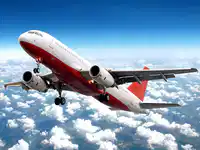
Land, Water, Sky, Oh My!

I can understand the importance of airplanes in today's society.
2
3
It Is Cold.
Cherokee: U-yv-tsa
Syllabary: ᎤᏴᏣ
It Is Snowing.
Cherokee: Gu-ti-ha
Syllabary: ᎫᏘᎭ
It Is Cloudy.
Cherokee: U-lo-gi-la
Syllabary: ᎤᎶᎩᎳ
It Is Hot.
Cherokee: U-di-le-ga
Syllabary: ᎤᏗᎴᎦ
4
Vocabulary
aviation: Includes all flying done through general aviation, commercial airlines and the military.
commercial aviation: Refers to commercial airlines whose business is the transportation of goods and services.
general aviation: Refers to all flying outside of the military and commercial aviation and includes pilots who fly for recreation, air taxis, and crop dusting, among others.
military aviation: Refers to planes flown in the Army, Navy and Air Force.
5
Open Ended
Brainstorming:
Have students generate a number of possible ideas about transportation. Encourage wild ideas and discourage criticism of any ideas.
6
Airplanes of all shapes and sizes are used for hundreds of different reasons, including recreation, commercial business, public transportation, and delivery of goods, among many others. From transporting people to crop-dusting, our society and our economy have come to depend on airplanes. Students discuss their own experiences with airplanes, and using the associated activity, learn more about the role of airplanes in our world.
7
Engineering Connection
Many different types of aircraft have beenn created for many different roles—commercial, general, transport and military—and engineers are responsible for designing and building them all. Engineers take into consideration the purpose of an airplane when they are designing it. Over the years, engineers have advanced the design of airplanes so they are more sophisticated and specialized. Engineers also design and build the aircraft support systems and structures, such as runways, airports, radar communications, and scheduling.
8
History of Flight
In the early 1900s, two American brothers, Orville and Wilbur Wright from Dayton, Ohio, began to experiment with gliders that they built using the results of experiments conducted by European Otto Lilienthal. However, most of the Wright brothers' flights failed.
In 1901, the Wright brothers decided to gather their own wing data by conducting systematic experiments on different types of wing configurations. In 1902, from this earlier experimentation, a glider with a wingspan of 32 ft. was invented. This was the first aircraft that could go up or down, left or right, and could roll about its longitudinal axis. Filled with confidence, Orville and Wilbur Wright returned to Kitty Hawk, North Carolina, where they had originally tested their first glider. At Kitty Hawk, they conquered the problem of aircraft control and stability.
9
History of Flight
The Wright brothers now decided to turn their attention to power. First, they built an engine that produced 12 horsepower. Next, they built the propellers. Consequently, the Kitty Hawk Flyer was born, and on December 17, 1903, Orville and Wilbur Wright demonstrated self-powered flight in an aircraft.
Following the Wright brothers' success, a flurry of aeronautical activity took place around the world. In 1909, Europe also saw its share of aeronautical successes in the work of Santos-Dumont and Louis Bleriot, whose monoplane achieved the first flight across the English Channel in 1909.
10
History of Flight
Today we still can see some of the supersonic aircraft that were built in the 1960s. These pioneering aircraft include the British/French Concorde (cruise speed of Mach 2.0), the Russian TU-144 (cruise speed of Mach 2.2), and the famous American spy plane SR-71 Blackbird (while the actual cruise speed is classified, it is known to be well over Mach 3.0).
Airplanes have been around for more than 100 years. As you can see, many advances have been made, particularly in the last 70 years. Now, airplanes are still an important part of our lives. Today, engineers continue to strive to design better airplanes for commercial, military and general aviation. Engineers must consider both the principles addressed in earlier lessons of this unit as well as the economic effects of the airplanes they design.
11
History of Flight
As time passed, the speed of airplanes increased, from the 12 mph top speed of the Wright Brothers Kitty Hawk Flyer to the 400+ mph of the famous WWII era American P-51 Mustang.
Even though the velocity of newer aircraft was increasing, very soon it was realized that an invisible barrier was preventing aircraft from surpassing the speed of sound. This barrier is known as the "sound barrier." This barrier became the second biggest obstacle since man's first attempt at flying. In 1947, a young test pilot, Chuck Yeager, broke that barrier and exceeded the speed of sound. From that point on, a series of experimental supersonic aircraft took to the sky breaking one speed record after another. In 1962, the North American X-15 airplane achieved 6.7 times the speed of sound (Mach 6.7) at an altitude of 108 km.
12
Match
Match the following
It Is Cold
It Is Hot
It Is Snowing
It Is Cloudy
U-yv-tsa
U-di-le-ga
Gu-ti-ha
U-lo-gi-la
U-yv-tsa
U-di-le-ga
Gu-ti-ha
U-lo-gi-la
13
Match
Match the following
aviation
commercial aviation
general aviation
military aviation
general aviation
business is the transportation
all flying outside of the military
Army, Navy and Air Force
general aviation
business is the transportation
all flying outside of the military
Army, Navy and Air Force
14
Open Ended
What role do engineers play in aviation?
15
Open Ended
Which type of aviation uses the most airports?
16
Open Ended
What are some uses of general aviation?
Land, Water, Sky, Oh My!
I can understand the importance of airplanes in today's society.
Show answer
Auto Play
Slide 1 / 16
SLIDE
Similar Resources on Wayground

13 questions
Food Safety
Presentation
•
9th - 12th Grade
14 questions
Engine Parts
Presentation
•
8th - 12th Grade
11 questions
Music Theory Review
Presentation
•
9th - 12th Grade
9 questions
D3L3: Describe Permissions
Presentation
•
9th - 12th Grade
10 questions
Domain and Range Lesson
Presentation
•
9th - 12th Grade
10 questions
Sum & Difference of Cubes
Presentation
•
9th - 12th Grade
14 questions
Infection Control: Hand Washing
Presentation
•
9th - 12th Grade
15 questions
Respiratory System
Presentation
•
9th - 12th Grade
Popular Resources on Wayground
10 questions
Safety Day 2026 – Student Review

Quiz
•
9th Grade
21 questions
Continents and Oceans
Quiz
•
6th Grade
20 questions
Parts of Speech
Quiz
•
5th Grade
16 questions
Subject & Predicate
Quiz
•
5th Grade
25 questions
Multiplication Facts
Quiz
•
5th Grade
12 questions
Map Skills
Quiz
•
3rd Grade
22 questions
Continents and Oceans
Quiz
•
5th Grade
15 questions
Rounding Decimals
Quiz
•
5th Grade
Discover more resources for Other
10 questions
Safety Day 2026 – Student Review
Quiz
•
9th Grade
20 questions
REGULAR Present tense verbs
Quiz
•
8th - 9th Grade
26 questions
SLIME!!!!!
Quiz
•
KG - 12th Grade
20 questions
Cell organelles and functions
Quiz
•
10th Grade
10 questions
Test Your Knowledge on Bullying
Quiz
•
9th Grade
12 questions
Absolute Value Equations
Quiz
•
9th Grade
20 questions
Position vs. Time Graphs
Quiz
•
9th Grade
20 questions
Function or Not a Function
Quiz
•
8th - 9th Grade