

18-2 Volcanic Eruptions

Presentation
•
Science
•
12th Grade
•
Practice Problem
•
Medium
+9
Standards-aligned

Tom Temple
Used 11+ times
FREE Resource
13 Slides • 11 Questions
1

18-2 Notes
Eruptions
2

Making Magma
Temperature
▪ Most rocks melt between 800C -1200C
▪ These temps are found in crust and
upper mantle
▪ Temp. increases with depth
▪ Pressure
▪ Also increases with depth
▪ Pressure can keep rocks from
melting
▪ Melting Temperature increases with
depth
▪ Water can make a big difference in
melting temperature
▪ See chart ->>>>>
3
Multiple Choice
Melting temperatures of dry rocks at the surface
Are higher than those at depth
Are lower than those at depth
Are the same as those at depth
4
Multiple Choice
A rock that is "wet" (meaning water is involved)
melts at higher temps than the same rock when its dry
melts at lower temps than the same rock when its dry
melts at the same temperature as a dry rock
tells you that it the guitar player was sweaty
5

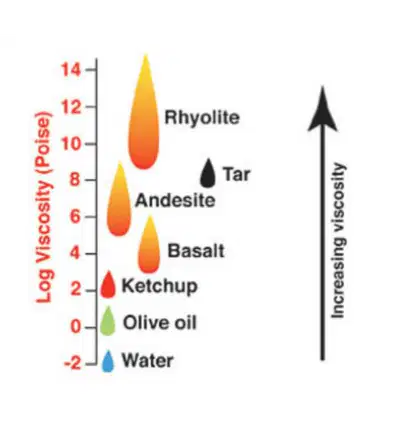
Composition of Magma
Determines a volcanoes explosiveness
Factors that influence composition are:
1. Dissolved Gases
▪ Provides the “bang” like a shaken up soda.
▪ Major gases include
-Water vapor
-Carbon dioxide
-Sulfur dioxide
-Hydrogen sulfide
2. Viscosity
-Resistance to flow
- High = thick (like tar)
- Low = runny (like water)
- Higher the silica, the higher the
viscosity
6
Drag and Drop
7
Multiple Select
High viscosity means a liquid that (choose all that apply)
flows fast
is like water
flows slow
resists flow
8
Multiple Choice
High viscosity magmas are high in
iron
magnesium
aluminum
silica
9

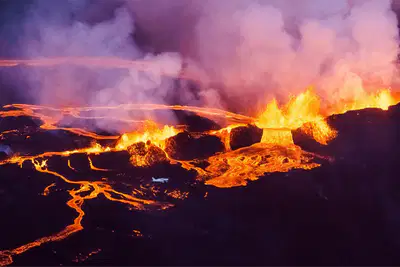
Types of Magma
Basaltic Magma
▪ Originates in the upper mantle
▪ Less than 50% silica
▪ Iron rich
▪ Low viscosity magma
▪ Quiet Eruptions
▪ Little or no interaction with
continental crust
▪ Kilauea, Mauna Loa, Hawaii
▪ Surtsey, Iceland
10
11
Multiple Choice
Two places to view basaltic eruptions would be
Washington and Alaska
Hawaii and Iceland
Indonesia and Japan
Montana and Colorado
12
Multiple Choice
Basalt eruptions tend to be
explosive because the magma is high in silica
not as explosive because the magma is high in silica
explosive because the magma is low in silica
quiet because the magma is low in silica
13

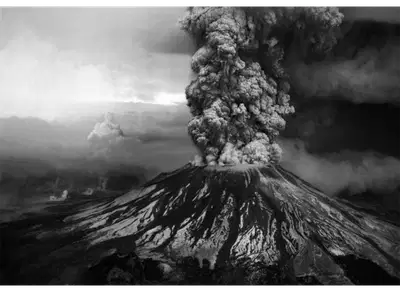
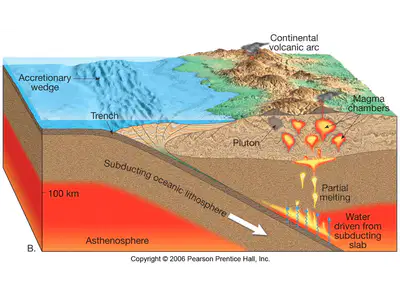
Andesitic Magma
▪ 50-60% Silica
▪ Same comp. as the rock with
same name
▪ Oceanic-Continental
Subduction Zones
▪ Higher Silica = Intermediate
Viscosity
▪ Volcanoes with intermediate
explosivity
▪ Massive Explosions –
Tambora
14
Drag and Drop
15

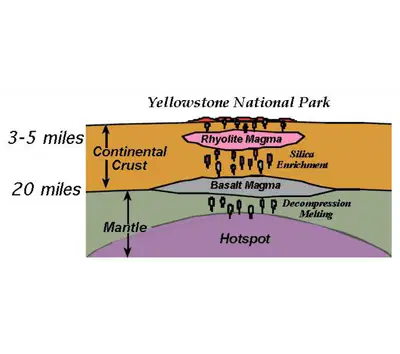
Rhyolitic Magma
▪ Continental crust mixes in with
magma from deep in Earth
▪ More than 60% silica
▪ Same comp. as granite
▪ Rich in both silica and water
▪ High viscosity slows its
movement
▪ Large volume (4-6%) trapped
gas
▪ Very explosive
▪ Yellowstone super volcano
16
Multiple Choice
The high silica content in rhyolitic magma is caused by
huge amounts of continental crust being melting into the mix
huge amounts of oceanic crust being melted into the mix
a 50:50 blend of ocean and continental crust in the mix
17

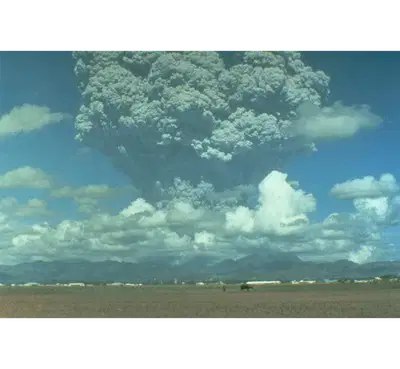
Explosive Eruptions
▪ When lava is too viscous to flow
▪ Pressure builds up until explosion
▪ Tephra – anything erupted in air
▪Ash – less than 2mm – can be
carried 40km into atmosphere
▪Bombs – lava that hardens in air
▪Blocks – as big as a car or small
house
▪ Sulfur dioxide can stay in upper
atmosphere for years lowering
global temperatures
▪ Tambora and the year without
summer
18
Drag and Drop
19
20

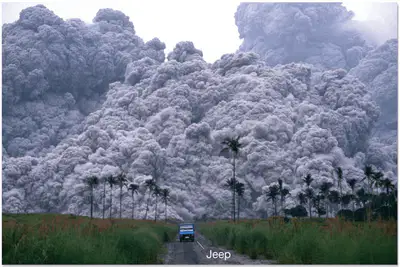
Pyroclastic Flows
• Rapidly moving clouds of
tephra (or pryroclastics)
• Often deadliest part of
eruption
• Searing hot
• Fast moving – can be over 100
mph
• Suffocating poisonous gas and
ash
• Mt Peleé – 29,000 people
killed in 1902 on Martinique
21
22
Fill in the Blanks
The only person to survive the Mt. Pele eruption was in a well built
23

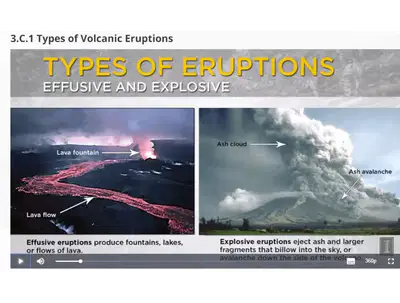
Video Summary
24
18-2 Notes
Eruptions
Show answer
Auto Play
Slide 1 / 24
SLIDE
Similar Resources on Wayground

18 questions
SHOULD, HAVE TO, MUST
Presentation
•
12th Grade
20 questions
The Federal Bureaucracy
Presentation
•
12th Grade
20 questions
Negative Exponents
Presentation
•
12th Grade
20 questions
Locard's Exchange Principle Lab
Presentation
•
12th Grade
20 questions
States of Matter Review
Presentation
•
3rd Grade
18 questions
Freshwater Ecology Notes
Presentation
•
12th Grade
19 questions
Forensic Entomology
Presentation
•
12th Grade
16 questions
Diabetes Episode
Presentation
•
12th Grade
Popular Resources on Wayground
10 questions
How much do you know about our Portrait of an Eagle?

Quiz
•
10th Grade
10 questions
Fast Food Slogans
Quiz
•
6th - 8th Grade
21 questions
Continents and Oceans
Quiz
•
6th Grade
20 questions
Parts of Speech
Quiz
•
5th Grade
16 questions
Subject & Predicate
Quiz
•
5th Grade
25 questions
Multiplication Facts
Quiz
•
5th Grade
12 questions
Map Skills
Quiz
•
3rd Grade
22 questions
Continents and Oceans
Quiz
•
5th Grade
Discover more resources for Science
22 questions
Periodic Table Review
Quiz
•
9th - 12th Grade
7 questions
Newton's Laws Video Quiz

Interactive video
•
9th - 12th Grade
17 questions
Unit 3A: Cells Vocab
Quiz
•
9th - 12th Grade
89 questions
Unit 1 (Ch 2 & 3) Test Review - Water/Ocean Currents
Quiz
•
9th - 12th Grade
58 questions
Biomolecule Test Corrections
Quiz
•
9th - 12th Grade
20 questions
Unit 2: Cell Energy Review
Quiz
•
9th - 12th Grade
17 questions
Explore Newton's Laws of Motion
Quiz
•
8th - 12th Grade
35 questions
Directional Terms, Body Cavities, Body Planes
Quiz
•
11th - 12th Grade