

How action potential carry information

Presentation
•
Biology
•
Professional Development
•
Practice Problem
•
Medium

Narimon Aliqulov
Used 5+ times
FREE Resource
32 Slides • 17 Questions
1

Impulse, Receptors
& Synapse
Chapter 15 – Control &
Coordination
2
Multiple Choice
What is the threshold potential?
a) The maximum potential a neuron can reach
b) The minimum potential required to initiate an action potential
c) The potential difference across the cell membrane at rest
d) The potential difference at the peak of an action potential
3

Review…
• (c) Describe how the neuron maintains the
resting potential.
4
Multiple Choice
Which of the following is true about the refractory period of an action potential?
a) It is the time during which the neuron is unable to generate another action potential
b) It is the time during which the neuron is hyperpolarized
c) It ensures that action potentials travel in one direction along the axon
d) All of the above
a) It is the time during which the neuron is unable to generate another action potential
b) It is the time during which the neuron is hyperpolarized
c) It ensures that action potentials travel in one direction along the axon
d) All of the above
5

Review…
• (c) Why is the change
from -70 mV to +30 mV
potential difference
during an action potential
called a ‘depolarization’
[A] ?
• (d) Why is the decrease
in potential difference
halfway through an action
potential called
‘repolarization’ [B]?
*an action potential recorded at one
position on an axon.
A
B
6

How do action potentials carry information?
•They don’t change in size
(always at +30 mV peak
value) as they travel along an
axon.
•Speed of impulse
transmission (travel) along an
axon is the same all the time.
•Example: looking at bright
light (strong stimulus) or dim
light (weak stimulus) sends
the same size of action
potential to the brain.
7
Multiple Choice
Which of the following correctly represents the sequence of events during an action potential?
a) Depolarization - Repolarization - refractory period
b) Repolarization - Depolarization - Hyperpolarization-refractory period
c) Hyperpolarization - Depolarization - refractory period-Repolarization
d) Depolarization - Hyperpolarization - Repolarization
8
Multiple Choice
What happens during the depolarization phase of an action potential?
a) Sodium ions enter the cell, causing the inside to become more positive
b) Potassium ions exit the cell, causing the inside to become more negative
c) Calcium ions enter the cell, causing the inside to become more positive
d) Chloride ions enter the cell, causing the inside to become more negative
9
Multiple Choice
Which of the following is responsible for the repolarization phase of an action potential?
a) Opening of potassium channels, allowing potassium ions to exit the cell
b) Opening of sodium channels, allowing sodium ions to exit the cell
c) Opening of calcium channels, allowing calcium ions to exit the cell
d) Opening of chloride channels, allowing chloride ions to exit the cell
10

How do action potentials carry information?
•So what is something
different between action
potentials from a strong or
weak stimulus?
•The answer is:
•Their frequency!
Frequency of impulse
-How often/frequent they occur along a neuron per second.
-Stronger stimulus = more frequent impulses
-Weaker stimulus = less frequent impulses
11

How do action potentials carry information?
•So what causes a
difference in frequency of
impulses?
•The answer is:
•Stronger stimuli
stimulates more
neurones than weaker
stimuli
•Stronger stimuli causes
action potentials in many
neurones, weaker stimuli
causes it only in one or
two neurones.
*(a) action potentials from a strong stimulus. (b) action potentials
from a weak stimulus.
12

How do action potentials carry information?
•So what is the importance of
different frequencies of action
potentials?
•The answer is:
•It helps the brain interpret
how strong the stimulus is.
•Example: brain always
interprets any stimulus that
comes from eyes as ‘light’.
•That’s why rubbing your
eyes produces patterns of
light.
13
Multiple Choice
What is saltatory conduction?
a) The process of propagating an action potential along unmyelinated axons
b) The process of propagating an action potential along myelinated axons
c) The process of propagating an action potential across a synapse
d) The process of propagating an action potential in the peripheral nervous system
14
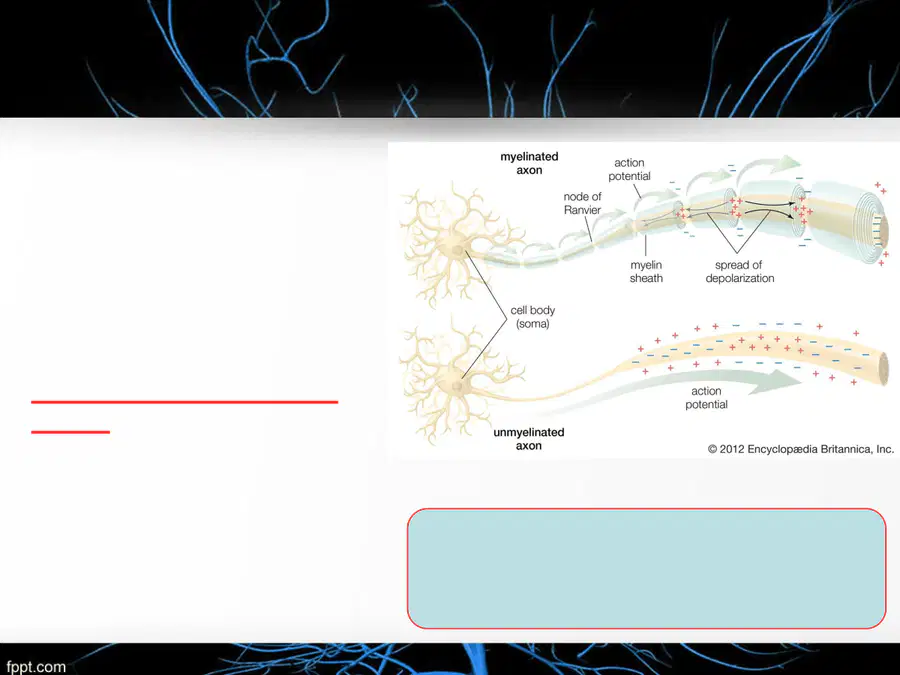
How fast is impulse conduction?
•2 factors that determine
impulse conduction speed:
•1. presence or absence of
myelin
•2. diameter of axons
1. presence or absence of
myelin
•Unmyelinated axon –
impulse speed can be as
slow as 0.5 ms-1(m/s)
•Myelinated axon – speed up
to 100 ms-1
Myelin speeds up the action
potential by insulating it.
15

How fast is impulse
conduction?
•Why is transmission of action potential along a
myelinated axon much quicker than in unmyelinated
axon?
The action potential in myelinated axons jump from one node to the next at a distance of about 1-3 mm. this is
called saltatory canduction. It can increase conduction speed up to 50 faster than in unmyelinated axon.
Na+ and K+ cannot flow through
the myeline sheath, they can
only be exchanged through the
nodes of Ranvier (where all
sodium-potassium pumps are
located)
16

How fast is impulse conduction?
•factors that determine
impulse conduction speed:
•2. diameter of an axon
•Thicker axons transmit
impulses faster than thin
ones
•Why?
•Thicker axons have greater
surface area for diffusion of
Na+ & K+ which means
faster change in diffusion
rates resulting to faster
depolarization &
polarization.
17
Multiple Choice
Which of the following factors can affect the speed of an action potential?
All of the below
Axon diameter
Myelination
Temperature
18
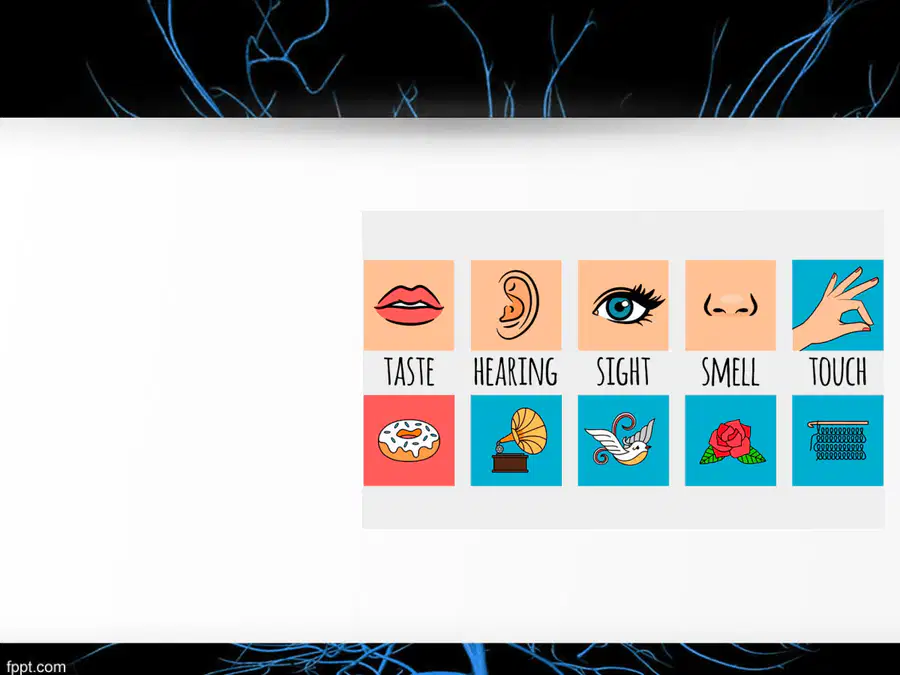
What Starts an action potential?
•Action potentials are
generated by hundreds of
stimuli!
•Some of them are:
•Light
•Pressure (touch)
•Sound
•Temperature
•Chemicals
•Stimuli are detected and
transformed to action
potentials by receptors.
19

Types of Receptors
Receptor Type
For which stimuli?
Example
1. Photoreceptor
light
Cells in retina
of the eye
Type of receptors
20

Receptor Type
For which stimuli?
Example
Types of Receptors
2. Chemoreceptor
chemicals
Taste buds
Type of receptors
21

Receptor Type
For which stimuli?
Example
Types of Receptors
3. Thermoreceptor
Temperature
changes
Cells in skin
Type of receptors
22

Receptor Type
For which stimuli?
Example
Types of Receptors
4. Mechanoreceptor
Mechanical changes
Ex. Change in length
Hair cells in ear
(hearing and
balance)
Type of receptors
23
Multiple Choice
Which of the following is responsible for initiating an action potential?
a) Neurotransmitters
b) Electrical synapses
c) Voltage-gated ion channels
d) Ligand-gated ion channels
24

2 forms of receptors based on sensory
neurone attached to them:
•(a) specialised cells
•Cells which receives the
stimuli and influence the
action potentials produced
in the sensory neurones
connected to them.
•(b) receiving end of
sensory neurone attached
to organ or tissue
•Stimulus directly influence
the action potentials
produced in the sensory
neurone without passing
through specialised cells.
25

Examples of Receptors
26
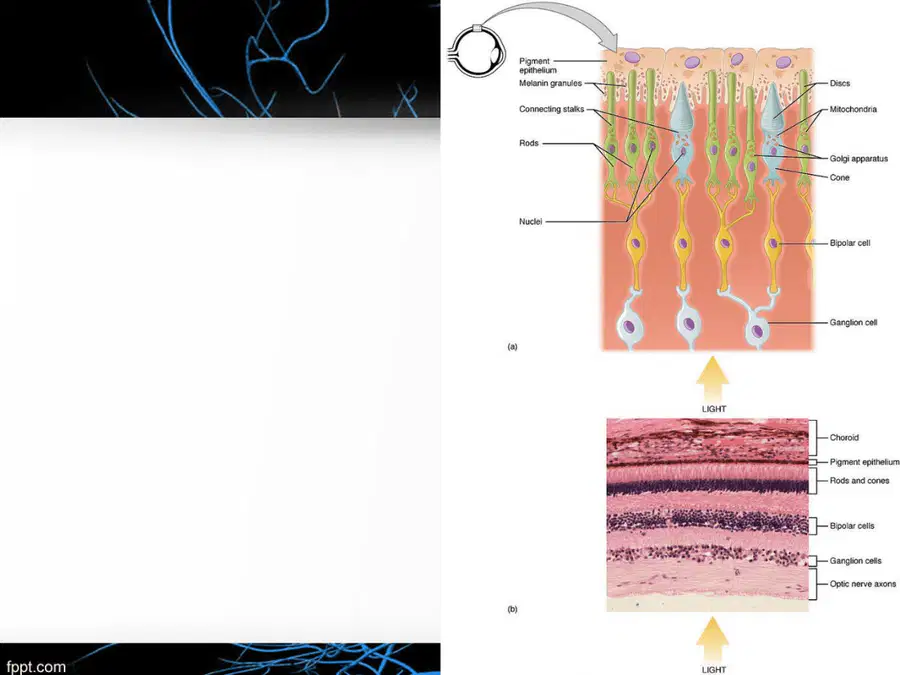
2 forms of receptors based on
sensory neurone attached to
them:
•(a) specialised cells
•Example 1:
•Rod cells & cone cells of
eye retina (photoreceptors)
27
Multiple Choice
In which direction does an action potential travel along an axon?
a) From the axon terminal to the cell body
b) From the dendrites to the axon terminal
c) From the cell body to the axon terminal
d) In both directions simultaneously
28

2 forms of receptors based on sensory
neurone attached to them:
•(a) specialised cells
•Example 2:
•Taste buds in the papillae of
the tongue
(chemoreceptors)
29

2 forms of receptors based on sensory
neurone attached to them:
•(a) specialised cells
•How taste sensation is generated in the taste
buds?
•Example for salty taste:
•1. sodium ions (Na+) enters the papilla receptor
cells – causing a depolarization inside (receptor
potential)
•2. voltage-gated ion channel proteins in the
receptor cell membranes opens and allow calcium
ions (Ca+) to enter.
•3. Ca+ ions stimulates synapse vesicles to release
the neurotransmitter (by exocytosis) into synaptic
gap.
•4. sensory neurone synaptic receptors receive the
neurotransmitters & translate signal into action
potential.
•5. action potential travels along sensory neurone to
the brain and it interprets the salty taste response.
30
Multiple Choice
Which of the following is true about the all-or-none principle of action potentials?
a) Action potentials can be of varying amplitudes depending on the stimulus
b) Action potentials always have the same duration
c) Action potentials occur only in sensory neurons
d) Action potentials either occur fully or do not occur at all
31

The “all-or-none law”
• All – or – none Law
•Impulses are only transmitted is
there is sufficient stimuli to raise
the action potential above the
threshold potential.
•If stimuli is not sufficient, no
impulse/action potential will be
created = no sensation will be felt
= no response will be generated!
•Threshold potential often
increases which means: more
and more stimulation is needed
for many nervous actions to
generate a response as time goes
by.
32

Relationship between receptor potential,
impulse frequency and the all-or-none law
33

What happens in the
Synapse?
34

Synaptic Gap or Synaptic Clef
• Synaptic cleft
•About 20 nm wide
Presynaptic neuron +
synaptic cleft +
postsynaptic neurone =
SYNAPSE
35
Multiple Choice
Which of the following ions is involved in neurotransmitter release at the presynaptic terminal?
a) Sodium (Na+)
b) Potassium (K+)
c) Calcium (Ca2+)
d) Chloride (Cl-)
36
Multiple Choice
Which of the following is responsible for the afterhyperpolarization phase of an action potential?
a) Opening of sodium channels, allowing sodium ions to exit the cell
b) Opening of potassium channels, allowing potassium ions to exit the cell
c) Opening of calcium channels, allowing calcium ions to exit the cell
d) Opening of chloride channels, allowing chloride ions to exit the cell
37
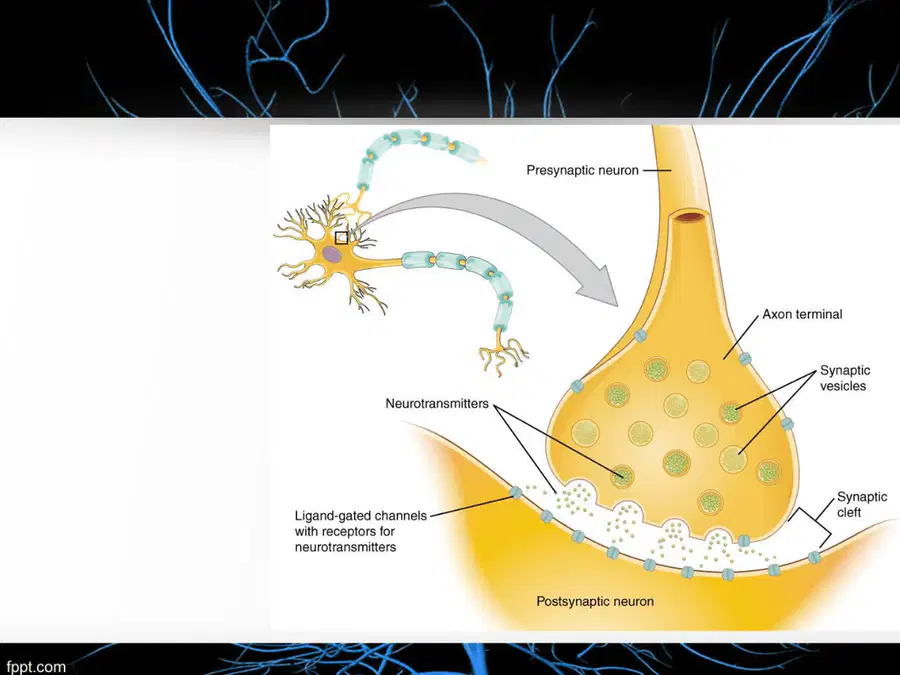
Mechanism of Synaptic Transmission
• neurotransmitters
•Chemicals released across
synaptic cleft to transmit
impulses between neurones or
between a motor neurone and
muscle fibre.
38
Multiple Choice
What is the role of calcium ions in synaptic transmission?
a) They trigger the release of neurotransmitters into the synapse
b) They bind to receptors on the postsynaptic neuron
c) They depolarize the presynaptic neuron
They repolarize the postsynaptic neuron
39

Mechanism of Synaptic Transmission
•Events that occur in the
synapse:
•1. action potential occurs at the
cell membrane of presynaptic
synaptic neurone (first neurone)
•2. action potential causes release
of neurotransmitters from
vesicles by exocytosis into the
cleft
•3. neurotransmitters bind to
receptors on post-synaptic
neurone
•4. postsynaptic neurone
depolarizes (if it goes above
threshold potential, an impulse is
generated)
40
Multiple Choice
Which of the following is true about the presynaptic neuron?
a) It receives incoming signals from other neurons
b) It releases neurotransmitters into the synapse
c) It contains receptors for neurotransmitters
d) It is responsible for initiating action potentials
41

Mechanism of Synaptic Transmission
• neurotransmitters
•More than 40 types known.
•Some are found all over the nervous
system (example: noradrenaline,
acetylcholine [ACh]
•Some are only in the brain (example:
dopamine, glutamic acid, GABA
(gamma-aminobutyric acid)
•SNARE proteins (Soluble N-
ethylmaleimide-sensitive factor
attachment protein receptors) are a group
of proteins that play a fundamental role in
the process of synaptic vesicle fusion and
neurotransmitter release at the synapse.
False-colour TEM of synapse. Presynaptic neurone
(top) shows mitochondria (yellow) & vesicles
containing neurotransmitters (blue circles).
42

Synaptic Transmission
of Acetylcholine (Ach)
Acetylcholine receptor & channel
protein for Na+ ions.
Cholinergic synapse
*a synapse where the neurotransmitter is
acetylcholine (Ach)
43
Multiple Choice
Which of the following is responsible for the release of neurotransmitters into the synapse?
a) Voltage-gated ion channels
b) Ligand-gated ion channels
c) Sodium-potassium pumps
d) Exocytosis of synaptic vesicles
44

•
acetylcholinesterase, which
catalyses the hydrolysis of each ACh
molecule into acetate and choline.
•
The choline is taken back into the
presynaptic neurone, where it reacts
with acetyl coenzyme A to form ACh
once more.
•
The ACh is then transported into the
presynaptic vesicles, ready for the
next action potential.
45

How ACh
receptors work
•It is made of a transmembrane
protein made of 5 protein subunits.
•2 of the subunits have Ach receptor
sites.
•When Ach bind to the receptor sites,
the proteins change shape = the
channel opens
•Negatively charged amino acids
inside the channel attracts positively
charged Na+ ions – allowing them to
pass through
46

Roles of Synapes
•1. Synapses ensure one-way
transmission
–Impulse only pass in one direction
because neurotransmitter is released
from one side to another and never vice
versa
•2. synapses allow the
interconnection of nerve pathways
–Billions of neurones are interconnected to
each other and to receptors & effectors –
creating pathways that increase over time
–Information spreads out through the body
–One neurone can receive information
from many different parts of the body and
integrate them (brain neurones)
*neuromuscular junctions
(motor neurones terminal branches
connecting to muscles allow for
coordinated muscle action.)
47
Multiple Choice
Which of the following is true about neuromuscular junctions?
a) They occur between two motor neurons
b) They involve the transmission of signals from a neuron to a muscle cell
c) They are only found in the brain
d) They utilize electrical synapses for communication
48

Roles of Synapes
•1. Synapses ensure one-way
transmission
–Impulse only pass in one direction
because neurotransmitter is
released from one side to another
and never vice versa
•2. synapses allow the
interconnection of nerve
pathways
–Billions of neurones are
interconnected to each other and
to receptors & effectors – creating
pathways that increase over time
–Information spreads out through
the body
–One neurone can receive
information from many different
parts of the body and integrate
them (brain neurones)
49
Multiple Choice
What is the role of acetylcholine in neuromuscular junctions?
It triggers the release of neurotransmitters from the motor neuron
b) It binds to receptors on the muscle cell, leading to muscle contraction
c) It inhibits the release of neurotransmitters at the synapse
It regulates the opening of ion channels in the motor neuron
Impulse, Receptors
& Synapse
Chapter 15 – Control &
Coordination
Show answer
Auto Play
Slide 1 / 49
SLIDE
Similar Resources on Wayground

44 questions
Appointment (10 points)
Presentation
•
Professional Development
43 questions
Atoms Lesson
Presentation
•
KG
44 questions
CMP Workshop
Presentation
•
Professional Development
43 questions
10 - Gastronomic class
Presentation
•
Professional Development
40 questions
Unit 2A Pt 2 - Chemical Reactions
Presentation
•
KG - University
44 questions
Maya, Aztec, Inca
Presentation
•
6th - 8th Grade
48 questions
POPULAR MEMBER SERVICES DIAGNOSTICS, HOSPITILIZATION AND SURGERY
Presentation
•
KG
Popular Resources on Wayground
11 questions
Hallway & Bathroom Expectations

Quiz
•
6th - 8th Grade
10 questions
HCS SCI 03 Summer School Assessment 2
Quiz
•
3rd Grade
11 questions
Home Scope
Quiz
•
7th - 8th Grade
12 questions
2026 TAP Technology in the Classroom
Presentation
•
Professional Development
15 questions
HCS SCI 05 Summer School Assessment 2 Review
Quiz
•
5th Grade
15 questions
HCS SCI 04 Summer School Review 2
Quiz
•
4th Grade
59 questions
Geometry Unit 3 Review
Quiz
•
9th - 12th Grade
14 questions
FAST ELA READING SMAPLE TEST MATERIALS

Passage
•
3rd Grade