Plate tectonics
Presentation
•
Science
•
6th - 8th Grade
•
Medium
+16
Standards-aligned

Benevolence Yangsi
Used 5+ times
FREE Resource
12 Slides • 38 Questions
1
Plate tectonics explains how the continents broke apart and moved to their current positions. Pangea wasn't the only supercontinent and scientists believe that there could be future supercontinents as well.​
​So what happened?
Around 225 million years ago, all current continents on Earth were connected as one supercontinent- Pangea.
​When was Pangea around?
​Pangea- Supercontinent and plate tectonics
2
what is Pangea?
The super continent that Alfred Wegener described in his theory of Continental Drift
Around 225 million years ago, all current continents on Earth were connected as one supercontinent- Pangea.
what is plate tectonics?
Plate tectonics explains how the continents broke apart and moved to their current positions. Pangea wasn't the only supercontinent and scientists believe that there could be future superc
3
Multiple Choice
About how fast is Earth's surface (lithosphere) moving?
as fast as my teacher walks (pretty slowly)
as fast as your nails grow
as fast as a student leaves the building on the last day of school
4
Multiple Choice
The idea that the continents were once part of a single landmass that broke apart and
moved is
Continental Drift
Tectonic Plates
Transform
5
Multiple Choice
Pangea was:
A great sandwich restaurant.
An old continent.
The only supercontinent.
A well-known supercontinent.
6
Multiple Choice
7
The earth moves! what is causes the movement?
We have many pieces of evidence to this fact. some we can even feel; like earthquakes.
So what is causes the movement? Magma! Deep in the Earth, molten rock churns as it heats and cools in convection currents. This moves the earths plates on top, and even creates and new and destroys old plates.
8
Multiple Select
Convection currents happen in the mantle. The outer core heats magma around it and causes it to become less dense. Because the magma is less dense than the material around it, it starts to rise toward the crust. Since the crust is not hot, the magma starts to cool as it gets close to the crust. Since it is cooling, it gets denser and starts to sink back down toward the outer core.
Use the information above to answer the following question: Which of the following TWO things happen to magma causing it to rise?
It gets cooler.
It gets warmer.
It gets denser.
It gets less dense.
9
Multiple Choice
Which of the following is NOT evidence of Earth's moving lithosphere? Look a the choices provided and there should be one that stands out as incorrect.
earthquake & volcanic activity
human remain evidence
similar fossils found on continents that are now very far apart
10
Multiple Choice
11
12
13
14
15
Multiple Choice
Metiorologist who porposed theory that continents move
Alfred Wegener
Pangea
Rock Strata
16
Multiple Choice
The theory of plate tectonics helps explain which of the following?
the symbiotic relationship between tubeworms and bacteria
the extinction of the dinosaurs
the movement of continents and the occurrence of volcanoes and earthquakes
17
Multiple Choice
This evidence shows ancient animals lived on several continents, even though they are an ocean apart.
Mountain Range Evidence
Glacial Evidence
Fossil Evidence
18
Multiple Choice
Similar patterns are found around the world in high peaks.
Mountain Range Evidence
Glacial Evidence
Fossil Evidence
19
Multiple Choice
Marks left behind showing direction of ice movement
Mountain Range Evidence
Glacial Evidence
Fossil Evidence
20
Multiple Choice
Lines of similar age/type matching on different continents
Alfred Wegener
Pangea
Rock Strata
21
Multiple Choice
Mega continent made of combined continents
Alfred Wegener
Pangea
Rock Strata
22
Multiple Select
Mark only those that are evidence for Plate Tectonics:
Rock Strata
Porosity
Fossil Record
Acceleration
Continental Drift
23
Multiple Choice
24
Multiple Choice
25
Multiple Select
Mark the different types of motion you see of the Earth's plates (pieces of lithosphere).
<- ->
apart
-> <-
together
the lithosphere is NOT moving, because there is NO lithosphere. This is all a conspiracy theory by teachers to torture students.
26
Multiple Choice
27
Divergent Boundary
Plates/Lithosphere pieces move apart
Material from the asthenosphere fills the gap - we get lava/volcanic activity on the surface of Earth
At one point a divergent boundary started in KS - but then stopped! Maybe it will restart again?!
28
Explanation Slide...
Check this out...
29
Multiple Choice
At divergent boundaries plates are moving away from each other. What happens in the space left between them?
Magma comes up, cools and hardens making new crust
Water comes up and fills the gap
Grass comes up and fills the gap
30
Multiple Choice
What happens to the magma that comes up at divergent boundaries?
It turns green
Nothing happens to the magma
The magma melts, wait isn't magma a liquid already?! I'm so confused.
The magma cools and hardens into new crust
31
Transform Boundary
Notice the plates are still touching
One goes one direction, the other the opposite
This boundary is found in California!
32
Multiple Choice
33
Multiple Choice
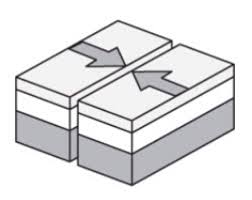
What type of boundary is formed when plates slide past each other?
convergent
when you like break up with your significant other, but are still friends.
divergent
transform
34
Multiple Choice
Last motion is when the two plates collide! Looking at the model image, which option below is most likely to happen to Earth's surface?
same thing as a transform boundary, just some cracks near the boundary
Volcanoes & Mountains oh My!
My teacher is dying looking at this yummy image. I think I am craving chocolate now too!
35
Convergent Boundary
Plates Collide
Creates mountains, volcanic mountains, or volcanic islands (depending on what plates are colliding - will go into detail in another lesson
NW U.S. - Cascade Mountains are all volcanic mountains!!!
36
Multiple Choice
What is it called when plates push together?
divergent
convergent
transform
all of the above
37
Multiple Choice
38
Multiple Choice
What are the three types of plate boundaries?
convergent, divergent, transform
constant, diverse, transformers
transformers are robots in disguise
39
Multiple Select
Everytime the lithosphere moves, we get earthquakes. Which boundary motion will create an earthquake.
Convergent
(plates move together)
Divergent
(plates move apart)
Transform
(plates slide past eachother)
40
Plate Tectonics
(formerly known as continental drift)
Earth's lithosphere is moving around
Movement of heat (convection) in the asthenosphere is creating this motion
The lithosphere still is moving
Earthquakes are what happen when the lithosphere moves!
41
Multiple Choice
42
Multiple Choice
43
Multiple Choice
44
Multiple Choice
45
Multiple Choice
46
Multiple Choice
47
Multiple Choice
48
Multiple Choice
49
Multiple Choice
50
Multiple Choice
Plate tectonics explains how the continents broke apart and moved to their current positions. Pangea wasn't the only supercontinent and scientists believe that there could be future supercontinents as well.​
​So what happened?
Around 225 million years ago, all current continents on Earth were connected as one supercontinent- Pangea.
​When was Pangea around?
​Pangea- Supercontinent and plate tectonics
Show answer
Auto Play
Slide 1 / 50
SLIDE

Similar Resources on Wayground
47 questions
Elkhorn History Images
Lesson
•
KG
45 questions
Elements, Compounds, Molecules, and Mixtures
Lesson
•
6th - 8th Grade
47 questions
Understanding Plate Tectonics
Lesson
•
6th - 8th Grade
46 questions
Force and Motion
Lesson
•
7th - 8th Grade
43 questions
Newton's 3rd Law
Lesson
•
6th - 8th Grade
43 questions
Fossil Fuels
Lesson
•
5th - 9th Grade
43 questions
Earthquakes
Lesson
•
6th - 8th Grade
45 questions
Big Idea 6: Earth Structures - Human Impact (CS1)
Lesson
•
6th - 8th Grade
Popular Resources on Wayground
8 questions
Spartan Way - Classroom Responsible
Quiz
•
9th - 12th Grade
15 questions
Fractions on a Number Line
Quiz
•
3rd Grade
14 questions
Boundaries & Healthy Relationships
Lesson
•
6th - 8th Grade
20 questions
Equivalent Fractions
Quiz
•
3rd Grade
3 questions
Integrity and Your Health
Lesson
•
6th - 8th Grade
25 questions
Multiplication Facts
Quiz
•
5th Grade
9 questions
FOREST Perception
Lesson
•
KG
20 questions
Main Idea and Details
Quiz
•
5th Grade
Discover more resources for Science
22 questions
Phases of the moon
Quiz
•
8th Grade
20 questions
Rocks and The Rock Cycle
Quiz
•
6th Grade
20 questions
Flow of Energy
Quiz
•
7th Grade
20 questions
Waves and Wave Properties
Quiz
•
6th - 8th Grade
8 questions
Amoeba Sister Asexual vs Sexual Reproduction
Interactive video
•
8th Grade
10 questions
Exploring the Rock Cycle: Types and Formation
Interactive video
•
6th - 8th Grade
16 questions
Photosynthesis and Cellular Respiration Review
Quiz
•
7th Grade
20 questions
8th Grade Science STAAR Review
Quiz
•
8th Grade