
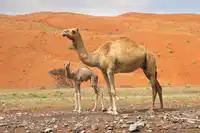
Animals in Qatar

Presentation
•
Geography
•
2nd Grade
•
Practice Problem
•
Medium

Lubaiba Mohamed
Used 6+ times
FREE Resource
15 Slides • 5 Questions
1

Research and gather ideas about the different animals found in their local environment
2
Multiple Select
Which of these animals is likely to be found in Qatar (Choose ALL that applies..)
3
Multiple Choice
Name the national animal of Qatar
Arabian Oryx
Camel
Falcon
Lion
4
Multiple Choice
Name the national bird of Qatar
Emu
Peacock
Falcon
Parrot
5
Multiple Choice

Identify this animal found in Qatar
Sultan Ibrahim
Desert Hedgehog
Sonic
Tales
6
Multiple Choice

The only true vegetarian mammal of the sea. Also called a sea cow or "Lady of the Sea".
Sultan Ibrahim
Dugong
Blue whale
shark
7
let's create a fact file on animals in Qatar
Work in pairs
Find out about the animals assigned to you
Fill in the Fact Sheet
Create a flip book
8

9

It is a symbol of national pride, of which many Arabic
poems and stories have been written detailing the beauty
and majesty of this remarkable mammal.
The Arabian Oryx of Qatar
The Arabian Oryx is an important animal and cultural
symbol in Qatar, historically, culturally and ecologically
for centuries.
10

The Arabian Oryx
It is approximately 1.2
meters in height at the
shoulder and can weigh
up to 80 kilograms.
It has long thin legs, as well as
spectacular horns that curve
backwards as they grow and can
reach up to 63 centimetres in length.
If provided with safe conditions in
the wild, the Arabian Oryx has a
lifespan of 20 years.
This species of antelope lives in
the Middle East and North Africa.
It has white fur with a black
stripe along its back, with a
distinct shoulder bump.
11

Surviving in the Desert
Its long legs allow it to bound across the sand
while its wide hooves that spread the weight of
its body, protect it against sinking in the sand.
The Arabian Oryx is adapted to live in the harsh desert climate. It has
various special adaptations which help it not only survive in this difficult
environment but thrive.
Its nostrils can close to prevent the inhalation
of sand particles. Its white colouration provides
camouflage and reflects the sun’s rays.
12

The Arabian Oryx and its Diet
Similar to other animals in the
antelope family, the Arabian Oryx
is a herbivore, meaning that its
diet consists mainly of plants.
They eat grasses, leaves, shrubs
and herbs, as well as roots,
bulbs and tubers.
Although it is not a staple
of their diet, the Arabian
Oryx may also sometimes
eat fruits and seeds.
13

The Arabian Oryx is very active
and requires a lot of food. It
consumes around 4 kilograms of
food every day.
Due to the moisture found
in some of these foods, the
Arabian Oryx can last a
significant amount of time
without drinking water.
Herds are usually
between 10 and 20
animals, with one
dominant male and
many females.
The Arabian Oryx and its Diet
14

Living in the Desert
Deserts are the preferred habitats for the Arabian Oryx.
Some of these desert habitats could include sand dunes,
stony plains and wadis.
Their numbers dropped rapidly
because of hunting and habitat
loss and they were listed as
critically endangered in the 1980s.
Living in small herds of between 5 and 30, these clever
animals could once be found throughout the Middle
East and North African desert regions.
15

Conservation Efforts
Due to the efforts of the government of Qatar, as well as an increased
awareness of the issues threatening the Arabian Oryx, more and more
calves are being born, both in captivity and in protected areas in the wild.
Arabian Oryx can breed at any time of the year. A female
Oryx has a gestation period of 240 days, and therefore
can generally produce only one offspring per year.
Twins are extremely uncommon. Calves are
born with tiny horns, they are covered with
hair and can stand, as well as walk within
a few hours of being born!
16

Though this animal is an integral part of the Qatari
culture, heritage and environment, unfortunately, this
importance has not always protected it from threats.
Hunting these majestic creatures
was common until multiple Arab
countries, including Qatar, made
this act illegal. Other threats to the
Arabian Oryx were overgrazing and
climate change.
In the past, the actions of humans have had a negative
impact on the population of the Arabian Oryx.
Conservation Efforts
17

Conservation Efforts
Many initiatives and programs have been planned and implemented
in Qatar to save this stunning animal from possible extinction.
In recent years, due to conservation projects that aim to protect the
Arabian Oryx through public education, breeding programs and the
creation of protected sanctuaries, the number of Arabian Oryx have
increased leading to them being listed as vulnerable rather than
critically endangered.
These programmes have the well-being of the animal in mind and hope
for the future of the Arabian Oryx through education, monitoring and
breeding programs.
Qatar has also created protected areas where Arabian Oryx can safely
graze without threat.
18

It's very important for Qatar to protect these
animals so that future generations can enjoy
them and so that the Arabian Oryx can stay
in Qatar for many more years to come.
Conservation Efforts
That the Arabian Oryx might be the
mythical unicorn? Looking at them
from their side, their two horns appear
as though they are one!
Did you know?
19

20

Replace this with a sub-header that can be in multiple lines.
Research and gather ideas about the different animals found in their local environment
Show answer
Auto Play
Slide 1 / 20
SLIDE
Similar Resources on Wayground

13 questions
Addition and Subtraction with Regrouping
Presentation
•
2nd Grade
15 questions
Writing an email
Presentation
•
1st - 2nd Grade
16 questions
Listening Comprehension
Presentation
•
2nd Grade
16 questions
Addition and Subtraction
Presentation
•
2nd Grade
13 questions
Character Response
Presentation
•
2nd Grade
13 questions
AT THE BEACH
Presentation
•
2nd Grade
17 questions
Verb Tenses
Presentation
•
2nd Grade
13 questions
READING COMPREHENSION
Presentation
•
2nd Grade
Popular Resources on Wayground
21 questions
Continents and Oceans

Quiz
•
6th Grade
20 questions
Parts of Speech
Quiz
•
5th Grade
16 questions
Subject & Predicate
Quiz
•
5th Grade
25 questions
Multiplication Facts
Quiz
•
5th Grade
12 questions
Map Skills
Quiz
•
3rd Grade
22 questions
Continents and Oceans
Quiz
•
5th Grade
15 questions
Rounding Decimals
Quiz
•
5th Grade
20 questions
Brand Labels
Quiz
•
5th - 12th Grade