Chemical Equilibrium
Presentation
•
Chemistry
•
9th - 12th Grade
•
Medium
+1
Standards-aligned
Brian O'Reilly
Used 11+ times
FREE Resource
11 Slides • 21 Questions
1
Chemical Equilibrium
2
Reversible Reactions:
A chemical reaction in which the products can react to re-form the reactants
Chemical Equilibrium:
When the rate of the forward reaction equals the rate of the reverse reaction and the concentration of products and reactants remains unchanged
2HgO(s) ⮀ 2Hg(l) + O2(g)
Arrows going both directions ( ⮀ ) indicates equilibrium in a chemical equation
3
4
Approaching Equilibrium
Reactant concentrations start high and decrease as the reaction proceeds. The forward rate, which depends on collisions of the reactants, also decreases.
Product concentrations start at zero and increase as the reaction proceeds. The reverse rate, which depends on collisions of the products, also increases.
Eventually the forward rate is equal to the reverse rate and the concentrations are constant. This is equilibrium.
5
Multiple Choice
Which of the following would NOT affect the rate of a reaction?
Temperature
Pressure
Catalyst
Concentration
Electronegativity
6
When a system at
equilibrium is placed under stress, the system will undergo a change in such a way as to relieve that stress.
Video
Le Chatelier's Principle
7
8
Multiple Choice
2SO2(g)+O2(g) ⇌ 2SO3(g) + Heat
Increasing the temperature will...
shift equilibrium right
shift equilibrium left
increase pressure
have no change
9
Multiple Choice
2SO2(g) + O2(g) ⇌ 2SO3(g) + Heat
Removing O2(g) will
shift equilibrium right
shift equilibrium left
increase pressure
have no change
10
Multiple Choice
2SO2(g)+O2(g) ⇌ 2SO3(g) + Heat
Adding SO3(g) will
shift equilibrium right
shift equilibrium left
increase K
have no change
11
Multiple Choice
2SO2(g)+1O2(g) ⇌ 2SO3(g) + Heat
Increasing the volume of the container will...
shift equilibrium right
shift equilibrium left
slow rate of reaction
have no change
12
Multiple Choice
2SO2(g)+1O2(g) ⇌ 2SO3(g) + Heat
Increasing the pressure on the system will...
shift equilibrium right
shift equilibrium left
slow rate of reaction
have no change
13
Multiple Select
2SO2(g) + O2(g) ⇌ 2SO3(g) + Heat
Using a catalyst
shift equilibrium right
shift equilibrium left
increase the rate of reaction
have no change
14
Multiple Choice
CoCI42- +6H2O →Co(H2O)62+ + 4CI-.
What would happen when H2O is added?
Position of equilibrium will shift to left (and become more blue)
Position of equilibrium will shift to right (and become more pink)
Keq will increase as H2O is added
Position of equilibrium will shift to left to reduce the added H2O
15
Multiple Choice
1N2 + 3H2 →2NH3
When the pressure on the system is increased, the equilibrium position shifts to the right. Why?
To increase the amount of products
To reduce the pressure, as the right side has fewer molecules of gas
Keq will increase when it is shifted to the right
To increase the pressure, as the right side has more molecules of gas
16
Multiple Choice
CoCI42- +6H2O →Co(H2O)62+ + 4CI-
What will happen when CI- ions are added?
Position of equilibrium will shift to left and become more pink
Color of system will turn to all pink
Concentration of reactants and products remain unchanged
Position of equilibrium will shift to left to reduce the added CI- ions
17
Multiple Choice
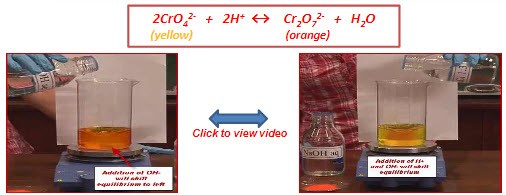
2CrO42- + 2H+ → Cr2O72- + H2O
What will happen when H+ ions are added to the system?
Position of equilibrium will shift to left and become more yellow
Color of system will turn all yellow
Color of system will turn all orange
Equilibrium will shift to right and become more orange
18
19
The Equilibrium Constant
The equilibrium constant, represented as Kc is a number that shows how far a chemical reaction goes before it stops changing and reaches a state of balance or equilibrium.
20
If Kc is much greater than 1: At equilibrium, there are a lot more products than reactants. The reaction strongly favors forward.
If Kc is much less than 1: This means that at equilibrium, there are a lot more reactants than products. The reaction favours reverse.
If Kc is around 1: This means that at equilibrium, the amounts of reactants and products are somewhat similar. Neither side is heavily favored.
21
22
23
Multiple Choice
The square brackets in a Kc expression represent ?
concentration
concentration in mol L-1
concentration in g L-1
the same as round brackets
24
Multiple Choice
Kc = ?
products / reactants
reactants /products
25
Multiple Choice
The Kc expression for the reaction 2NH3 ⇌ N2 + 3H2
26
Multiple Choice
What is the equation/reaction for this Kc expression?
O3 ⇌ 3O2
2O3 ⇌ 3O2
2O3 ⇌ O2
3O2 ⇌ 2O3
27
Multiple Choice
What is the reaction/equation for this Kc expression
2N2 + O2 ⇌ 2NO
N2 + O2 ⇌ NO
NO ⇌ 2NO
N2 + O2 ⇌ 2NO
28
Multiple Choice
reversible
irreversible
29
Multiple Choice
Chemical Equilibrium
Chemical Balance
Chemical Constant
Chemical Reaction
30
Multiple Choice
At what time does the reaction reach equilibrium?
t1
t2
t3
t4
31
Multiple Choice
W is a chemical reaction where the reactants form products and the products form reactants.
reversible reaction
nonreversible reaction
decomposition reaction
standard reaction
32
Multiple Choice
Identify the labels (a) and (b) on the graph.
a is the amount (concentration) of reactants and b is the concentration of products
a is the amount (concentration) of products and b is the concentration of reactants
a is the volume of reactants and b is the volume of products
a is the mass of reactants and b is the mass of products
Chemical Equilibrium
Show answer
Auto Play
Slide 1 / 32
SLIDE

Similar Resources on Wayground
28 questions
Lab Demo: Conservation of Mass
Presentation
•
9th - 12th Grade
28 questions
History of the Periodic Table
Presentation
•
10th - 12th Grade
27 questions
Day 1 of Solutions
Presentation
•
9th - 12th Grade
25 questions
Semicolons
Presentation
•
9th - 12th Grade
26 questions
Data Sampling
Presentation
•
9th - 12th Grade
26 questions
Preterite Tense AR Verbs
Presentation
•
9th - 12th Grade
26 questions
Characteristics of Quadratics
Presentation
•
9th - 12th Grade
26 questions
Half Life
Presentation
•
9th - 12th Grade
Popular Resources on Wayground
20 questions
"What is the question asking??" Grades 3-5
Quiz
•
1st - 5th Grade
20 questions
“What is the question asking??” Grades 6-8
Quiz
•
6th - 8th Grade
10 questions
Fire Safety Quiz
Quiz
•
12th Grade
20 questions
Equivalent Fractions
Quiz
•
3rd Grade
34 questions
STAAR Review 6th - 8th grade Reading Part 1
Quiz
•
6th - 8th Grade
20 questions
“What is the question asking??” English I-II
Quiz
•
9th - 12th Grade
20 questions
Main Idea and Details
Quiz
•
5th Grade
47 questions
8th Grade Reading STAAR Ultimate Review!
Quiz
•
8th Grade
Discover more resources for Chemistry
15 questions
Balancing and Reaction Types
Quiz
•
10th Grade
22 questions
Solubility Curve Practice
Quiz
•
10th Grade
16 questions
STAAR Review Quizziz 5
Quiz
•
10th Grade
20 questions
Types of Chemical Reactions
Quiz
•
9th - 12th Grade
5 questions
DOL REC: pH and pOH Calculations
Quiz
•
10th - 11th Grade
11 questions
Balancing Chemical Equations
Presentation
•
9th Grade
20 questions
Naming & Writing Chemical Formulas
Quiz
•
10th Grade
5 questions
DOL PreAP: pH and pOH Calculations
Quiz
•
10th Grade