
Exploring Narrative Structure and Writing Hooks

Presentation
•
English
•
9th Grade
•
Practice Problem
•
Easy
+10
Standards-aligned

Domonique Davis
Used 6+ times
FREE Resource
15 Slides • 4 Questions
1


Exploring
Narrative
Structure and
Writing Hooks
Unveiling the Elements of Plot and
Captivating Beginnings
2

Introduction
•Objective: To understand the
elements of plot structure and
learn effective hooks for
narrative essays.
•Importance: Mastering plot
structure and writing hooks
enhances storytelling skills and
engages readers from the
beginning.
3


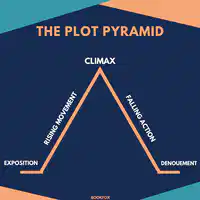
What is Plot
Structure?
•Definition: Plot structure is the
framework that outlines the
events in a story.
•Elements: Introduction, Rising
Action, Climax, Falling Action,
Resolution.
•Example: "The Hunger Games"
by Suzanne Collins.
4
Open Ended
Explain the importance of plot structure in storytelling. How does understanding plot structure enhance the reading experience?
5


Introduction
(Exposition)
•Introduces characters, setting,
and background information.
•Sets the stage for the story.
•Example: In "Harry Potter and
the Sorcerer's Stone," we meet
Harry, learn about his
background, and discover he's
a wizard.
6
Multiple Choice
What is the purpose of the introduction in a narrative story?
a) To resolve conflicts
b) To introduce characters and setting
c) To reach the climax
d) To tie up loose ends
7


Rising Action
Series of events that build tension and conflict.
Characters face challenges and obstacles.
Example: In "The Hobbit" by J.R.R. Tolkien, Bilbo Baggins encounters
trolls, goblins, and spiders as he journeys to reclaim treasure.
8

Climax
Turning point of the story.
The most intense moment where
the conflict reaches its peak.
Example: In "Romeo and Juliet" by
William Shakespeare, the climax
occurs when Romeo kills Tybalt,
leading to tragic consequences.
9

Falling Action
Events that occur after the climax.
Tension begins to decrease.
Example: In "The Lion King," Simba
defeats Scar and restores peace to the
Pride Lands.
10

Resolution
(Denouement)
The conclusion where loose ends are tied up.
Questions are answered, and conflicts
are resolved.
Example: In "The Giver" by Lois
Lowry, Jonas escapes the community
and finds a new way of life.
11
Open Ended
Reflect on a narrative we have read recently in class. How did the author use rising action to build tension and create conflict in the story?
12


Writing Hooks
Definition: A hook is a compelling opening that grabs the reader's
attention.
Types of Hooks: Question, Shocking Statement, Dialogue,
Description, Action.
Example: "It was a dark and stormy night..."
13

Question Hook
• Pose a thought-provoking question related
to your topic.
• Engages the reader's curiosity.
• Example: "What if you woke up one day and
realized you could time-travel?"
14


Shocking Statement Hook
Start with a surprising
fact or statement.
Captures the reader's
interest immediately.
Example: "Every year,
millions of plastic bottles
end up in the ocean,
threatening marine life."
15


Dialogue Hook
BEGIN WITH A CONVERSATION
BETWEEN CHARACTERS.
SETS THE TONE AND INTRODUCES
CONFLICT.
EXAMPLE: "‘I CAN'T BELIEVE YOU
DID THAT!’ SHE EXCLAIMED. ‘I HAD
NO CHOICE,’ HE WHISPERED."
16


Description Hook
PAINT A VIVID PICTURE WITH
DESCRIPTIVE LANGUAGE.
SETS THE SCENE AND DRAWS READERS
INTO THE NARRATIVE.
EXAMPLE: "THE SUN DIPPED BELOW
THE HORIZON, CASTING A FIERY GLOW
ACROSS THE ENDLESS DESERT."
17

Action Hook
Start with an exciting event or moment.
Immediately immerses the reader in the story.
Example: "The explosion echoed through the city streets,
sending shards of glass flying."
18
Open Ended
Your Task: Write a hook for your narrative essay, based on the prompt you chose using one of the techniques discussed.
19


Conclusion
Recap: We explored plot structure elements and
learned about writing hooks.
Encourage students to use these techniques in
their narrative writing to create engaging stories.
Exploring
Narrative
Structure and
Writing Hooks
Unveiling the Elements of Plot and
Captivating Beginnings
Show answer
Auto Play
Slide 1 / 19
SLIDE
Similar Resources on Wayground

14 questions
Author's Purpose
Presentation
•
9th Grade
14 questions
Present simple
Presentation
•
9th Grade
14 questions
Subject Verb Agreement
Presentation
•
9th Grade
13 questions
Capitalization
Presentation
•
9th Grade
13 questions
Infinitives/Infinitive Phrases
Presentation
•
9th Grade
12 questions
Commas
Presentation
•
9th Grade
13 questions
Participles
Presentation
•
9th - 10th Grade
12 questions
IRONY - Let's PRACTICE IT!
Presentation
•
8th - 9th Grade
Popular Resources on Wayground
6 questions
PRIDE Always and Everywhere
Presentation
•
12th Grade
20 questions
Lab Safety Quiz

Quiz
•
6th Grade
26 questions
KOR Review Kahoot Questions
Quiz
•
8th Grade
21 questions
Continents and Oceans
Quiz
•
6th Grade
12 questions
Unit Zero lesson 2 cafeteria
Presentation
•
9th - 12th Grade
20 questions
Parts of Speech
Quiz
•
5th Grade
10 questions
Riddles Riddles fun Riddles
Quiz
•
6th - 12th Grade
16 questions
Subject & Predicate
Quiz
•
5th Grade
Discover more resources for English
34 questions
Parts of Speech Review
Quiz
•
9th - 12th Grade
10 questions
Differentiating Primary and Secondary Sources in History

Interactive video
•
6th - 10th Grade
20 questions
Parts of Speech Review
Quiz
•
9th Grade
5 questions
9/4 RI 1 CCFU
Quiz
•
9th Grade
18 questions
"The Vietnam Wall" by Alberto Rios
Quiz
•
9th Grade
17 questions
Making Inferences
Quiz
•
8th - 9th Grade
20 questions
Denotation and Connotation Review
Quiz
•
7th - 9th Grade
20 questions
Compound Sentences
Quiz
•
9th Grade