Unit 5-5: Evolution & Genetics
Presentation
•
Science
•
12th Grade
•
Medium
+9
Standards-aligned
Abby Fancsali
Used 10+ times
FREE Resource
17 Slides • 24 Questions
1
Science Root of the Day:
DO NOW: Write what you think the example words mean in your lab manual.
Extra Credit: Find three additional words that use this root and write them and their definition in your lab manual (6 Points Max)
2
3
Evolution & Genetics
4
Multiple Choice
True or False? Before cells undergo meiosis they pass through interphase first.
true
false
5
Multiple Choice
In which stage of MEIOSIS does crossing over occur? (The exchange of genetic material between chromosomes)
Anaphase I
Metaphase I
Prophase I
Telophase I
6
Multiple Choice
Mendel also observed seed color in pea plants. In a study of several generations, yellow seeds appeared more frequently than green seeds. Which of the following is most likely the reason for this observation?
Green seeds are dominant to yellow seeds.
Yellow seeds are recessive to green seeds
Green seeds are recessive to yellow seeds.
Green Seeds are just rare random mutations in the population
7
Multiple Choice
Multiple Genes
8
Multiple Choice
9
Multiple Choice
10
Multiple Choice
11
Multiple Choice
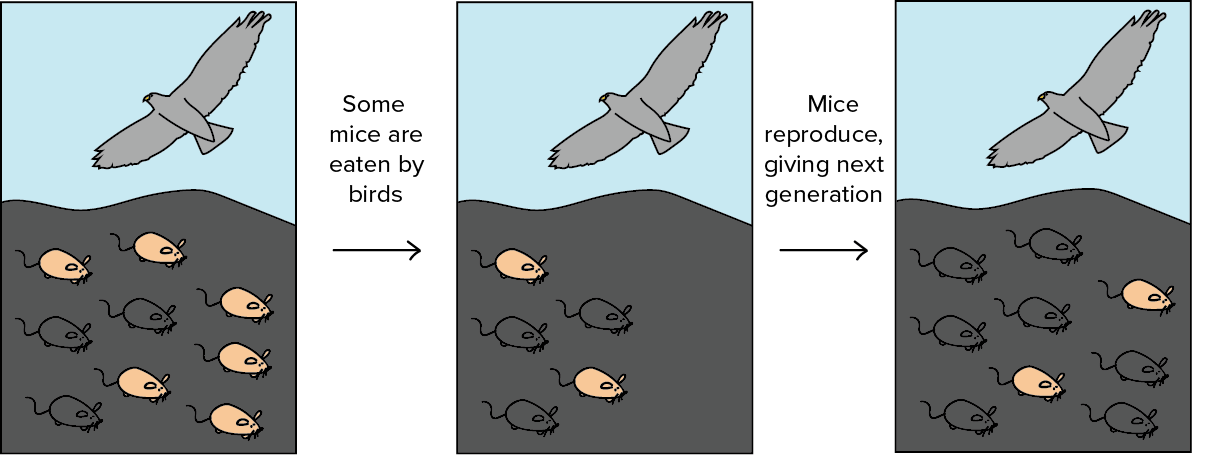
What most likely explains why the mouse population changing over time?
The light mice can reproduce more successfully than the dark mice
The hawks eat more dark mice than light mice because the dark mice taste better
The hawks eat more light mice than dark mice because they can see the light mice more easily
The hawks eat more dark mice than light mice because they can see the dark mice more easily
12
Multiple Choice
the best adapted
the fastest
the strongest
the most tame
13
Multiple Choice
This makes an organism more suited to its environment
species
lifespan
adaptation
mutation
14
Multiple Choice
Offspring with inherited advantageous traits leave more offspring than organisms with other traits, which causes these advantageous traits to become more common in a population over time. This describes...
Speciation
Genetic Drift
The inheritance of Acquired characteristics
Natural Selection
15
Lesson Objectives
Explain how an understanding of genetics produced insights into the mechanisms of evolution and the origin of genetic variation
Explain how new Species Form
16
Allele Frequencies
Natural selection acts on traits, but traits are not what are passed on to offspring
Alleles that produce the traits are what are passed
Evolution is described as Changes in the allele frequencies of genes over time
Allele Frequency: how common different alleles are in a population
17
Allele Frequencies and Natural Selection
Genetic Variation: Exists when there are multiple alleles
Natural Selection: An Allele that serves as an adaptation allows an individual with that allele to reproduce more frequently than other organisms
Evolution: As a result more copies of the advantages allele are passed to the next generation, which increases the allele frequency
Note: Natural selection acts on the phenotype, not the allele itself
18
Multiple Choice
True or False: Natural Selection acts on an individual's genes
True
False
19
Multiple Choice
What term describes how common different alleles are in a population?
chromosome rate
20
Mechanisms of Evolution
Natural Selection is the driving force of evolution, but not the only force
Several other factors play a role
Mutation Pressure
Genetic Drift
Gene Flow
21
Mutation Pressure
Mutation Pressure: The change in allele frequencies due to repeated occurrence of the same mutations
If the same mutation occurs over and over again, than the allele frequency will change in one directions
22
Genetic Drift
Genetic Drift: The evolution of populations due to random chance
Imagine two alleles in a population that are neither advantageous nor disadvantageous, so neither allele is selected for
Now suppose a storm occurs and randomly kills off individuals, but more individuals with the second allele die than the first
The allele frequency has changed, but not due to natural selection
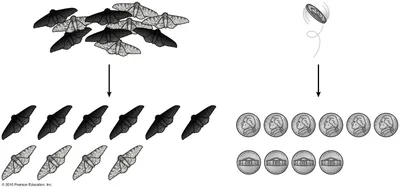
Genetic drift acts like a coin flip
sometimes a random chance forms a pattern
23
Gene Flow
A change in allele frequencies that result from a net movement of allels in or out of population
Caused by individuals leaving and entering the population
24
Where Genetic Variation Comes From
Natural selection requires genetic variation
More variation in a population makes it more likely to survive
Genetic Mutations constantly create new variations in a population
Sexual Reproduction brings alleles together in new combinations to
25
Multiple Choice
Genetic drift is change in the allele frequency of a population due to...
random chance
natural selection
non-random mating (sexual selection)
artificial selection
26
Multiple Choice
Mutations are important because they bring about...
death of the organism in which they develop
genetic variation needed for a population to evolve
benefits for the individual, not for the population
equilibrium within a population
27
Multiple Choice
Which of the following is NOT a mechanism of evolution?
Biogeography
Natural Selection
Gene Flow
Genetic drift
28
Multiple Choice
A group of polar bears migrates from the ice floes where they live to the nearby forest, where they interbreed with the brown bears there. This is an example of...
Genetic drift
Gene flow
Natural Selection
Founder Effect
29
Multiple Choice
Blue catfish are going extinct. A dam in a lake full of blue catfish bursts due to poor engineering and kills some of the blue catfish. This is an example of:
Natural Selection
Gene Flow
Mutation
Genetic Drift
30
Multiple Choice
Which of the following mechanisms of evolution consistently causes populations to become better adapted to environments?
Mutation Pressure
Gene flow
31
How Species Form
Species: A group of organisms whose members can breed with each other to create fertile offspring
Speciation: Formation of new species
Involve the evolution of reproductive barriers to prevent interbreeding
Two types
Prezygotic
Postzygotic
32
Prezygotic Barriers
Fertilization: The joining of an Egg Cell and a Sperm Cell to create a new individual
Prezygotic Barriers: Reproductive barriers that either prevent individuals from mating or fertilization from occurring when they do mate
Examples
Breeding seasons and Courtship Rituals may prevent two organisms from breeding with each other
Physical Anatomy
33
Postzygotic Barriers
Postzygotic Barriers: Reproductive barriers that occur after fertilization that prevent viable offspring from being produced
Offspring may be weaker/less fit than the parents
Offspring may be sterile
Examples:
Horse + Donkey = Mules
Lion + Tiger = Liger
34
Allopatric Speciation
It takes time and separation for reproductive barriers to evolve
Allopatric Speciation: New species are formed after a geographic barrier divides a single population into two isolated populations
Once Separated, natural selection & genetic drift slowly cause each population to evolve traits independently of one another
35
Adaptive Radiation
Adaptive Radiation: An example of allopatric speciation where many new species evolve from a single ancestor
Each new species is highly adapted to its environment
Example: Darwin's Finches
36
Sympatric Speciation
Sympatric Speciation: Occurs without geographic isolation
Less common than allopatric speciation
Often results from sudden chromosomal changes or hybridization
Hybridization: two different species interbreed and produce fertile offspring
Most common in plants
37
Multiple Choice
38
Multiple Choice
True or False: The offspring from a cross-species breeding being infertile is an example of a prezygotic barrier
True
False
39
Multiple Choice
After a long time in isolation, Island fruit flies and mainland fruit flies meet. They do not produce viable eggs due to genetic differences. The flies have resulted in two seperate lineages due to:
Gene Pool
Genetic Drift
Gene Frequency
Speciation
40
Multiple Choice
Sometimes many new species evolve from a single ancestor, each adapted to a distinct way of life. This is called...
Adaptive Radiation
Natural Selection
Hybridization
Sympatric Speciation
41
Open Ended
You are studying a population of beetles that has red and yellow beetles, and know that their color is an inherited trait. You count the number of red and yellow beetles in the population and notice that the number of red beetles is increasing and yellow beetles is decreasing. Name three reasons why this may be occurring.
Science Root of the Day:
DO NOW: Write what you think the example words mean in your lab manual.
Extra Credit: Find three additional words that use this root and write them and their definition in your lab manual (6 Points Max)
Show answer
Auto Play
Slide 1 / 41
SLIDE

Similar Resources on Wayground
33 questions
Chapter 6 Integumentary System
Presentation
•
11th - 12th Grade
35 questions
Muscle & Nervous Tissues
Presentation
•
12th Grade
34 questions
The Federal Reserve
Presentation
•
12th Grade
40 questions
Medical Terminology
Presentation
•
12th Grade
36 questions
01 - Aquatic Abiotic and Biotic Factors
Presentation
•
12th Grade
35 questions
Bernoulli's Principle (with answers)
Presentation
•
12th Grade
36 questions
M19.6 Sterile Compounding
Presentation
•
12th Grade
37 questions
Tragedy Notes
Presentation
•
12th Grade
Popular Resources on Wayground
20 questions
"What is the question asking??" Grades 3-5
Quiz
•
1st - 5th Grade
20 questions
“What is the question asking??” Grades 6-8
Quiz
•
6th - 8th Grade
10 questions
Fire Safety Quiz
Quiz
•
12th Grade
20 questions
Equivalent Fractions
Quiz
•
3rd Grade
34 questions
STAAR Review 6th - 8th grade Reading Part 1
Quiz
•
6th - 8th Grade
20 questions
“What is the question asking??” English I-II
Quiz
•
9th - 12th Grade
20 questions
Main Idea and Details
Quiz
•
5th Grade
47 questions
8th Grade Reading STAAR Ultimate Review!
Quiz
•
8th Grade
Discover more resources for Science
5 questions
Evolution (Darwin)
Interactive video
•
9th - 12th Grade
16 questions
Taxonomy and Classification
Quiz
•
6th - 12th Grade
15 questions
Explore Genetics with Punnett Squares and Pedigree Charts
Quiz
•
9th - 12th Grade
20 questions
4.1 Biology STAAR review
Quiz
•
9th - 12th Grade
17 questions
Understand Codominance and Incomplete Dominance
Quiz
•
9th - 12th Grade
28 questions
Biology STAAR Rapid Review
Quiz
•
9th - 12th Grade
19 questions
A&P Urinary System Review
Quiz
•
12th Grade
7 questions
Acids and Bases
Presentation
•
9th - 12th Grade