

U2M1L4 Reproduction of Organisms 4 - Plants

Presentation
•
Science
•
6th - 8th Grade
•
Medium
Standards-aligned

LaQualia Chatman
Used 6+ times
FREE Resource
11 Slides • 12 Questions
1


Reproduction of Organisms 4:
Reproduction and Growth of Plants
Learning Objectives:
Explore how plants
reproduce.
Describe factors that
affect probability of
successful reproduction
and growth.
2
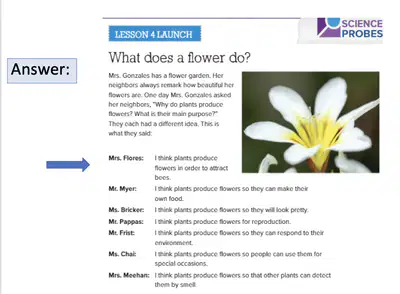
Draw
circle the person you agree with
3
4

Two types of Plant Reproduction
Plants can reproduce both sexually and asexually.
Asexual reproduction happens when part of the
plant develops into a new, separate plant.
Sexual reproduction happens when a male
reproductive cell (sperm) combines with a female
reproductive cell (egg). This produces a seed.
5


Seedless Plants
The first land plants were seedless and grew from
spores. The lightweight spores allow for easy
spreading in the wind. Seedless vascular plants
require water for sperm motility during reproduction
and, thus, are often found in moist environments.
Examples:
MOSS FERN
6

In flowering plants, the female
reproductive organ is the pistil, the
male reproductive organ is the
stamen
sexual
reproduction in
flowering plants
7

Seed Plants
There are two groups of seed plants:
• Non-flowering
In nonflowering plants, male and female cones
exist
• Flowering
Plants produce pollen grains which contain sperm.
They also female structures that contain eggs.
Pollination occurs when pollen grains land on
female structures of the same species. If the
pollen joins with an egg, fertilization happens, and
a seed develops.
8


pollination explained
9

Knowledge check
10
Draw
circle the correct answer
11

12

A tropism is a response that results in plant growth towards or away
from a stimulus.
The growth of a plant toward or away from light is phototropism. A
plant has a light sensing chemical that helps it detect light.
Thigmotropism is the response of a plant to touch. Example: vine
growing up a fence.
Gravitropism is the response of a plant to gravity. Stems grow away
from gravity; roots grow towards gravity.
Genetic factors also determine how a plant grows.
What factors affect Plant Growth?
Plant parts.mp4
13
Draw
circle correct answer
14


15
Multiple Choice
16
Multiple Choice
17
Multiple Choice

18
Multiple Choice
Jamie wanted to grow tomato plants. He placed five seeds in the soil and watered them. A few days later he noticed that the seeds were beginning to break open, and a plant was emerging. What process did Jamie most likely observe?
pollination
fertilization
germination
condensation
19
Multiple Choice

The drawing below shows a process that is important to plants. What is most likely happening?
The bee is bringing water to the plant.
The plant is being pollinated by the bee
The plant is getting nectar from the bee.
The bee is removing insects from the plant.
20
Multiple Choice
the female reproductive part of a flower
pistil
stamen
flowering
non-flowerin
21
Multiple Choice
the pollen producing part of a flower
pistil
stamen
flowering
non-flowering
22
Multiple Choice
Combining of egg and sperm
Asexual Reproduction
Sexual Reproduction
Diverse
Uniform
23
Multiple Choice
Involves only one parent
Asexual Reproduction
Sexual Reproduction
Diverse
Uniform
Reproduction of Organisms 4:
Reproduction and Growth of Plants
Learning Objectives:
Explore how plants
reproduce.
Describe factors that
affect probability of
successful reproduction
and growth.
Show answer
Auto Play
Slide 1 / 23
SLIDE
Similar Resources on Wayground

19 questions
Abiotic and Biotic Factors/ Components of an Ecosystem
Presentation
•
6th - 8th Grade
19 questions
The Metric System & Metric Conversions
Presentation
•
6th - 8th Grade
17 questions
Distance Time Graph Lesson
Presentation
•
6th - 8th Grade
20 questions
Bridge Types
Presentation
•
6th - 8th Grade
20 questions
Natural Resources
Presentation
•
6th - 8th Grade
20 questions
States of Matter Review
Presentation
•
3rd Grade
18 questions
Prefixes and Suffixes
Presentation
•
6th - 8th Grade
18 questions
Newton's Third Law
Presentation
•
6th - 8th Grade
Popular Resources on Wayground
20 questions
Math Review

Quiz
•
3rd Grade
15 questions
Fast food
Quiz
•
7th Grade
20 questions
Context Clues
Quiz
•
6th Grade
20 questions
Inferences
Quiz
•
4th Grade
19 questions
Classifying Quadrilaterals
Quiz
•
3rd Grade
20 questions
Figurative Language Review
Quiz
•
6th Grade
20 questions
Equivalent Fractions
Quiz
•
3rd Grade
10 questions
Identify Fractions, Mixed Numbers & Improper Fractions
Quiz
•
3rd - 4th Grade
Discover more resources for Science
16 questions
Interactions within Ecosystems
Presentation
•
6th - 8th Grade
26 questions
Amplify Chemical Reactions
Quiz
•
6th - 8th Grade
20 questions
Rocks and The Rock Cycle
Quiz
•
6th Grade
16 questions
Photosynthesis and Cellular Respiration Review
Quiz
•
7th Grade
15 questions
Punnett Squares
Quiz
•
6th Grade
20 questions
genetics, punnett squares, heredity
Quiz
•
7th Grade
18 questions
Oceans, Atmosphere, Climate Vocabulary Amplify
Quiz
•
6th Grade
49 questions
NC Released EOG 8 Science (2024)
Quiz
•
8th Grade