

Early Republic

Presentation
•
History
•
7th Grade
•
Practice Problem
•
Medium

Danny Neugent
Used 14+ times
FREE Resource
15 Slides • 11 Questions
1
2
3
https://www.flocabulary.com/unit/george-washington/
4
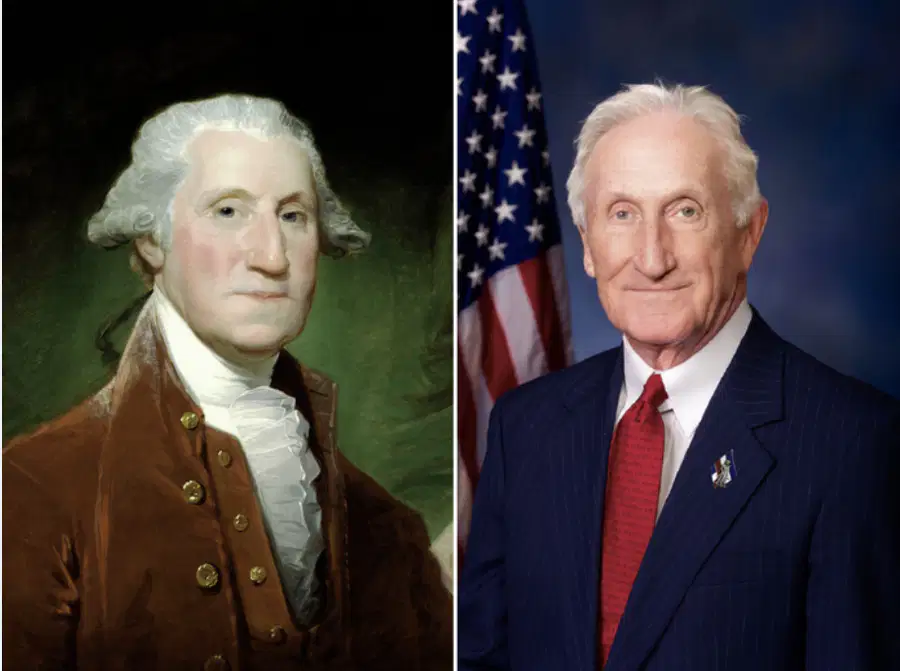
Washington's Innogeration began the "Early Republic" as we now call it.
The Early
Republic
5

The Constitution provided a framework for the new government of the United States.
It did not explain how the President should govern from day to day. "There is scarcely any part of my conduct," he said, "which may not hereafter be drawn into precedent."
In 1789, the first Congress created five executive departments.
They were the departments of...
- State - Treasury - War
- offices of Attorney General and Postmaster General
Heads of the Cabinet gave Washington advice and were responsible for directing their departments.
The two most influential Cabinet members were the Secretary of State, Thomas Jefferson, and the Secretary of the Treasury, Alexander Hamilton.
Unsure beginnings
6
Multiple Choice
George Washington was at a disadvantage because the Constitution did not provide
a framework for the new government.
information about the Supreme Court.
details about how the President should govern.
information about Congress.
7


8
Multiple Choice
Who was given the authority to set up a system of federal courts?
the Congress
the President
the Supreme Court
the state legislatures
9
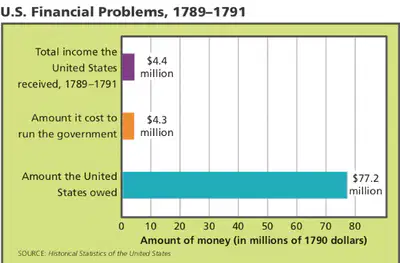

During the Revolution, both the national government and individual states borrowed heavily from foreign countries and ordinary citizens to pay soldiers and buy supplies.
Then, as now, governments borrowed money by issuing bonds. A bond is a certificate that promises to repay the money loaned, plus interest, on a certain date.
National Debt
Hamilton called for the government to repay both federal and state debts. He asked Congress to pass a tariff to pay for the government. Congress passed this tariff in 1789. Hamilton wanted the government to buy up all the bonds issued by both the national and state governments before 1789. He then planned to issue new bonds to pay off the old debts.
Hamilton's Plan
10
Multiple Choice
"To justify and preserve their confidence; to promote the encreasing [increasing] respectability of the American name; to answer the calls of justice; to restore landed property to its due value; to furnish new resources both to agriculture and commerce; to cement more closely the union of the states;... These are the great and invaluable ends to be secured for the support of public credit."
-Alexander Hamilton, "Report on Public Credit," January 9, 1790
Based on the quote above; What was Alexander Hamilton’s main reason for insisting that all the nation’s debts must be paid in full?
So the country could borrow in the future
so the country would be seen as a world leader
because many citizens needed the money
because the nation had a moral obligation to do so
11

To help reduce the national debt, Congress approved a tax on all liquor made and sold in the United States. Hamilton wanted this tax to raise money for the treasury. Instead, the new tax sparked a rebellion that tested the strength of the new government.
The new laws varied the tax rate and often left smaller liquor manufacturers paying more than larger ones. Furthermore, the tax had to be paid in cash. This was often difficult for farmers with small distilleries. Large liquor enterprises in the East had less trouble with the tax than those on the frontier or in small towns.
12
Multiple Choice
Who was most opposed to the tax on whiskey that Congress had imposed?
small states that were poor
southern farmers with a lot of money
farmers in the backcountry with small distilleries
large farmers with large distilleries
13

Many corn farmers made whiskey from their crops, because the alcohol was more profitable. They opposed this tax and refused to pay it. Some Pennsylvania farmers launched a violent protest, the Whiskey Rebellion. Washington sent militia to stop the rebellion, showing that such actions would not be tolerated.
Whiskey Rebellion
14
Open Ended

Frontiersmen tar and feather a government tax collector during the Whiskey Rebellion to protest a tax on liquor.
Classify and Categorize
How would you describe the behavior of the crowd in the picture?
15
16


In 1789, Americans supported the French Revolution, but by 1793, increasing violence in France caused division. France's attack on Austria led Britain to declare war. Despite being allies, if the U.S. allowed France to use American ports, there were concerns about British hostility. To maintain neutrality, Washington declared the United States would remain neutral.
Despite this, Britain and France seized American ships going to each other's ports. Washington sent John Jay to negotiate with Britain. The resulting treaty included the U.S. agreeing to pay debts to British merchants, and Britain agreeing to compensate for seized ships and withdraw troops from the Northwest Territory.
French Revolution impact on America
17
Word Cloud
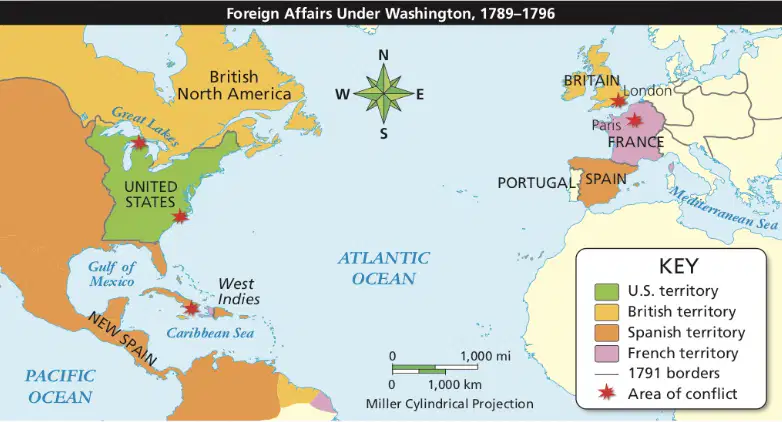
Paris was the site of the violent French Revolution.
The map also identifies places where the United States faced British hostility or outright aggression.
Draw Conclusions
Which nation--Britain or France appeared to pose a more serious threat to the United States?
18
Word Cloud
Location
Near what bodies of water did the United States face British aggression in America?
19
Open Ended
Analyze Diagrams
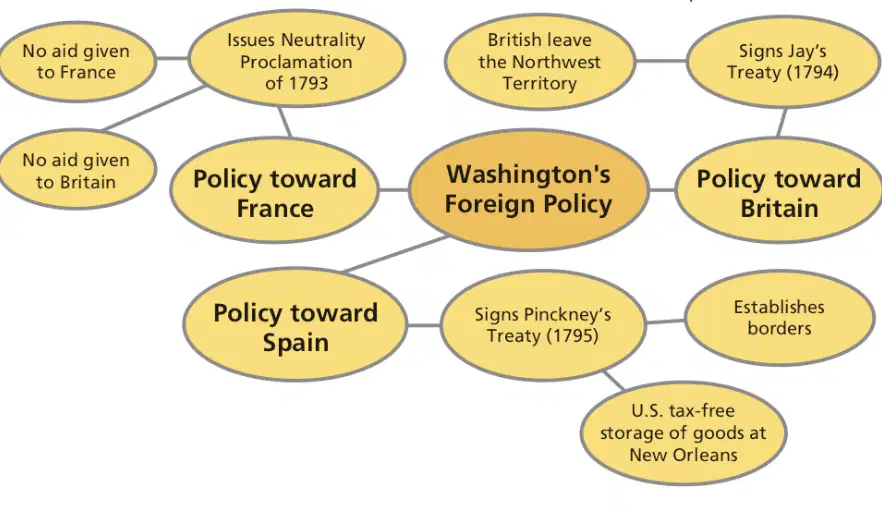
The information in the chart reflects Washington's foreign policy.
Identify Main Ideas
Based on the chart, how did Washington deal with European powers and how did his actions reflect his foreign policy preferences?
20
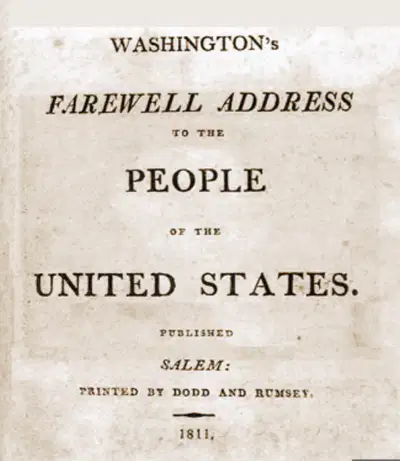
At the end of his second term, Washington wrote his Farewell Address where he;
advised Americans to avoid political divisions at home (i.e. political parties)
emphasized his belief that the United States must stay out of European affairs.
set a precedent for presidents to only sit in office for 2 terms
21
Multiple Choice
What was the impact of Washington’s Farewell Address?
It kept future Presidents from running for more than two terms.
It guided American foreign policy toward neutrality for quite some time.
It made the new nation realize how much Washington had given up to be President.
It made Congress determined that all Presidents would follow Washington’s example.
22
https://www.flocabulary.com/unit/jefferson-vs-hamilton/
23


Simply... DID NOT want a national bank
Jefferson
Simply... WANTED a national bank
Hamilton


24
Multiple Select
How did Jefferson’s views differ from Hamilton’s? Choose the TWO correct answers.
Jefferson wanted a smaller federal government.
Jefferson wanted close ties with Britain rather than France.
Jefferson opposed the Bank of the United States.
Jefferson supported policies that favored business leaders.
25
Open Ended
Compare and contrast the arguments of Hamilton and Jefferson regarding the Bank of the United States.
26
https://www.flocabulary.com/unit/war-of-1812/
Show answer
Auto Play
Slide 1 / 26
SLIDE
Similar Resources on Wayground

20 questions
7.28 Early Middle Ages - Monasteries
Presentation
•
7th Grade
19 questions
Da Vinci Part #1
Presentation
•
7th Grade
17 questions
The Hundred Years' War
Presentation
•
7th Grade
21 questions
TCI 9.6 The Amendment Process
Presentation
•
8th Grade
19 questions
Egyptian Hieroglyphics
Presentation
•
6th - 8th Grade
21 questions
Unit 6 - Jackson's Administration
Presentation
•
7th Grade
21 questions
Unit 8 - The California Gold Rush
Presentation
•
7th Grade
22 questions
Empire of Mali
Presentation
•
7th Grade
Popular Resources on Wayground
10 questions
Safety Day 2026 – Student Review

Quiz
•
9th Grade
21 questions
Continents and Oceans
Quiz
•
6th Grade
20 questions
Parts of Speech
Quiz
•
5th Grade
16 questions
Subject & Predicate
Quiz
•
5th Grade
25 questions
Multiplication Facts
Quiz
•
5th Grade
12 questions
Map Skills
Quiz
•
3rd Grade
22 questions
Continents and Oceans
Quiz
•
5th Grade
15 questions
Rounding Decimals
Quiz
•
5th Grade
Discover more resources for History
25 questions
The American Revolution
Quiz
•
7th - 10th Grade
30 questions
Foundations of Gov. Test Review
Quiz
•
7th Grade
15 questions
Ancient Rome
Quiz
•
7th - 10th Grade
16 questions
Students of Civics Unit 2: The Constitution
Quiz
•
7th - 11th Grade
14 questions
Lawmaking (CE.2b)
Quiz
•
7th Grade
10 questions
Exploring the 7 Principles of the Constitution

Interactive video
•
6th - 10th Grade
10 questions
Significance of the Declaration of Independence
Interactive video
•
6th - 10th Grade
20 questions
Quiz on Spanish and Mexican Colonization
Quiz
•
7th Grade