#7 MECHANISMS OF GENETICS
Presentation
•
Science
•
9th Grade
•
Easy
+17
Standards-aligned
Federica Ramos
Used 2+ times
FREE Resource
9 Slides • 22 Questions
1
Match
Match the following
Allele
Dominant
Genotype
Homozygous
Phenotype
letters represent characteristics (Pp)
trait that is expressed, capital letter
combo of alleles, usually 2 letters
having two identical alleles for a particular gene
appearance based on its genotype
letters represent characteristics (Pp)
trait that is expressed, capital letter
combo of alleles, usually 2 letters
having two identical alleles for a particular gene
appearance based on its genotype
2
Labeling
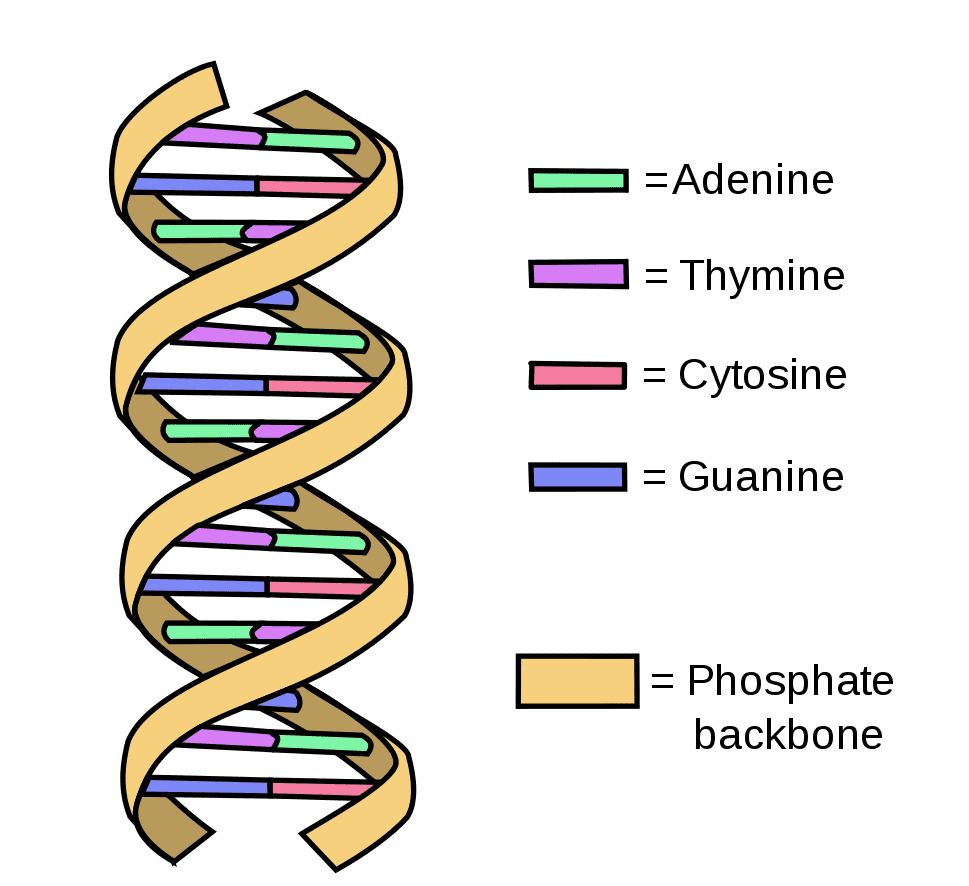
Label your DNA
Phosphate
Sugar
Nitrogenous Base
3
In Summary...
DNA
RNA
Sugar is deoxyribose
Sugar is ribose
Double stranded helix
Single stranded helix
Uses Adenine (A), Guanine (G), Cytosine
(C)... but also uses Thymine (T)
Uses Adenine (A), Guanine (G), Cytosine
(C)... but also uses Uracil (U)
Made via DNA synthesis
Made via transcription
Only 1 main type in a somatic (body)
cell’s nucleus
Has 3 main types (mRNA, tRNA, rRNA) in
a cell.
Sends out messages, tells your body
what to do
Transcribes and translates messages on
DNA’s behalf
4
Categorize
Double Stranded
Helix Structure
Deoxyribose Sugar
Thymine Base
Adenine Base
Guanine Base
Cytosine Base
Replication Process
Single Stranded
Uracil Base
Ribose Sugar
Messenger RNA
Transfer RNA
Ribosomal RNA
Transcription Process
Translation Process
5
6
Hotspot
List the step that is TRANSLATION.
Translation—process by which a protein is made from mRNA; tRNA matches
codons to amino acids which then join together to form a protein chain
7
Hotspot
List the step that is TRANSCRIPTION.
Transcription—process that copies DNA’s genetic information into messenger
RNA
8
Multiple Choice
What is the role of mRNA
Carry an amino acid to the ribosome
Copy the instructions from DNA and carry it out of the nucleus
Make up the ribosomes
9
Multiple Choice
Where does Transcription occur
Nucleus
Ribosome
ER
Mitochondria
10
Multiple Choice
What is the mRNA for the following DNA strand?
TAC GTA
GCT AGC
ATG CAT
AUG CAU
11
Fill in the Blanks
Transcribe the following DNA strand into its mRNA strand
TAC TGA GGA GTC
Type answer...
12
Fill in the Blanks
Transcribe the following DNA strand into its mRNA strand
TAC TGA GGA GTC
Type answer...
13
14
Multiple Choice
Phenylalanine
Tyrosine
Leucine
Stop codon
15
Multiple Choice
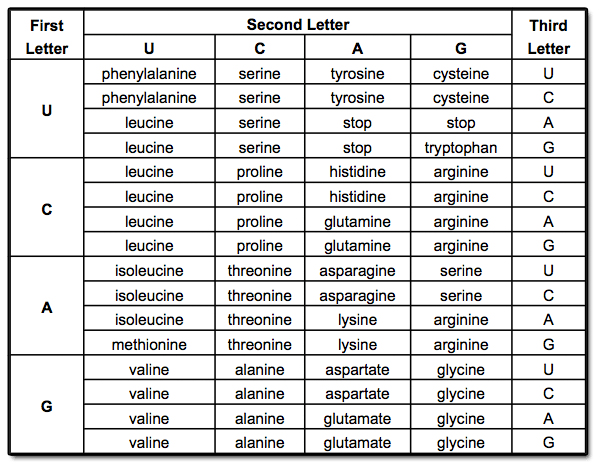
Use your CODON CHART to answer the following question.
What amino acid is codded for by the codon GCA?
serine
alanine
arginine
proline
16
Match
Match the following CODONs with its corresponding Amino Acid
GCA
AAC
AGC
GAA
CCC
Ala
Asn
Ser
Glu
Pro
Ala
Asn
Ser
Glu
Pro
17
Changes in the DNA sequence
These mutations can cause a change in the mRNA sequence, and ultimately may change the protein synthesis. Mutations in DNA can be harmful, beneficial, or neutral, and can be passed to offspring only if it is in a
gamete.
18
Multiple Choice
The mutated DNA segment is TTCGCAAG. This is an example of ___ mutation.
19
Multiple Choice
T-G-A-C-C-A
T-G-A-G-C-A
20
Multiple Choice
Mutation: ATC GCAT
What mutation occurred?
21
Punnett Square = a chart used to predict the genotype & phenotype of a trait in the offspring of two mates
22
Large letters are dominant and are written first
Small letters are recessive and are written second.
If both letters are present, the dominant trait will show in the phenotype.
Try not to use letters which look the same in capital and lowercase.
23
Homozygous Dominant = two large letters for a trait
Homozygous Recessive = two small letters for a trait
Heterozygous (carrier) = one large letter and one small letter for a trait
24
How to use it
Punnett Square
25
Multiple Choice
26
Multiple Choice
(Click the picture to see it without the text)
27
Multiple Choice
28
What is a dihybrid cross?
*A dihybrid cross is a cross among two
traits.
DI= TWO
HYBRID=
COMBINATION
Dihybrid Punnett squares are
prediction tools used to determine
probability for two traits.
Problem: Show the possible genetic
combinations among offspring of a man who
is heterozygous for both dimples and
freckles, and a woman who is recessive for
dimples and freckles.
FfDd x ffdd
29
Multiple Choice
30
Multiple Choice
31
Multiple Choice
What is the genotype for a pea plant homozygous for round seeds (R), and heterozygous for yellow seeds?
RrYy
RRyy
RRYy
rryy
Match the following
Allele
Dominant
Genotype
Homozygous
Phenotype
letters represent characteristics (Pp)
trait that is expressed, capital letter
combo of alleles, usually 2 letters
having two identical alleles for a particular gene
appearance based on its genotype
letters represent characteristics (Pp)
trait that is expressed, capital letter
combo of alleles, usually 2 letters
having two identical alleles for a particular gene
appearance based on its genotype
Show answer
Auto Play
Slide 1 / 31
MATCH

Similar Resources on Wayground
22 questions
Isotopes
Presentation
•
9th Grade
25 questions
Ecosystem Interaction Intro
Presentation
•
9th Grade
21 questions
Evolução
Presentation
•
9th Grade
21 questions
Photosynthesis
Presentation
•
9th Grade
24 questions
10.1-Cell Growth, Division, Reproduction
Presentation
•
9th Grade
21 questions
Ions and Oxidation #
Presentation
•
9th Grade
24 questions
Biotechnology Test Review
Presentation
•
9th Grade
22 questions
Mendelian Genetics
Presentation
•
9th Grade
Popular Resources on Wayground
10 questions
How much do you know about our Portrait of an Eagle?
Quiz
•
10th Grade
10 questions
Fast Food Slogans
Quiz
•
6th - 8th Grade
21 questions
Continents and Oceans
Quiz
•
6th Grade
20 questions
Parts of Speech
Quiz
•
5th Grade
16 questions
Subject & Predicate
Quiz
•
5th Grade
25 questions
Multiplication Facts
Quiz
•
5th Grade
12 questions
Map Skills
Quiz
•
3rd Grade
22 questions
Continents and Oceans
Quiz
•
5th Grade
Discover more resources for Science
10 questions
Exploring Chemical and Physical Changes
Interactive video
•
6th - 10th Grade
20 questions
Atomic Structure
Quiz
•
9th Grade
10 questions
Decoding the Periodic Table of Elements
Interactive video
•
6th - 10th Grade
10 questions
Exploring the Periodic Table
Interactive video
•
6th - 10th Grade
22 questions
Periodic Table Review
Quiz
•
9th - 12th Grade
20 questions
Observation vs. Inference
Quiz
•
7th - 9th Grade
10 questions
Exploring the States of Matter
Interactive video
•
6th - 10th Grade
10 questions
Exploring Physical and Chemical Changes
Interactive video
•
6th - 10th Grade