

Unit 7 Chapter 6

Presentation
•
English
•
3rd Grade
•
Practice Problem
•
Easy
+25
Standards-aligned

Jennifer Gibson
Used 4+ times
FREE Resource
8 Slides • 12 Questions
1

Chapter 6: Galaxies
pages 34-41
What’s In Our
Universe?
2
Poll
Asteroids are space rocks that orbit the sun.
TRUE
FALSE
3
Poll
Pieces of a meteor found on the ground are meteorites.
TRUE
FALSE
4

5
Multiple Choice
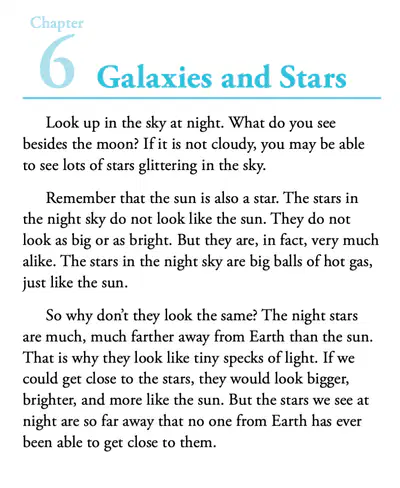
What is the same about the sun and the stars in the night sky?
They both shine brightly in the winter.
They are both big balls of hot gas.
They are both very large and are made of ice and dust.
6
Multiple Choice
Why do the night stars look different than the sun?
The night stars are much farther away from Earth than the sun.
Night stars reflect the moon, so shine more brightly than the sun.
Night stars are much larger than the sun, so appear brighter.
7

8
Fill in the Blanks
9
Multiple Choice
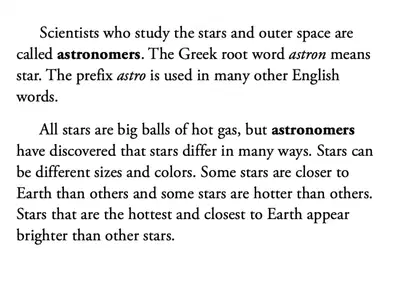
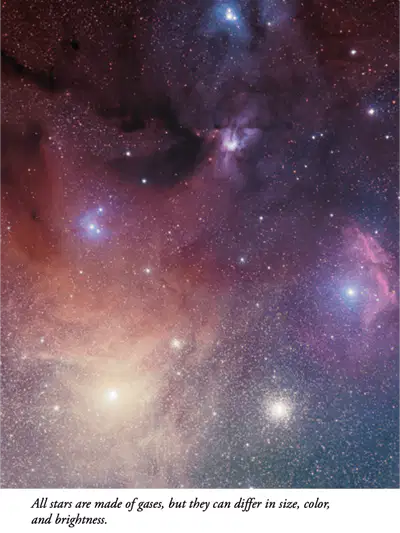
What is the main idea of page 36?
Some stars are very close to Earth.
Astronomers have discovered that stars are different in many ways.
Some stars are much hotter and larger than other stars.
10

11
Fill in the Blanks
12
13
Multiple Choice
Which word could replace cluster in the following sentence:
Astronomers also discovered that stars cluster together in large groups.
gather
spin
float
14
Multiple Choice
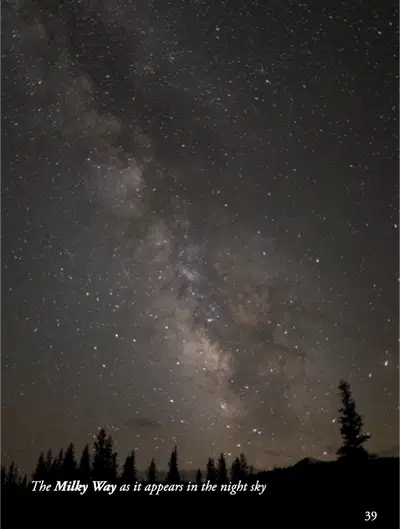
Which galaxy do our sun and solar system belong to?
Andromeda
United States
Milky Way
Southern Spiral
15

16
Multiple Choice
Why is the word billions used to describe stars and galaxies?
Billions is a very large number and there is a very large number of stars and galaxies in the universe.
Billions is a Greek word that means bright stars clustered together in the galaxy.
Billions means very bright and describes how the stars appear to people on Earth.
17

18
Poll
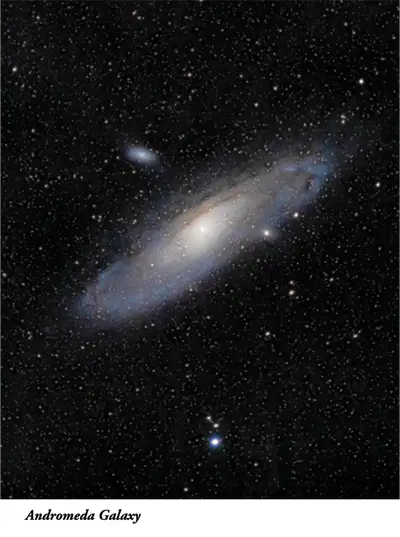
It is possible to see the Andromeda Galaxy at night.
TRUE
FALSE
19
Match
Match the following
Milky Way Galaxy
Billions
Astronomers
Galaxy
Stars
The galaxy that contains Earth
A very large number
Scientists who study stars
A large group of stars together
Big balls of hot gas
The galaxy that contains Earth
A very large number
Scientists who study stars
A large group of stars together
Big balls of hot gas
20

Chapter 6: Galaxies
pages 34-41
What’s In Our
Universe?
Show answer
Auto Play
Slide 1 / 20
SLIDE
Similar Resources on Wayground

15 questions
Possessive Nouns
Presentation
•
3rd Grade
14 questions
Subjects & Predicates
Presentation
•
3rd Grade
14 questions
Abstract Nouns
Presentation
•
3rd Grade
14 questions
Contractions
Presentation
•
3rd Grade
16 questions
Get Smart Plus 3 Module 8 Enrichment Was Were
Presentation
•
3rd Grade
15 questions
main idea review
Presentation
•
3rd Grade
15 questions
Reading Comprehension 4_Grade 2
Presentation
•
3rd Grade
15 questions
Intermediate 2 - part 4 - Slumdog Millionaire
Presentation
•
3rd Grade
Popular Resources on Wayground
15 questions
Grade 3 Simulation Assessment 1

Quiz
•
3rd Grade
22 questions
HCS Grade 4 Simulation Assessment_1 2526sy
Quiz
•
4th Grade
16 questions
Grade 3 Simulation Assessment 2
Quiz
•
3rd Grade
19 questions
HCS Grade 5 Simulation Assessment_1 2526sy
Quiz
•
5th Grade
17 questions
HCS Grade 4 Simulation Assessment_2 2526sy
Quiz
•
4th Grade
20 questions
Equivalent Fractions
Quiz
•
3rd Grade
24 questions
HCS Grade 5 Simulation Assessment_2 2526sy
Quiz
•
5th Grade
20 questions
Math Review
Quiz
•
3rd Grade
Discover more resources for English
12 questions
Figurative Language
Quiz
•
3rd Grade
20 questions
Main Idea
Quiz
•
3rd Grade
10 questions
Context Clues
Quiz
•
3rd Grade
20 questions
Find the Main Idea and Supporting Details
Quiz
•
3rd Grade
20 questions
Reading & Test Testing Strategies
Quiz
•
3rd - 5th Grade
20 questions
Prefix and Suffix Review
Quiz
•
3rd - 5th Grade
14 questions
Figurative Language Review
Quiz
•
3rd Grade
41 questions
Reading Practice - Comprehension
Quiz
•
3rd Grade