
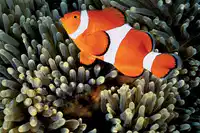
Bony Fish Lesson

Presentation
•
Science
•
9th - 12th Grade
•
Medium
+5
Standards-aligned

Kristin A Ambrose
Used 9+ times
FREE Resource
15 Slides • 14 Questions
1

This is a graded lesson. If you do not like your grade, take the lesson again.
2
Jawed fish with skeletons made of cartilage
Sharks
Rays
Guitarfish
Cartilaginous fish
Jawless fish
Hagfish
Lamprey
Agnatha
3
Bony fish
bony fish have skeletons made of bone
they are the largest group of living fish


4

operculum protects a bony fish’s gills
movements of operculum help bony fish move water over gills
Operculum
5
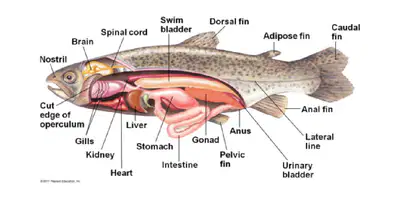
Bony fish have a swim bladder that helps them float higher or lower in the water.
Cartilaginous fish do not have these.
Swim bladder
6
Multiple Choice
The earliest fish in the oceans were:
sponges
corals
jawless fish
sharks
7
Multiple Select
Jawless fish include which of the following? Check all that apply:
moray eels
lampreys
hagfish
stingrays
8
Multiple Choice

Sharks, skates, and rays have bony skeletons.
True
False
9
Multiple Choice

96% of all fish are
agnatha
bony
cartilaginous
10
Multiple Choice
What part of the fish protects AND covers the gills?
Pectoral Fin
Operculum
Mouth
Gill filaments
11
Multiple Choice
In fish, what is the name of the organ that detects movement and vibrations in water?
Lateral Line
Vertical Line
Horizontal Line
Lateral Spine
12
Multiple Choice
What is the name of the internal structure that controls a bony fish's depth in the water?
Liver
Air Pocket
Lung Bladder
Swim Bladder
13

Ray-finned fish have fins supported by a fan-shaped array of bones.
embedded in a thin layer of skin and connective tissue
light, collapsible, and easy to move
14

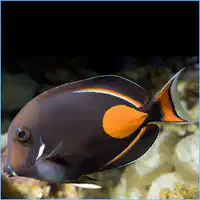
Family of tropical fish usually in coral reefs
The main characteristic of this group is the scalpels that are at the base of the tails. They can be erected and used to inflect pain onto other creatures.

15

They use their pectoral fins to walk on land.
They hold water in their gill chambers to breathe on land.
They dig burrows by scooping out mud with their mouths.
16
17

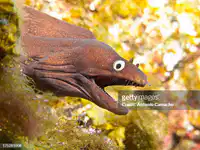
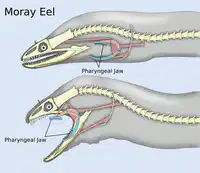
Morays live in crevices in coral reefs.
They average 5-6 ft long.
They have a second set of jaws (pharyngeal jaws) inside of their mouths to help swallow prey.
While known to have a nasty bite, they rarely attack unless provoked.

18

Female seahorses lay dozens, sometimes hundreds, of eggs inside a brood pouch of the male. Once the eggs hatch, the male pushes them out.
Seahorses offer no parental care, so babies have to be ready to survive on their own when born!


19
Multiple Choice
Which fish can walk on land?
tang
mudskipper
sea horse
sturgeon
20
Multiple Choice
A characteristic of tangs is
a scalpel on their tail
a pharyngeal jaw
a bony wrist
orange eyes
21
Multiple Choice
Seahorses use their pouches to protect their young.
true
false
22
Multiple Choice
Which fish has a pharyngeal jaw?
tangs
moray eels
seahorses
hagfish
23

Lobed-fins are round in shape with a solid bone inside
not as maneuverable as ray-fins
able to support weight
Lobe-Finned Fish
24

Last known fossils dated back to the Cretaceous period, so they were thought to be extinct
In 1938, 1 species was found alive of the coast of South Africa, a second species was found in 1990s
All fins “lobed” except 1st dorsal
Give birth to live babies
Found in the deep ocean in caves
Can not be eaten as their meat contains waste and wax
25
26
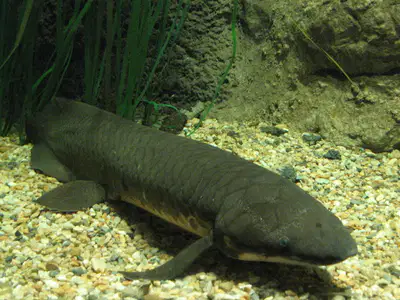
Only 6 species alive today
Not as easy to use as our lungs.
The fish do something similar to swallowing the air, but it goes into their lungs instead of their stomachs
In Africa, lungfish living in seasonally dry habitats burrow in mud.
Metabolism slows, breathe air 4 months until rain returns
Lungfish
27
Multiple Choice
Which fish was once thought to be extinct?
coelacanth
lungfish
birchir
mudskipper
28
Multiple Choice
Lungfish can survive without water up to
12 minutes
4 days
75 years
4 months
29
Match
Match the following
eating this fish will make you sick
this fish can survive without water
the male holds the eggs in a pouch
the bright colored tail warns of danger
coelacanth
lungfish
seahorse
tang
coelacanth
lungfish
seahorse
tang
This is a graded lesson. If you do not like your grade, take the lesson again.
Show answer
Auto Play
Slide 1 / 29
SLIDE
Similar Resources on Wayground

21 questions
Active Transport
Presentation
•
9th - 11th Grade
22 questions
Experimental vs. Observational Studies
Presentation
•
9th - 12th Grade
23 questions
Hydroelectric and Geothermal Energy
Presentation
•
9th - 12th Grade
20 questions
Fossil Fuels: Coal
Presentation
•
9th - 12th Grade
25 questions
Solar and Wind Energy
Presentation
•
9th - 12th Grade
24 questions
Acceleration, Velocity, Speed
Presentation
•
10th - 12th Grade
22 questions
Physical Properties of Sea water
Presentation
•
9th - 12th Grade
23 questions
Building Blocks of life- Biology
Presentation
•
8th - 12th Grade
Popular Resources on Wayground
10 questions
How much do you know about our Portrait of an Eagle?

Quiz
•
10th Grade
10 questions
Fast Food Slogans
Quiz
•
6th - 8th Grade
21 questions
Continents and Oceans
Quiz
•
6th Grade
20 questions
Parts of Speech
Quiz
•
5th Grade
16 questions
Subject & Predicate
Quiz
•
5th Grade
25 questions
Multiplication Facts
Quiz
•
5th Grade
12 questions
Map Skills
Quiz
•
3rd Grade
22 questions
Continents and Oceans
Quiz
•
5th Grade
Discover more resources for Science
10 questions
Exploring Chemical and Physical Changes

Interactive video
•
6th - 10th Grade
20 questions
Atomic Structure
Quiz
•
9th Grade
10 questions
Decoding the Periodic Table of Elements
Interactive video
•
6th - 10th Grade
10 questions
Exploring the Periodic Table
Interactive video
•
6th - 10th Grade
14 questions
Physical and Chemical Changes
Quiz
•
10th Grade
22 questions
Periodic Table Review
Quiz
•
9th - 12th Grade
20 questions
Observation vs. Inference
Quiz
•
7th - 9th Grade
14 questions
Periodic Trends
Interactive video
•
11th Grade