

Big Idea 1

Presentation
•
Other
•
12th Grade
•
Practice Problem
•
Hard

Amy Austin
FREE Resource
16 Slides • 0 Questions
1


AP CS Principles Exam Review
1
Big Idea 1:
Creative
Development
Exam
Weighting:
10% - 13%
Adapted from:
https://longbaonguyen.github.io/courses/apcsp/apprinciples.html
This work is licensed under a Creative Commons Attribution-NonCommercial-ShareAlike 4.0 International License.
With material from:
Reichelson, Seth. AP Computer Science Principles Premium with 6
Practice Tests (Barron's Test Prep). Barrons Educational Series.
2

Big Idea 1:
Creative
Development
2
3

Big Idea 1
A computing innovation includes a program as an integral part of its
function.
A computing innovation can be physical (e.g., self-driving car), nonphysical
computing software (e.g., picture editing software),or a nonphysical computing
concept (e.g., e-commerce).
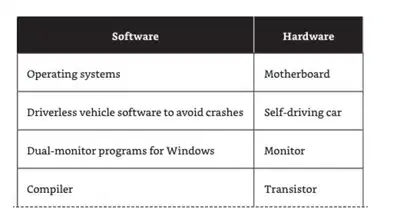
Hardware is the physical components of a computing device, while software is
the instructions in a programming language to the computing device. A
computing innovation can have hardware components. However, the computing
innovation is about the software, not the hardware.
3
4

Big Idea 1
Computing hardware has gotten smaller and more powerful over the years.
Moore’s law predicts that the size of transistors halves every two years while
the cost also halves every two years. Computers went from taking up 1,800
square feet and weighing almost 50 tons to being able to fit in your pocket.
4
5

Big Idea 1
Collaboration helps people learn from each other. Collaboration that
includes diverse perspectives helps to avoid bias in the development of
computing innovations.
For example, if females play video games at the same percentage as males, a
game company might not avoid bias if it employed males to write the code for
the games. Bringing in female coders could bring additional perspectives that
might not have been achieved otherwise.
Programming companies often hire people who not only are good
programmers but also have interpersonal skills needed to collaborate
effectively. Effective collaboration can help one gain insight and knowledge by
applying multiple perspectives, experiences, and skill sets.
5
6

Big Idea 1
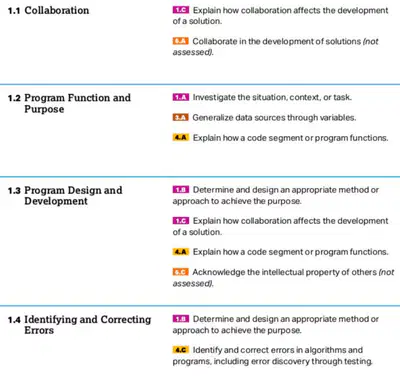
Collaboration is a learned skill. That skill includes but is not limited to:
■Communication
■Consensus building
■Conflict resolution
■Negotiation
Collaboration with others can make the programmer more self-aware.
Group programming can match up your weaknesses with someone else’s
strengths, which results in a better product and leads to insight and knowledge
not obtainable when working alone.
6
7

Big Idea 1
Collaboration is not limited by location. Current computing tools allow people
in different physical locations to share data.
Online collaboration tools, such as Google Docs, Zoom, Slack, Yammer,
and—by the time you read this—dozens of other tools, allow programmers to
collaborate from home or from anywhere that has internet access.
A program is a collection of program statements that performs a specific task
when run by a computer. A program is often referred to as software.
A code segment refers to a collection of program statements that are part
of a program.
7
8

Big Idea 1
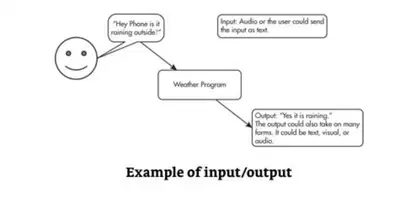
Program input is data sent to a computer for processing by a program. Input
can come in a variety of forms, such as tactile, audio, visual, or text. For
example, a cell phone can convert voice (audio) to text to send a message.
A weather program on your phone could take input in many forms.This
weather app was triggered by the user saying (audio) “Hey Phone…,” which
would be an example of audio input.
This triggering is called an event. The event is the action that supplies input
data to a program. Events can be generated when a key is pressed, a mouse is
clicked, a program is started, or by any other defined action that affects the
flow of execution.
8
9

Big Idea 1
Program outputs are any data sent from a program to a device. Program
output can come in a variety of forms, such as tactile, audio, visual, or text.
Program output is usually based on a program’s input or prior state (e.g.,
internal values).
9
10

Big Idea 1
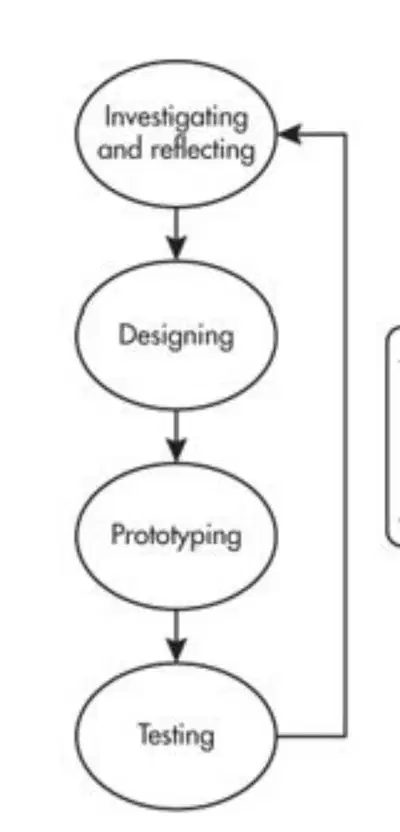
A development process can be ordered and intentional, or exploratory in
nature.
A development process that is incremental is one that
breaks the problem into smaller pieces and makes sure
each piece works before adding it to the whole.
A development process that is iterative requires refinement
and revision based on feedback, testing, or reflection
throughout the process. This may require revisiting earlier
phases of the process.
10
11

Big Idea 1
The design of a program incorporates investigations to determine its
requirements. Most programs are designed to be used by people other than
the programmers.
To meet the needs of the users, the investigation must identify the program
constraints as well as the concerns and interests of people who will use the
program.
Some ways investigations can be performed are as follows:
■Collecting data through surveys
■User testing
■Interviews
■Direct observations
11
12

Big Idea 1
The design phase of a program may include:
■Brainstorming
■Planning and storyboarding
■Organizing the program into modules and functional components
■Creating diagrams that represent the layouts of the user interface
■Developing a testing strategy for the program
Program documentation is a written description of the function of a code
segment, event, procedure, or program and how it was developed.
Program documentation helps in developing and maintaining correct programs
when working individually or in collaborative programming environments.
12
13

Big Idea 1
Programmers should document a program throughout its development.
Documentation helps the programmer remember what he or she was thinking
or the collaborative partners were thinking at the time they were
programming.
Comments are a form of program documentation written into the program
that do not affect how the program runs. Comments do not affect the run
speed of a program. Python, for example, uses # for comments.
13
14

Big Idea 1
Three types of program errors can occur:
■Logic error—This is a mistake in the algorithm or program that causes it to
behave incorrectly or unexpectedly. (incorrect implementation of algorithm)
■Syntax error—This is a mistake in the program where the rules of the
programming language are not followed. (missing parenthesis, incorrect
indentation, misspelling name of function calls)
■Runtime error—This is a mistake in the program that occurs during the
execution of a program. Programming languages define their own runtime
errors.(divide by 0, accessing out-of-bounds index of a list)
14
15

Big Idea 1
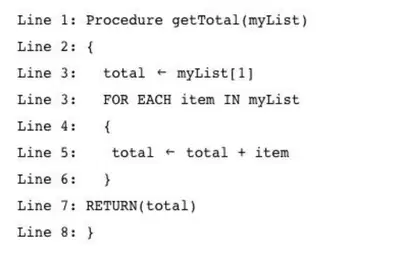
Read the code below. Assume that myList is a nonempty list of numbers.
Identify the error. What kind of error is it?
15
16
Big Idea 1
Read the code below. Assume that myList is a nonempty list of numbers.
Identify the error. What kind of error is it?
Logic Error. The code adds the first number twice in the sum.
15
AP CS Principles Exam Review
1
Big Idea 1:
Creative
Development
Exam
Weighting:
10% - 13%
Adapted from:
https://longbaonguyen.github.io/courses/apcsp/apprinciples.html
This work is licensed under a Creative Commons Attribution-NonCommercial-ShareAlike 4.0 International License.
With material from:
Reichelson, Seth. AP Computer Science Principles Premium with 6
Practice Tests (Barron's Test Prep). Barrons Educational Series.
Show answer
Auto Play
Slide 1 / 16
SLIDE
Similar Resources on Wayground

12 questions
What is Science?
Presentation
•
KG - 12th Grade
10 questions
READING COMPREHENSION
Presentation
•
12th Grade
10 questions
Második világháború
Presentation
•
12th Grade
11 questions
1-D Kinematics: Graphing Velocity
Presentation
•
12th Grade
10 questions
AP Macroeconomics game 1
Presentation
•
12th Grade
13 questions
ACCOUNTING
Presentation
•
University
12 questions
Introdução funções 1grau
Presentation
•
12th Grade
10 questions
El Nino and La Nina Notes
Presentation
•
12th Grade
Popular Resources on Wayground
15 questions
Grade 3 Simulation Assessment 1

Quiz
•
3rd Grade
22 questions
HCS Grade 4 Simulation Assessment_1 2526sy
Quiz
•
4th Grade
16 questions
Grade 3 Simulation Assessment 2
Quiz
•
3rd Grade
19 questions
HCS Grade 5 Simulation Assessment_1 2526sy
Quiz
•
5th Grade
17 questions
HCS Grade 4 Simulation Assessment_2 2526sy
Quiz
•
4th Grade
20 questions
Equivalent Fractions
Quiz
•
3rd Grade
24 questions
HCS Grade 5 Simulation Assessment_2 2526sy
Quiz
•
5th Grade
20 questions
Math Review
Quiz
•
3rd Grade
Discover more resources for Other
20 questions
Earth Day Trivia
Quiz
•
9th - 12th Grade
10 questions
Earth Day Awareness and Impact

Interactive video
•
6th - 12th Grade
5 questions
A.F/ST Quizizz Day 1
Quiz
•
9th - 12th Grade
100 questions
Biology EOC Review
Quiz
•
9th - 12th Grade
20 questions
Earth Day
Quiz
•
3rd - 12th Grade
16 questions
AP Biology: Unit 1 Review (CED)
Quiz
•
9th - 12th Grade
5 questions
G.PC/DF Quizizz Day 2
Quiz
•
9th - 12th Grade
20 questions
verbos reflexivos en español
Quiz
•
9th - 12th Grade