

Air Distribution Systems

Presentation
•
Fun
•
KG
•
Practice Problem
•
Medium

Matthew Welsh
Used 10+ times
FREE Resource
46 Slides • 6 Questions
1


Air Distribution Systems
2


Module 03109 – Air Distribution Systems
• Supply the right quantity of air to each conditioned
space to offset the heating or cooling load.
• Supply the air to each space in a manner such that
air movement doesn’t cause discomfort.
• Provide for the conditioning of air from all areas
served by the air handling unit.
• Operate efficiently without excessive power
consumption or noise.
• Operate with minimum maintenance.
1.0.0 – Objectives of Air Distribution
3
Air Movement and Air Measurement
An HVAC system performs no better than its air distribution system. Understanding air distribution is essential to evaluating system performance. An adequate air distribution system must do all of the following.
• Supply the right volume of air to each conditioned space.
• Provide air to each space without causing discomfort.
• Operate efficiently without noise.
• Require minimum maintenance.
4
Air Movement and Air Measurement
Air distribution systems are forced-air systems. Natural air movement cannot provide the momentum required for a proper quantity of conditioned air to travel through a series of ducts to conditioned areas. The major components that make up a forced-air system are as follows
•An air handling unit (AHU) or fan coil unit (FCU)
•An air distribution system for conditioned air
•An air distribution system for return air
•Grilles and registers to distribute conditioned air and collect return air
5
6
Multiple Choice

What is the main purpose of chillers?
Generate electricity
Generate Solar Power
Generate chilled or cold water for air conditioning
Generate Hot Water
7
Multiple Choice

What is the main purpose of AHUs?
Generate Electricity
Distribute Air around the building
Provide Heating for the building
Generate Chilled Water
8
Multiple Choice

What differentiates RTUs from AHUs?
Whether they have their own cooling system
The size of the unit
The type of refrigerant used
The location of the Unit
9
Labeling
Label the Air Distribution Components
Air Handler Unit AHU
Chiller
Fan Coil Unit FCU
Cooling Tower
Roof Top Unit RTU
Air Cooled Chiller
10


Module 03109 – Air Distribution Systems
More supply and return grilles are certainly common.
The construction of the interconnecting ducts varies,
as well as the air-moving equipment and the terminal
devices used.
1.0.0 – Simplified Residential System
11


12
Module 03109 – Air Distribution Systems
Looking at the simplified Residential System Talk with you neighbor and describe if this system is forced air or natural.
1.0.0 – Simplified Residential System
13


Module 03109 – Air Distribution Systems
All are variations of the same equation. Each of the
values can be determined if the other two are known
or measured.
1.1.0 – Calculations Related to Air Movement
14
Three Things to Know to Measure air flow.
Volume Flow Rate -- CFM
Duct Area -- Square Feet
Velocity -- Feet per Minute
15
Volume Flow Rate
We measure the volume of air in cubic feet per minute. The volume flow rate is the duct area x velocity of air.
16


17
What is the volume flow rate of 1.66 Sq Ft Duct and a velocity of 900 feet per minute.
Volume flow rate (cfm) = Duct Sq Ft X Velocity (fpm)
18
Duct Area
We measure duct area in square feet
For example 14 inch duct would be converted to feet by dividing 14 by 12.
1.66 ft
19
20
Duct Area
Convert a 12 inch x 15 inch duct to square feet.
21
Velocity
We measure Velocity by Volume flow Rate divided by the duct area in square feet.
22
Math Response
Calculate the Square Ft of a Duct that is 15 inches x 19 inches.
23
Math Response
Given a velocity of 900 fpm and your previous answer what is the volume flow rate of the supply air?
24


Module 03109 – Air Distribution Systems
Friction loss is caused by all items and areas that
cause the air to change direction or become turbulent.
That includes objects such as grilles and registers, and
even the walls of the duct.
1.1.0 – Areas of Greatest Friction Loss
25


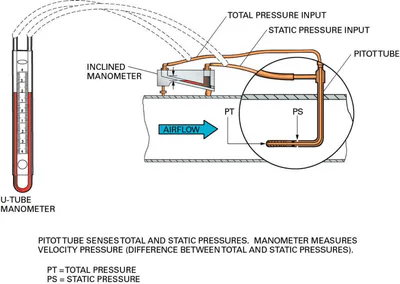
Module 03109 – Air Distribution Systems
1.1.0 – Measuring Duct Pressure (1 of 2)
26


Module 03109 – Air Distribution Systems
Total pressure equals static pressure plus velocity
pressure
Static pressure equals total pressure minus velocity
pressure
Velocity pressure equals total pressure minus
velocity pressure
1.1.0 – Measuring Duct Pressure (2 of 2)
27


Module 03109 – Air Distribution Systems
1.1.1 – Absolute, Gauge, and Barometric
Pressure Scales (1 of 2)
28


Module 03109 – Air Distribution Systems
• Gauge pressures can be converted to absolute
pressures by adding 14.7 to the gauge pressure
value.
• Absolute pressures can be converted to gauge
pressures by subtracting 14.7.
• Negative pressures (those below 0 psig) are
expressed in inches of mercury vacuum (in. Hg
vacuum).
1.1.1 – Absolute, Gauge, and Barometric
Pressure Scales (2 of 2)
29


Module 03109 – Air Distribution Systems
1.2.0 – Single-Story Home System
30


Module 03109 – Air Distribution Systems
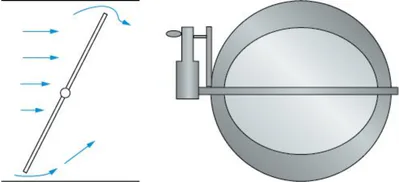
• Dampers provide a means to reduce airflow in branch or
trunk lines.
• They also increase static pressure as they are moved
towards closed. Even an open damper in the airstream
causes a slight pressure loss.
1.2.0 – Balancing Dampers
31


Module 03109 – Air Distribution Systems
• Thermistor or
thermocouple probes.
• Some have two or more
probes to monitor
multiple points and the
differential between two
of them.
• Some digital
multimeters can be
converted into digital
thermometers with the
right accessories.
1.3.1 – Electronic (Digital) Thermometers
32


Module 03109 – Air Distribution Systems
Evaporation from the wick cools the bulb, delivering a
wet-bulb temperature. The other thermometer bulb is dry.
1.3.1 – Sling Psychrometer
33


Module 03109 – Air Distribution Systems
The electronic
psychrometer serves as
both a psychrometer and
a hygrometer.
1.3.1 – Electronic Psychrometer
34


Module 03109 – Air Distribution Systems
Inclined and
vertical-inclined
manometers must be level
for accuracy. One port is
connected to the duct, while
the other remains open to
atmosphere. If both ports
are connected to different
points, the difference in
pressure between the two
will be measured.
1.3.2 – Monometers
35


Module 03109 – Air Distribution Systems
This type of gauge can also be used to measure low
pressures as well as differential pressures across filter
banks, coils, and similar components in the airstream.
1.3.2 – Differential Pressure Gauge
36


Module 03109 – Air Distribution Systems
Velometers generally read velocity directly. Digital
models may also be able to calculate air volume if the
duct dimensions are entered.
1.3.3 – Velometers
37


Module 03109 – Air Distribution Systems
Rotating-vane
anemometers can
also read velocity
directly. You can see
that inserting the vane
assembly through a
small opening in the
duct is not practical;
they are primarily
used for open-air
measurements.
1.3.3 – Rotating Vane Anemometer
38


Module 03109 – Air Distribution Systems
Hot-wire
anemometers are
typically used to
accurately measure
very low velocities,
such as the draft
under a closed door.
1.3.3 – Hot-Wire Anemometer
39


Module 03109 – Air Distribution Systems
This digital model can
measure rotational speed
by making contact with
the end of a rotating shaft,
or by using its built-in
optics. A reflective tape is
applied to a rotating
pulley (for example), and
the tachometer
determines the rpm by
counting how many times
it reflects the beam back
to the instrument.
1.3.4 – Tachometers
40


Module 03109 – Air Distribution Systems
1. Multiplying the cross-sectional area of a duct
by the air velocity is used to calculate _____.
a.
static pressure
b.
velocity pressure
c.
air volume
d.
air density
1.0.0 Section Review – Question 1
41


Module 03109 – Air Distribution Systems
1. Multiplying the cross-sectional area of a duct
by the air velocity is used to calculate _____.
a.
static pressure
b.
velocity pressure
c.
air volume
d.
air density
1.0.0 Section Review – Question 1 (Answer)
42


Module 03109 – Air Distribution Systems
2.
The supply-air grilles in a residential system
are often placed around the perimeter of the
structure because ____.
a.
they are easier to install there
b.
the perimeter is where most of the heat
gain or loss occurs
c.
the return-air grilles are also located there
d.
it allows the air distribution ducts to be
shorter in length
1.0.0 Section Review – Question 2
43


Module 03109 – Air Distribution Systems
2.
The supply-air grilles in a residential system
are often placed around the perimeter of the
structure because ____.
a.
they are easier to install there
b.
the perimeter is where most of the heat
gain or loss occurs
c.
the return-air grilles are also located there
d.
it allows the air distribution ducts to be
shorter in length
1.0.0 Section Review – Question 2 (Answer)
44


Module 03109 – Air Distribution Systems
3. A manometer is used to measure _____.
a. pressure
b. velocity
c. dry-bulb temperature
d. relative humidity
1.0.0 Section Review – Question 3
45


Module 03109 – Air Distribution Systems
3. A manometer is used to measure _____.
a. pressure
b. velocity
c. dry-bulb temperature
d. relative humidity
1.0.0 Section Review – Question 3 (Answer)
46


Module 03109 – Air Distribution Systems
Blower door
An assembly containing a fan used to depressurize a
building by drawing air out, to support duct leak
testing. It is usually installed temporarily in place of an
outside door.
Cubic feet per minute (cfm)
A unit for the volume of air flowing past a point in one
minute. Cubic feet per minute can be calculated by
multiplying the velocity of air, in feet per minute (fpm),
times the area it is moving through, in square feet (cfm
= fpm x area). The metric value is cubic meters per
hour (m3/h).
Wrap Up – Trade Terms (1 of 7)
47


Module 03109 – Air Distribution Systems
Dew point
The temperature at which air becomes saturated with
water vapor, and the water starts to condense into
droplets; a state of 100 percent relative humidity.
Dry-bulb temperature
The temperature measured using a standard
thermometer. It represents the measure of sensible
heat present.
Wrap Up – Trade Terms (2 of 7)
48


Module 03109 – Air Distribution Systems
External static pressure (ESP)
The total resistance of all objects and ductwork in the
air distribution system beyond the blower assembly
itself.
Pitot tube
A tool used to capture pressure measurements in a
moving air stream.
Psychrometric chart
A graphic method of showing the relationship of
various air properties.
Wrap Up – Trade Terms (3 of 7)
49


Module 03109 – Air Distribution Systems
Relative humidity (RH)
The ratio of the amount of moisture present in a given
sample of air to the amount it can hold at saturation.
Relative humidity is expressed as a percentage.
Revolutions per minute (rpm)
The number of rotations made by a spinning object
over the course of one minute.
Wrap Up – Trade Terms (4 of 7)
50


Module 03109 – Air Distribution Systems
Static pressure (s.p.)
The pressure exerted uniformly in all directions within
a duct system, usually measured in inches of water
column (in. w.c.) or centimeters of water column (cm
H2O).
Total pressure
The sum of the static pressure and the velocity
pressure in an air duct.
Wrap Up – Trade Terms (5 of 7)
51


Module 03109 – Air Distribution Systems
Velocity
The speed at which air is moving. The rate of airflow
usually measured in feet per minute.
Velocity pressure
The pressure in a duct due to the linear movement of
the air. It is the difference between the total pressure
and the static pressure.
Wrap Up – Trade Terms (6 of 7)
52


Module 03109 – Air Distribution Systems
Wet-bulb temperature
Temperature taken with a thermometer that has a wick
wrapped around its sensing bulb, saturated with
distilled water before taking a reading. The reading
from a wet-bulb thermometer, through evaporation of
the water, takes into account the moisture content of
the air. It reflects the total heat content (sensible and
latent) of the air.
Wrap Up – Trade Terms (7 of 7)
Air Distribution Systems
Show answer
Auto Play
Slide 1 / 52
SLIDE
Similar Resources on Wayground

48 questions
Subject Pronouns, Ser, and Adjectives
Presentation
•
6th - 12th Grade
43 questions
El imperfecto
Presentation
•
10th Grade
43 questions
Day 2 2026 Semester 2
Presentation
•
9th - 12th Grade
47 questions
Introduction to World Religions
Presentation
•
6th Grade
47 questions
LT 5 HR Diagram Synchronous
Presentation
•
8th Grade
47 questions
Invertebrates
Presentation
•
6th - 8th Grade
47 questions
Population Ecology
Presentation
•
8th - 10th Grade
47 questions
TA 5 - Unit 6 - How many lessons do you have today?
Presentation
•
5th Grade
Popular Resources on Wayground
10 questions
Safety Day 2026 – Student Review

Quiz
•
9th Grade
21 questions
Continents and Oceans
Quiz
•
6th Grade
20 questions
Parts of Speech
Quiz
•
5th Grade
16 questions
Subject & Predicate
Quiz
•
5th Grade
25 questions
Multiplication Facts
Quiz
•
5th Grade
12 questions
Map Skills
Quiz
•
3rd Grade
22 questions
Continents and Oceans
Quiz
•
5th Grade
15 questions
Rounding Decimals
Quiz
•
5th Grade