

Unit 6 Part 1: Minerals & Rocks

Presentation
•
Science
•
9th - 12th Grade
•
Practice Problem
•
Medium
+12
Standards-aligned

Abby Fancsali
Used 2+ times
FREE Resource
19 Slides • 13 Questions
1
2

Explain what a mineral is
Describe how minerals form
Identify types of rock
Explain and identify the stages of the rock cycle
3
What are Minerals?
There are over 4000 different types of minerals, with many more being discovered each year
Are used in almost everything from glass to electronics
Mineral: A naturally occurring inorganic solid with a crystalline structure and definite chemical composition
4
Occur in Nature
All minerals have to be formed naturally, and not in a lab using synthetic materials
Are formed by processes
In the Earth
On the surface of the Earth
Within organisms

5
Be Chemically Inorganic
All minerals are inorganic
they do not have carbon-carbon bonds or carbon-hydrogen bonds

6
Solids With Crystilline Solids
Minerals are solids at room temperature
Crystalline structure: atoms in a compound are arranged in an orderly and repeating pattern
The Structure of each mineral is unique

7
Definite Chemical Composition
Most minerals are compounds made of two or more elements.
Some minerals only have one element
Minerals with multiple elements always have the same proportion of elements
Quartz=SiO2
8
Properties of Minerals
Properties of minerals can vary greatly

9
Multiple Choice

All Minerals...
Have a hardness level of 10
Have Cleavage
Have the Same Crystal Form
are inorganic Solids
10
Multiple Choice
______ is the way a mineral reflects light from its surface.
Luster
Streak
Hardness
Color
11
Multiple Choice
What property describes the powder that a mineral leaves behind?
Color
Cleavage
Luster
Streak
12
Drag and Drop
13
Multiple Choice
A naturally formed, inorganic solid with a crystalline structure
Density
Streak
Mineral
Non silicate mineral
14
Multiple Choice
15
Mineral Formation
Minerals can form nearly everywhere
In General, there are four ways that minerals can form

16
Crystallization From Magma or Lava
Magma: The molten mixture of substances that forms within the Earth
Lava: Magma that comes to the Earth's Surface
As magma and lava cool and harden, crystallization occurs
The size of crystals can be affected by many factors
Slower cooling yields larger crystals
Lava cools faster and forms small crystals

17
Precipitation
Precipitation: When the liquids in a solution evaporate and the remaining solids crystallize
Below the Earth's Surface, magma heats water and dissolved substances to cause them to precipitate
Often occurs in narrow channels called veins
18
Pressure and Temperature
Under great pressure, atoms in a mineral can rearrange
Polymorphs: minerals that have the same elements and compounds in them, but arranged in a different structure
Example: Carbon and diamond are both made of carbon, but it is different arrangements due to being compressed at different temperatures and pressures

19
Produced by Organisms
Some organisms form inorganic minerals that produce hard structures that provide support
Examples: Calcium Carbonate in shells, Calcium Phosphate in bones

20
Multiple Choice
What is the terms for minerals have the same elements and compounds in them, but arranged in a different structure
Geomorphs
21
Multiple Choice
22
Drag and Drop
23
Rocks
Rock: A solid mass of Minerals and mineral-like substances that naturally occur
Can be made of one type of mineral or many different types of minerals
Most rocks undergone changes, but they take long periods of time
Rock Cycle: a process in which rocks are heated, melted, cooled, weathered, and eroded as they slowly change between three different types of rock
24
Igneous Rock
Rocks that form as magma cools and solidifies
Intrusive igneous rock cools below the Earth's surface
The most common type is Granite
Extrusive Igneous rock cools on the Earth's Surface
The most common type is Basalt
25
Sedimentary Rock-Clastic Types
Rocks on the surface are subjected to erosion
As particles are broken off, they settle in a location and can build up on each other
As they build up, the sediments put pressure on each other until they compact each other
Over time, minerals seep in between the particles and bind them together
Clastic Sedimentary Rock is composed of broken pieces of older weathered and eroded rocks
26
Sedimentary Rock-Chemical
When water evaporates, it leaves behind minerals as well as other materials
Both can crystallize and form chemical sedimentary rocks
27
Sedimentary Rock-Biochemical
Dead coral and shells can bond together to form a biochemical sedimentary rock

28
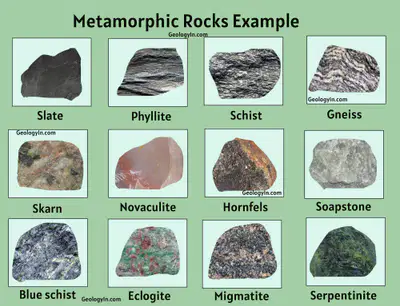
Metamorphic Rock
Metamorphic rock forms when a rock is exposed to heat and pressure lower than rock's melting point, but high enough to rearrange crystals within a rock.
Mainly occurs a few kilometers below the Earth's Surface
Pressure can decrease the space between the minerals
Examples: Marble and Soap Stone
29
Multiple Choice
Which type of Rock forms when layers of weathered materials are pressed together over time?
Igneous
Sedimentary
Metamorphic
30
Multiple Choice

Rocks that are formed from magma or lava are called
sedimentary
metamorphic
igneous
clastic
31
Multiple Choice

Of the three kinds of sedimentary rocks, a rock that is made up of fragments of older rocks is called
Clastic sedimentary rock
Organic sedimentary rock
Chemical sedimentary rock
32
Multiple Choice
Granite is an example of extrusive igneous rock because it cooled beneath Earth's surface
True
False
Show answer
Auto Play
Slide 1 / 32
SLIDE
Similar Resources on Wayground

25 questions
Newtons 3 laws
Presentation
•
KG - University
24 questions
Unit 5 - Gas Laws
Presentation
•
9th - 12th Grade
27 questions
DNA RNA
Presentation
•
9th - 12th Grade
27 questions
Evidence of Evolution Notes
Presentation
•
9th - 12th Grade
25 questions
Photosynthesis
Presentation
•
9th - 11th Grade
24 questions
Free fall
Presentation
•
10th - 12th Grade
26 questions
Gas Laws
Presentation
•
9th - 12th Grade
24 questions
1C Unit 9.1 - Distance and Displacement
Presentation
•
8th - 12th Grade
Popular Resources on Wayground
10 questions
How much do you know about our Portrait of an Eagle?

Quiz
•
10th Grade
10 questions
Fast Food Slogans
Quiz
•
6th - 8th Grade
21 questions
Continents and Oceans
Quiz
•
6th Grade
20 questions
Parts of Speech
Quiz
•
5th Grade
16 questions
Subject & Predicate
Quiz
•
5th Grade
25 questions
Multiplication Facts
Quiz
•
5th Grade
12 questions
Map Skills
Quiz
•
3rd Grade
22 questions
Continents and Oceans
Quiz
•
5th Grade
Discover more resources for Science
10 questions
Exploring Chemical and Physical Changes

Interactive video
•
6th - 10th Grade
20 questions
Atomic Structure
Quiz
•
9th Grade
10 questions
Decoding the Periodic Table of Elements
Interactive video
•
6th - 10th Grade
10 questions
Exploring the Periodic Table
Interactive video
•
6th - 10th Grade
14 questions
Physical and Chemical Changes
Quiz
•
10th Grade
22 questions
Periodic Table Review
Quiz
•
9th - 12th Grade
20 questions
Observation vs. Inference
Quiz
•
7th - 9th Grade
14 questions
Periodic Trends
Interactive video
•
11th Grade