

Exposition Text - XE-5 - GROUP 1

Presentation
•
English
•
10th Grade
•
Practice Problem
•
Medium

Dhiny evelin
Used 4+ times
FREE Resource
8 Slides • 5 Questions
1
2
3
4
5
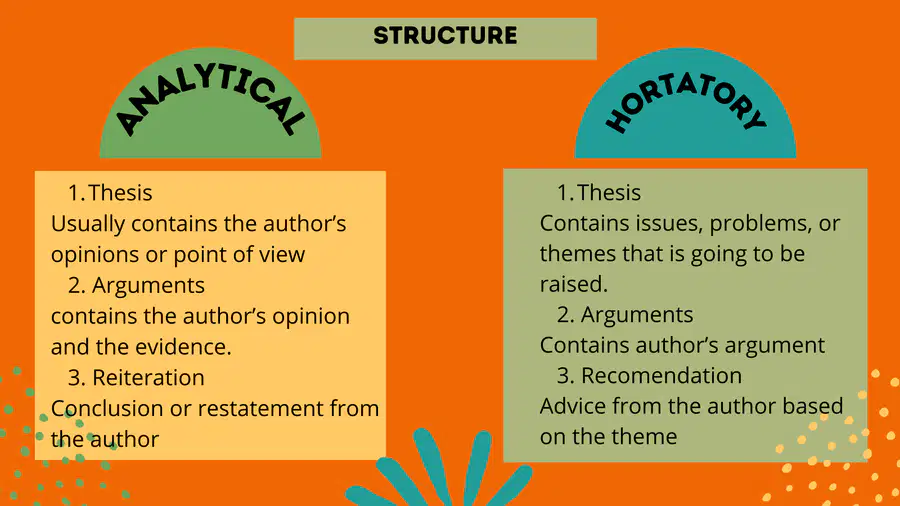
6
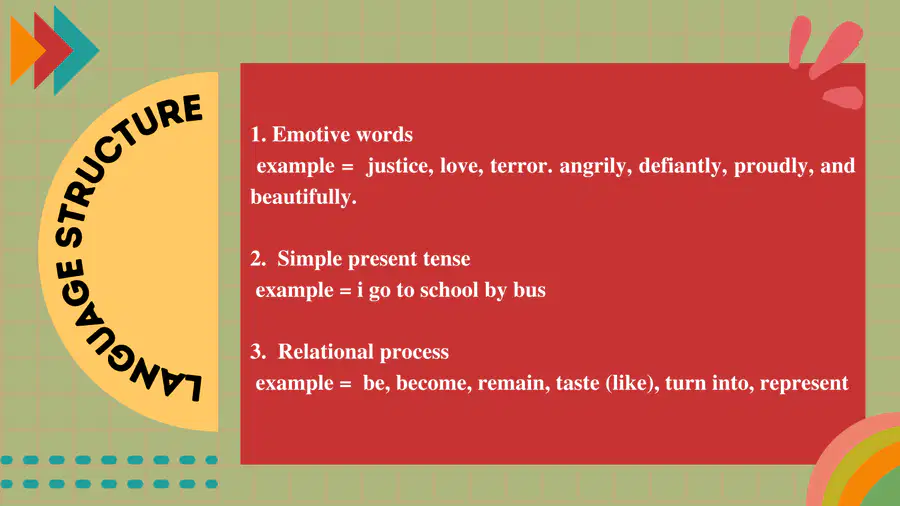
7
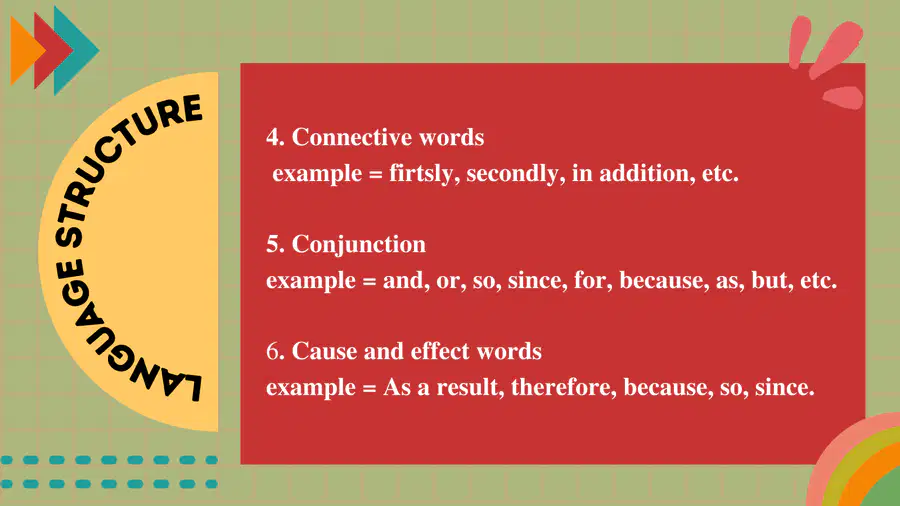
8
9
Multiple Choice
(1) Learning English through music and songs can be very enjoyable. You can mix pleasure with learning when you listen to a song and exploit the song as a means to your English progress. Some underlying reason can be drawn to support the idea why we use songs in language learning.
(2) Firstly, "the song stuck in my head" Phenomenon (the echoing in our minds of the last song we heard after leaving a restaurant, shopping malls, etc) can be both enjoyable and sometimes unnerving. This phenomenon also seems to reinforce the idea that songs work on our short-and-long term memory.
(3) Secondly, songs in general also use simple conversational language, with a lot of repetition, which is just what many learners look for sample text. The fact that they are effective makes them many times more motivating than other text. Although usually simple, some songs can be quite complex syntactically, lexically and poetically, and can be analyzed in the same way as any other literary sample.
(4) Furthermore, song can be appropriated by listener for their own purpose. Most pop songs and probably many other types don't have precise people, place or time reference.
(5) In addition, songs are relaxing. They provide variety and fun, and encourage harmony within oneself and within one group. Little wonder they are important tools in sustaining culture, religion, patriotism and yeas, even revolution.
(6) Last but not least, there are many learning activities we can do with songs such as studying grammar, practicing selective listening comprehension, translating songs, learning vocabulary, spelling and culture.
What type of exposition text above?
Hortatory exposition
Analytical exposition
Extraordinary exposition
unusual exposition
10
Multiple Choice
Rock began in the USA in the early 1950's. At the time, 'Rhythm and Blues' music was very popular with black Americans.
'R&B' was a mixture of black religious music (gospel) and jazz. It had strong rhythms that you could dance to and simple, fast lyrics.
The following recommendations are the ways how to appreciate 'R&B' music: first you have to recognise black music, second you also have to recognise jazz, then you have to love strong rhythm.
What kind of exposition text above?
Hortatory exposition
Analytical exposition
Extraordinary exposition
Unusual exposition
11
Multiple Choice
(1) Learning English through music and songs can be very enjoyable. You can mix pleasure with learning when you listen to a song and exploit the song as a means to your English progress. Some underlying reason can be drawn to support the idea why we use songs in language learning.
(2) Firstly, "the song stuck in my head" Phenomenon (the echoing in our minds of the last song we heard after leaving a restaurant, shopping malls, etc) can be both enjoyable and sometimes unnerving. This phenomenon also seems to reinforce the idea that songs work on our short-and-long term memory.
(3) Secondly, songs in general also use simple conversational language, with a lot of repetition, which is just what many learners look for sample text. The fact that they are effective makes them many times more motivating than other text. Although usually simple, some songs can be quite complex syntactically, lexically and poetically, and can be analyzed in the same way as any other literary sample.
(4) Furthermore, song can be appropriated by listener for their own purpose. Most pop songs and probably many other types don't have precise people, place or time reference.
(5) In addition, songs are relaxing. They provide variety and fun, and encourage harmony within oneself and within one group. Little wonder they are important tools in sustaining culture, religion, patriotism and yeas, even revolution.
(6) Last but not least, there are many learning activities we can do with songs such as studying grammar, practicing selective listening comprehension, translating songs, learning vocabulary, spelling and culture.
Which paragraph of the following text is part of the argumentation?
2,3,4,6
1,2,3,6
2,3,4,5
1,2,3,4
12
Multiple Choice
(1) Learning English through music and songs can be very enjoyable. You can mix pleasure with learning when you listen to a song and exploit the song as a means to your English progress. Some underlying reason can be drawn to support the idea why we use songs in language learning.
(2) Firstly, "the song stuck in my head" Phenomenon (the echoing in our minds of the last song we heard after leaving a restaurant, shopping malls, etc) can be both enjoyable and sometimes unnerving. This phenomenon also seems to reinforce the idea that songs work on our short-and-long term memory.
(3) Secondly, songs in general also use simple conversational language, with a lot of repetition, which is just what many learners look for sample text. The fact that they are effective makes them many times more motivating than other text. Although usually simple, some songs can be quite complex syntactically, lexically and poetically, and can be analyzed in the same way as any other literary sample.
(4) Furthermore, song can be appropriated by listener for their own purpose. Most pop songs and probably many other types don't have precise people, place or time reference.
(5) In addition, songs are relaxing. They provide variety and fun, and encourage harmony within oneself and within one group. Little wonder they are important tools in sustaining culture, religion, patriotism and yeas, even revolution.
(6) Last but not least, there are many learning activities we can do with songs such as studying grammar, practicing selective listening comprehension, translating songs, learning vocabulary, spelling and culture.
Which conjunctions are mentioned in the text?
And, or, for
translating, studying, practicing
songs, variety, more
syntactically, lexically, poetically
13
Multiple Choice
(1) Learning English through music and songs can be very enjoyable. You can mix pleasure with learning when you listen to a song and exploit the song as a means to your English progress. Some underlying reason can be drawn to support the idea why we use songs in language learning.
(2) Firstly, "the song stuck in my head" Phenomenon (the echoing in our minds of the last song we heard after leaving a restaurant, shopping malls, etc) can be both enjoyable and sometimes unnerving. This phenomenon also seems to reinforce the idea that songs work on our short-and-long term memory.
(3) Secondly, songs in general also use simple conversational language, with a lot of repetition, which is just what many learners look for sample text. The fact that they are effective makes them many times more motivating than other text. Although usually simple, some songs can be quite complex syntactically, lexically and poetically, and can be analyzed in the same way as any other literary sample.
(4) Furthermore, song can be appropriated by listener for their own purpose. Most pop songs and probably many other types don't have precise people, place or time reference.
(5) In addition, songs are relaxing. They provide variety and fun, and encourage harmony within oneself and within one group. Little wonder they are important tools in sustaining culture, religion, patriotism and yeas, even revolution.
(6) Last but not least, there are many learning activities we can do with songs such as studying grammar, practicing selective listening comprehension, translating songs, learning vocabulary, spelling and culture.
Which connectives are mentioned in the text?
Firstly, there, learning
Many, secondly, with
In addition, Furthermore, Firstly
And, in addtion, secondly
Show answer
Auto Play
Slide 1 / 13
SLIDE
Similar Resources on Wayground

10 questions
Point of View
Presentation
•
9th - 10th Grade
12 questions
Action and State Verbs
Presentation
•
10th Grade
12 questions
Anne Frank Character Change
Presentation
•
6th - 9th Grade
10 questions
Julius Caesar Apostrophe Review
Presentation
•
10th Grade
9 questions
Sonnets
Presentation
•
9th Grade
9 questions
Subject Complement vs. Object Complement
Presentation
•
10th Grade
10 questions
Analyzing Influences
Presentation
•
10th Grade
9 questions
Limiting Reactant and Percent Yield
Presentation
•
10th Grade
Popular Resources on Wayground
15 questions
Grade 3 Simulation Assessment 1

Quiz
•
3rd Grade
22 questions
HCS Grade 4 Simulation Assessment_1 2526sy
Quiz
•
4th Grade
16 questions
Grade 3 Simulation Assessment 2
Quiz
•
3rd Grade
19 questions
HCS Grade 5 Simulation Assessment_1 2526sy
Quiz
•
5th Grade
17 questions
HCS Grade 4 Simulation Assessment_2 2526sy
Quiz
•
4th Grade
20 questions
Equivalent Fractions
Quiz
•
3rd Grade
24 questions
HCS Grade 5 Simulation Assessment_2 2526sy
Quiz
•
5th Grade
20 questions
Math Review
Quiz
•
3rd Grade
Discover more resources for English
20 questions
Figurative Language Review
Quiz
•
10th Grade
10 questions
Test Taking Strategies for State Reading Assessments

Interactive video
•
6th - 10th Grade
20 questions
Context clues
Quiz
•
10th Grade
10 questions
Credible Sources
Presentation
•
8th - 12th Grade
20 questions
Text Structures
Quiz
•
9th - 12th Grade
20 questions
English 2 STAAR Grammar Review
Quiz
•
9th - 11th Grade
15 questions
Quotation Marks vs. Italics for MLA
Quiz
•
9th Grade - University
20 questions
Figurative Language Review
Quiz
•
6th - 12th Grade