
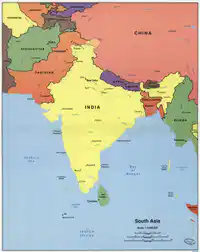
South Asian History

Presentation
•
History
•
6th - 8th Grade
•
Medium

Brittany Hearn
Used 6+ times
FREE Resource
10 Slides • 21 Questions
1

©2017LearnedLessons
HISTORY OF
SOUTH ASIA
2


©2017LearnedLessons
MAURYAN EMPIRE🡪 3rd century B.C.,
helped spread Buddhism around Asia.
•Buddhism🡪 formed
in northern India by
about 500 B.C.
3
Multiple Choice
Which empire helped spread Buddhism around Asia in the 3rd century B.C.?
Gupta Empire
Mauryan Empire
Mughal Empire
Chola Empire
4
Multiple Choice
When was Buddhism formed in northern India?
About 500 A.D.
About 400 B.C.
About 500 B.C.
About 600 B.C.
5


©2017LearnedLessons
Muslim Invade around A.D. 1000 and
brought Islam into the northwest
•Sikhism🡪 15th
century, Muslim culture
and teaching mixes with
Hinduism.
6
Multiple Choice
When did Muslim invasions around A.D. 1000 bring Islam into the northwest?
14th century
15th century
16th century
Around A.D. 1000
7
Multiple Choice
What does Sikhism represent in terms of cultural and religious mixture?
A mixture of Buddhism and Islam
A mixture of Christianity and Hinduism
A mixture of Muslim culture and teachings with Hinduism
A mixture of Jainism and Islam
8
Multiple Choice
In which century did Sikhism emerge?
14th century
15th century
16th century
17th century
9


©2017LearnedLessons
1526, the Mogul Empire gained
control over India, Muslim
rule--last invasion.
10
Multiple Choice
Which empire gained control over India in 1526?
The British Empire
The Ottoman Empire
The Mogul Empire
The Maurya Empire
11


©2017LearnedLessons
EUROPEAN COLONIALISM
• 16th century, Europeans arrived in India to trade and set up trading sites
• Portuguese🡪 wanted to spread Christianity and open new trade ports🡪
empire spreading.
• Dutch🡪 Controlled East Indies spice trade.
• Britain & France🡪 India was good for resources
12


©2017LearnedLessons
• 1740s British gains control over India after conflicts in
Europe.
• By 1858 majority of Indian subcontinent officially part of
the British Empire (present India, Pakistan, Bangladesh,
Sri Lanka). Indian subcontinent called “jewel in the
crown” of British Empire.
• India shipped cotton, tea, indigo, coffee, and jute to Britain.
• Railroads, roads, and ports were built in India by the British.
• English left impact by bringing their ideas of language, law,
education, and political system.
13
Multiple Choice
Which of the following was NOT shipped from India to Britain?
Cotton
Tea
Spices
Indigo
14


©2017LearnedLessons
INDEPENDENCE MOVEMENT
• Early 1900s a desire for
independence rose up in India led
by Mohandas Gandhi
• Gandhi believed in “nonviolent
noncooperation” as a method to
bring political and social change🡪
boycotts, marches, and fasts.
• 1947 India gained independence
from Britain ending the colonial era
in India
• British divided the region between
Muslims and Hindus to avoid conflict.
15


©2017LearnedLessons
Muslims went to Pakistan, Hindus
and Sikhs left Pakistan for India
• 1948 Gandhi was killed by a
Hindu extremist
• 1971 Pakistan broke into East
Pakistan and West Pakistan
• East Pakistan became
Bangladesh
• West Pakistan became
modern Pakistan🡪 an Islamic
Republic
•Religious and ethnic
divisions still are a problem
in South Asia.
16

©2017LearnedLessons
HISTORY READING
• South Asia has a rich and complex history that dates back thousands of years. The region is home to some of the earliest civilizations in the world, including the Indus Valley civilization, which flourished around 2500 BCE. The Indus Valley civilization was characterized by its advanced urban planning, sophisticated engineering, and a writing system that is yet to be fully deciphered.
• In the centuries that followed, South Asia saw the rise and fall of several powerful empires, including the Mauryan Empire, the
Gupta Empire, and the Mughal Empire. These empires left a lasting impact on the region's culture, politics, and architecture.
• During the 18th and 19th centuries, South Asia was colonized by European powers, with the British establishing control over the
region. The British colonial period had a profound impact on the region, shaping its political, economic, and social structures.
• In the early 20th century, South Asia saw a wave of nationalist movements that sought to overthrow colonial rule and establish independent nation-states. The most prominent of these movements was the Indian independence movement, led by figures such as Mahatma Gandhi and Jawaharlal Nehru. In 1947, India gained independence from British colonial rule, while Pakistan was created as a separate Muslim-majority state.
17

©2017LearnedLessons
HISTORY READING
•Since gaining independence, South Asia has experienced significant political, social, and economic changes. The region has seen the rise of democracy and the establishment of new political systems, as well as the growth of industries and modernization. However, South Asia continues to face challenges such as poverty, inequality, and political instability.
•In conclusion, the history of South Asia is rich and complex, shaped by powerful empires, colonialism, nationalism, and independence movements. The region continues to evolve and face new challenges as it strives towards social, economic, and political progress.
18
Multiple Choice
What type of rule was established in India after the last invasion in 1526?
Hindu rule
British rule
Muslim rule
Sikh rule
19
Multiple Choice
What decade did the British gain control over India after conflicts in Europe?
1750s
1740s
1760s
1770s
20
Multiple Choice
By what year was the majority of the Indian subcontinent officially part of the British Empire?
1858
1860
1848
1875
21
Multiple Choice
What was the Indian subcontinent called in relation to the British Empire?
Diamond of the British Empire
Crown of the British Empire
Jewel in the crown
Pearl of the British Empire
22
Multiple Choice
What infrastructure was built in India by the British?
Railroads, roads, and ports
Airports, highways, and bridges
Canals, dams, and tunnels
Schools, hospitals, and libraries
23
Multiple Choice
Which of the following did the English NOT introduce to India?
Language
Law
Religion
Education
24
Multiple Choice
Who led the desire for independence in India in the early 1900s?
Jawaharlal Nehru
Subhas Chandra Bose
Mohandas Gandhi
Bhagat Singh
25
Multiple Choice
What method did Gandhi believe in to bring political and social change?
Armed revolution
Violent protests
Nonviolent noncooperation
Political debates
26
Multiple Choice
Why did the British divide the region between Muslims and Hindus?
To create separate nations
To promote trade between communities
To avoid conflict
To establish educational institutions
27
Multiple Choice
What happened in 1971 regarding Pakistan?
Pakistan was established
Pakistan and India signed a peace treaty
Pakistan broke into East Pakistan and West Pakistan
Pakistan became a democratic republic
28
Multiple Choice
What type of divisions are still a problem in South Asia?
Political and economic divisions
Religious and ethnic divisions
Geographical and demographic divisions
Linguistic and cultural divisions
29
Multiple Choice
What was the Indus Valley civilization characterized by?
Its advanced urban planning and sophisticated engineering
Its colonial period under British control
The wave of nationalist movements in the early 20th century
The establishment of Pakistan as a separate state
30
Multiple Choice
What has been established in South Asia with the rise of democracy?
New political systems and modernization
Decrease in poverty and inequality
Political instability and economic decline
Only new political systems
31
Multiple Choice
What challenges does South Asia continue to face?
Economic prosperity and stability
Poverty, inequality, and political instability
Rapid industrial growth and modernization
Decline in national movements
©2017LearnedLessons
HISTORY OF
SOUTH ASIA
Show answer
Auto Play
Slide 1 / 31
SLIDE
Similar Resources on Wayground

24 questions
Badminton
Presentation
•
6th - 8th Grade
24 questions
Prepositions
Presentation
•
6th - 8th Grade
24 questions
Food Processing
Presentation
•
6th - 8th Grade
25 questions
The Revolution Begins
Presentation
•
6th - 8th Grade
24 questions
Causes of the Texas Revolution (Part 1)
Presentation
•
7th Grade
24 questions
Mean, Median, Mode, Range
Presentation
•
6th - 8th Grade
24 questions
EOG Review - Theme 1
Presentation
•
6th - 8th Grade
24 questions
Energy Transformation
Presentation
•
6th - 8th Grade
Popular Resources on Wayground
10 questions
HCS SCI 03 Summer School Assessment 1

Quiz
•
3rd Grade
15 questions
HCS SCI 05 Summer School Assessment 1 Review
Quiz
•
5th Grade
22 questions
Day 9 Equations and Inequalities Review
Quiz
•
9th Grade
10 questions
Writing and Identifying Ratios Practice
Quiz
•
5th - 6th Grade
7 questions
PYRAMID PERSPECTIVES part 1
Presentation
•
9th - 12th Grade
12 questions
Understanding the Fourth of July
Quiz
•
9th Grade
15 questions
Soccer World Cup Quiz Questions
Quiz
•
7th Grade