

Weather and Climate

Presentation
•
Geography
•
10th Grade
•
Practice Problem
•
Hard

Neeraja Sangarapillai
FREE Resource
102 Slides • 0 Questions
1

WEATHER AND CLIMATE
2


1.1: WEATHER
AND CLIMATE
3

In this topic, you will learn:
◼What is weather and climate?
◼What are climatic hazards?
LESSON OBJECTIVES
4
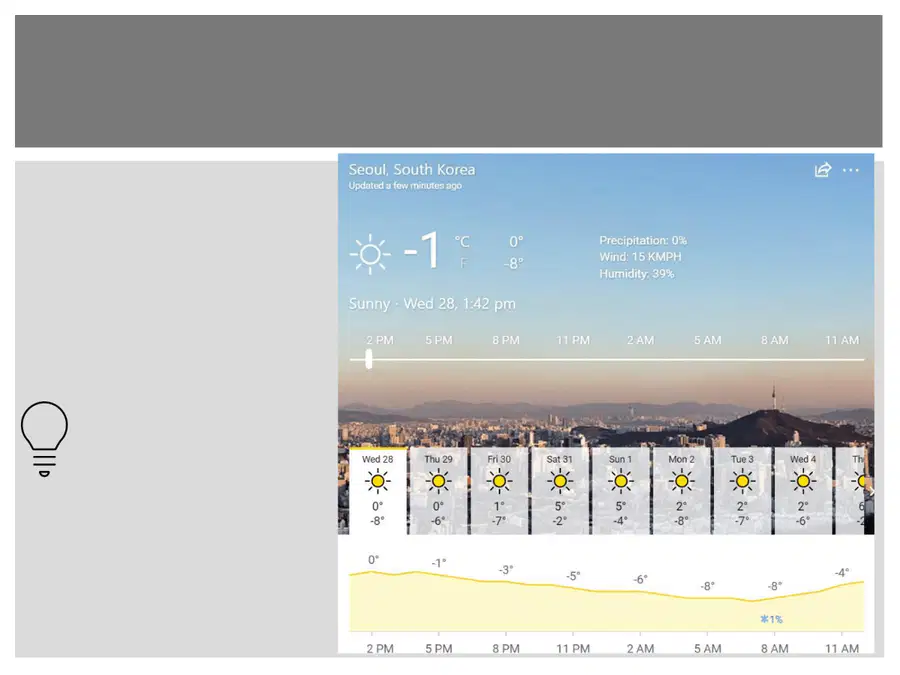
◼ Weather is the
state of the
atmosphere at a
specific place and
time.
WEATHER
What are the different
weather variables
shown?
5

Weather is described using variables such as:
1. Temperature - the degree of how hot or cold a place is,
as measured using a thermometer.
2. Cloud cover - the amount of sky covered by clouds.
3. Precipitation - all forms of water that fall to the Earth
from the atmosphere e.g. hail, snow, rain.
4. Wind speed - how fast the wind travels
5. Wind direction - the direction from where the wind
comes from.
WEATHER
6


• Refers to the average state of the atmosphere at
a particular place over a long period of time
(usually over 25 years).
CLIMATE
Seoul’s climograph
7

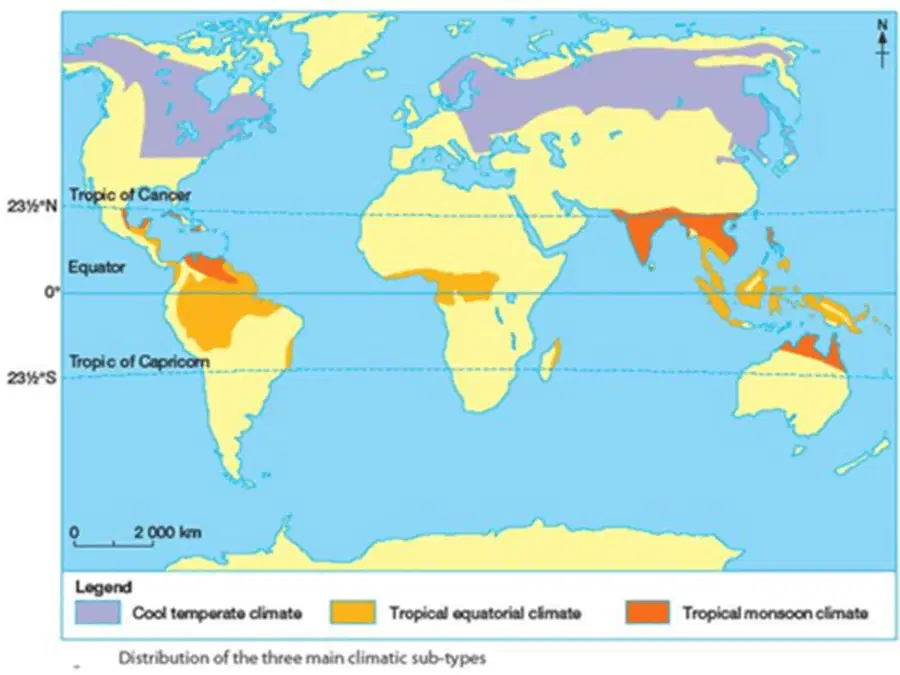
1. Tropical Equatorial Climate
2. Tropical Monsoon Climate
3. Cool Temperate Climate
TYPES OF CLIMATE
8
9
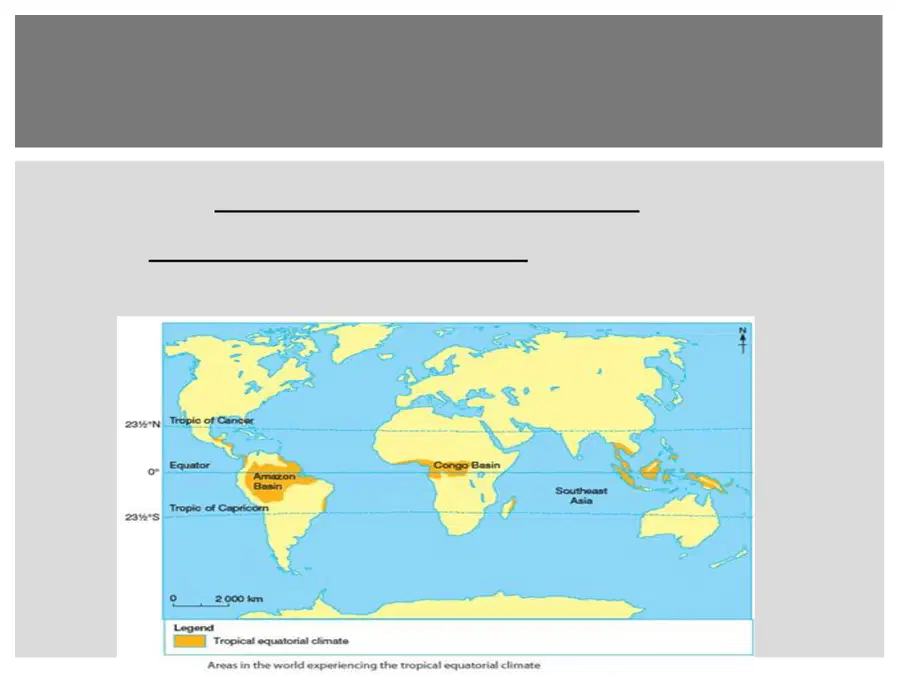
◼Between latitudes 10° north and south of equator
◼E.g.: Singapore, Malaysia, Brazil
EQUATORIAL CLIMATE
10

◼High temperatures all year round, about 27°C
◼Small annual temperature range of 2 °C to 3 °C
◼High annual precipitation of more than 2000 mm/year
◼Precipitation falls evenly throughout the year
EQUATORIAL CLIMATE
11

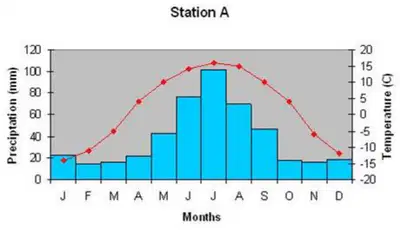
CLIMOGRAPHS
◼A climograph is a graph that shows a particular location's
average temperature and precipitation during the year.
Title
The title at the top shows the location
Months
The letters at the bottom show the months of the year
Precipitation
• The average
precipitation
for each month
is indicated by
the bars
• Which may be
expressed in
millimetres
(mm) or inches
(in)
Temperature
∙The average
temperature for
each month is
indicated by the
line graph
∙Which may be
expressed in
Celsius (oC) or
Fahrenheit (oF)
12

Steps to reading a climograph:
Look for patterns in the temperature data.
∙Is the temperature constant or fluctuating all year round?
∙Which month is the warmest? What is the temperature?
∙Which month is the coolest? What is the temperature?
∙What
isthe
annual
temperature
range?
(Subtract
the
minimum
temperature from the maximum temperature).
Look for patterns in the rainfall data.
∙Does the rainfall occur all year round?
∙Which are the driest and wettest months? State the values.
∙What is the total annual rainfall? Add each month's total together to get
the annual total.
If possible, try to identify the type of climatic region the country / city falls
under, e.g. tropical equatorial, tropical monsoon, cool temperate.
13


Practice: Identify the type of climate experienced in
Singapore and describe its temperature and rainfall
distribution.
14

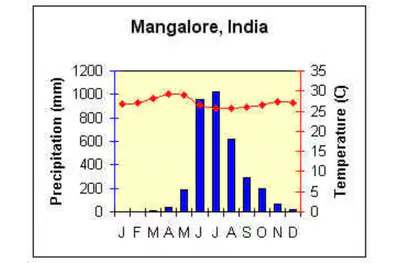
◼Between latitudes 5°-30°North and South of the
Equator
◼E.g. Vietnam, Bangladesh, Mumbai
◼High mean annual temperature around 25°C
◼Small annual temperature range 3-4°C
◼High annual precipitation of about 1500mm
◼Unevenly distributed as there are distinct wet and dry
seasons
MONSOON CLIMATE
15

16

◼Between latitudes 45°- 60°North and South of the
Equator
◼E.g. London, United Kingdom
◼E.g. Paris, France
◼4 distinct seasons
◼Large annual temperature range of about 21 °C
◼Low precipitation between 300mm to 900mm
◼Precipitation falls evenly throughout the year
COOL TEMPERATE CLIMATE
17


18
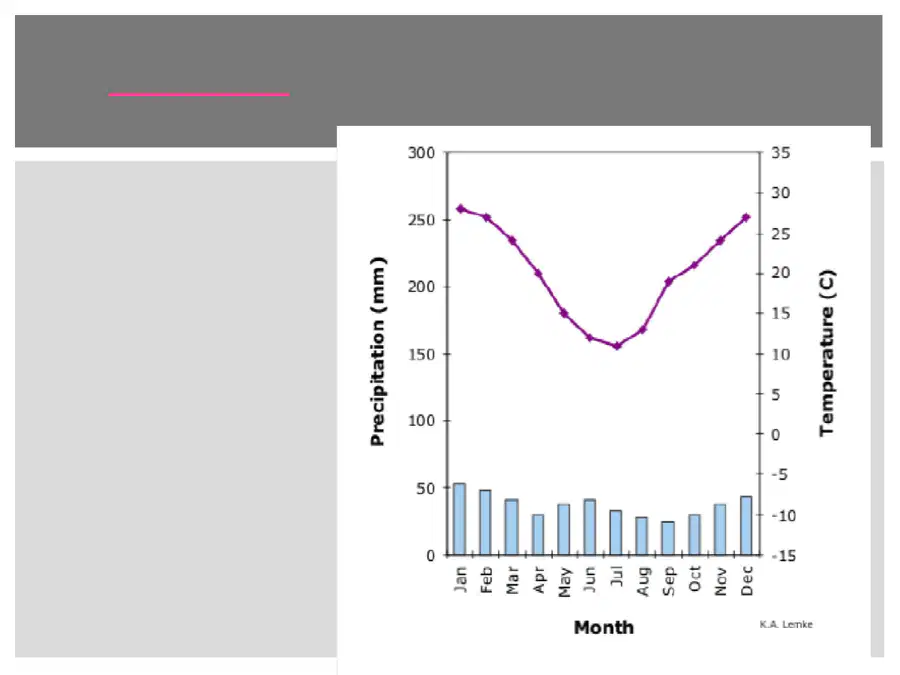
◼Identify the
type of climate
experienced at
Station X and
describe its
temperature
and rainfall
distribution.
PRACTICE: READING A CLIMOGRAPH
Station X
19

◼Station Y : cool temperate climate
◼Characteristics: moderate mean annual temperature
of about 20˚C with
◼large annual temperature range of 16˚C OR
◼experiences seasons where temperatures are higher
than 25˚C during summer from November to March
and lower than 15˚C during winter from June to
August
◼Rainfall distribution is quite even with low annual
total of about 400mm
IDENTIFY & DESCRIBE CLIMATIC TYPE
20

◼Climates are changing due to natural and human
induced causes.
◼Predictable weather patterns are now beginning to
change and becoming unpredictable.
◼Extreme weather events, such as heat waves,
droughts, floods, cyclones and wildfires and expected
to occur more often or with greater severity.
◼These can impact natural and human systems
significantly.
WHAT ARE CLIMATIC HAZARDS?
21

DIFFERENCE BETWEEN NATURAL AND
HUMAN SYSTEMS
Natural systems
Human systems
•Natural systems consist of
natural processes that occur on
Earth, and all the living and non-
living things that are found
naturally. These natural
processes and living and non-
living things are interconnected.
•An example of a natural system
is an ecosystem.
•On the other hand, human
systems consist of human-led
processes and the interconnected
human activities.
•An example of a human system
is agriculture.
22


1.2 VARIATION IN
AIR
TEMPERATURE
ACROSS EARTH’S
SURFACE
23

In this topic, you will learn:
◼Why air temperature varies across the earth’s surface
LESSON OBJECTIVES
24

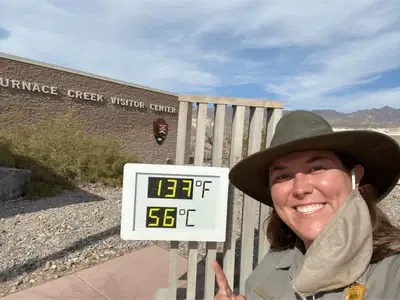
• Hottest temperature recorded on Earth?
– 56.7°C in Death Valley, California, on 10 July
1913
25
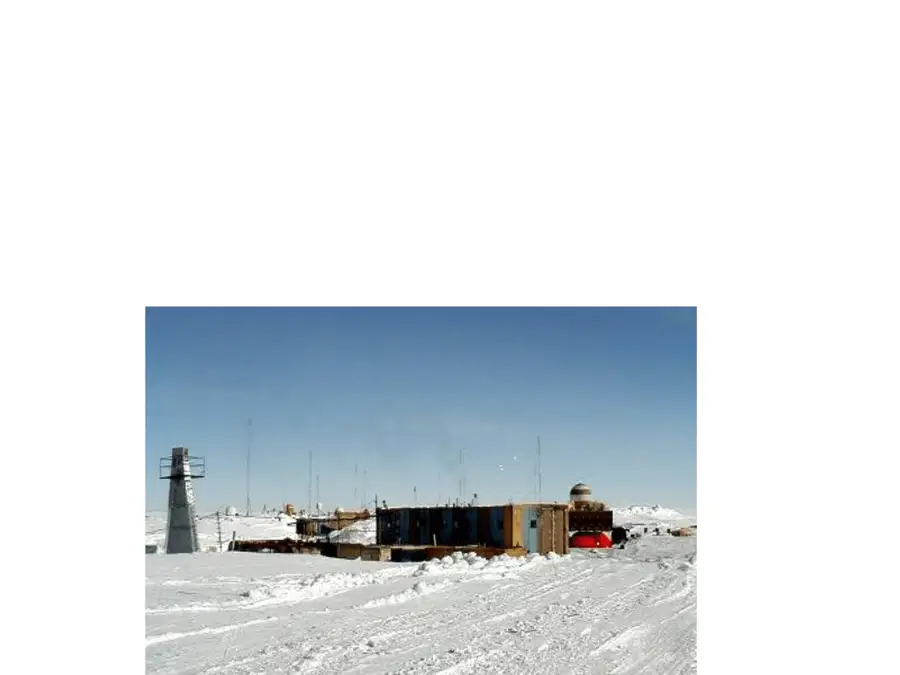
• Coldest temperature recorded on
Earth?
– Official record- Vostok station on July 21,
1983
-89.2 °C
– Vostok is a Russian station in Antarctic.
26

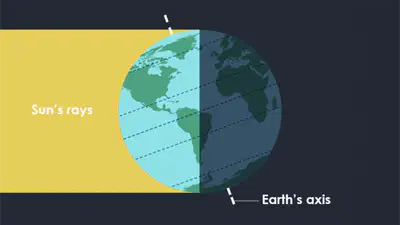
◼Air temperature at a place varies:
• Throughout the day because of Earth’s rotation
on its axis.
HOW AND WHY DOES AIR TEMPERATURE
VARY ACROSS TIME?
27

28

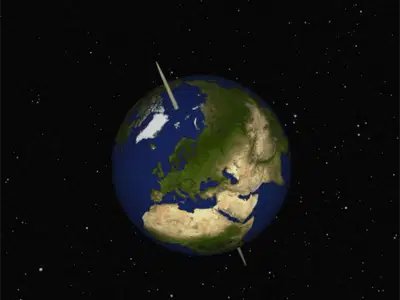
◼The side of the Earth that faces
the sun receives solar radiation
and experiences day time and
higher temperatures.
◼As the Earth continues to rotate,
this side will eventually face away
from
the
sun
and
experience
night
time
and
therefore
experiences lower temperatures.
◼The Earth takes about 24 hours to
complete one rotation on its axis,
hence that is the length of a day
we experience.
HOW AND WHY DOES AIR TEMPERATURE
VARY ACROSS TIME?
29


◼Air temperature at a place varies:
• Over time in a year due to the earth’s
revolution around the sun.
HOW AND WHY DOES AIR TEMPERATURE
VARY ACROSS TIME?
30

HOW AND WHY DOES AIR TEMPERATURE
VARY ACROSS TIME?
Time of
the year
Explanation for mean temperatures
June
Due to the Earth’s tilted axis, in June, the northern hemisphere leans towards
the sun. It receives more direct solar radiation. Solar radiation is spread over
a smaller area and is more concentrated, resulting in higher temperatures.
Sept
In September, both the hemispheres do not lean towards the sun. At this
time, both hemisphere experiences moderate temperature.
Dec
Due to the Earth’s tilted axis, in December, the northern hemisphere leans
away from the sun. It receives the least direct solar radiation and solar
radiation spreads over a larger area compared to the other months. Hence, it
experiences the lowest temperature.
March
In March, both the hemispheres do not lean towards the sun. At this time,
both hemisphere experiences moderate temperature.
31


32

HOW AND WHY DOES AIR TEMPERATURE
VARY ACROSS PLACES?
Latitude
Altitude
Type of
surface
Distance
from the sea
33

34

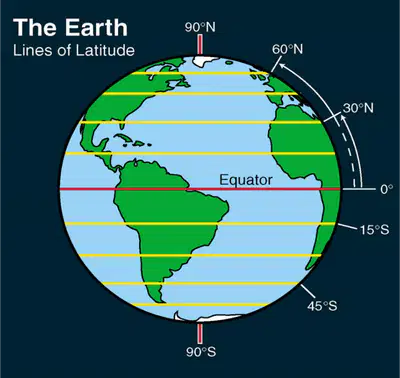
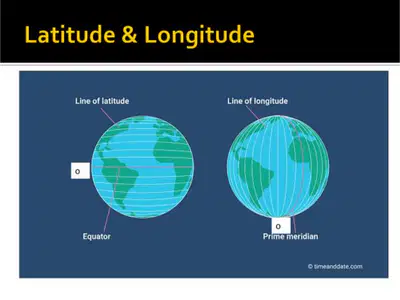
◼Latitude refers to
the distance to
the north and
south of the
Equator.
Latitudes are
imaginary
horizontal lines
running from east
to west around
the earth
measured in
degrees
FACTORS INFLUENCING TEMPERATURE AT
LOCATIONS : 1)LATITUDE
35

◼Temperatures decreases from lower latitude to higher
latitude. WHY?
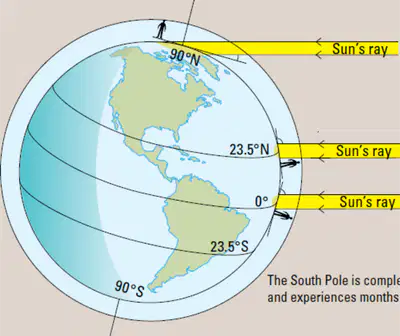
◼The earth tilts at 23.5° on its axis. As a result, the sun’s
ray strike at various angle at different parts of the
earth.
◼The angle of incidence is the angle at which the sun’s
ray reaches the earth. When angle of incidence is
higher, sun’s rays will be more concentrated on the
area.
HOW DOES LATITUDES AFFECT
TEMPERATURES?
36
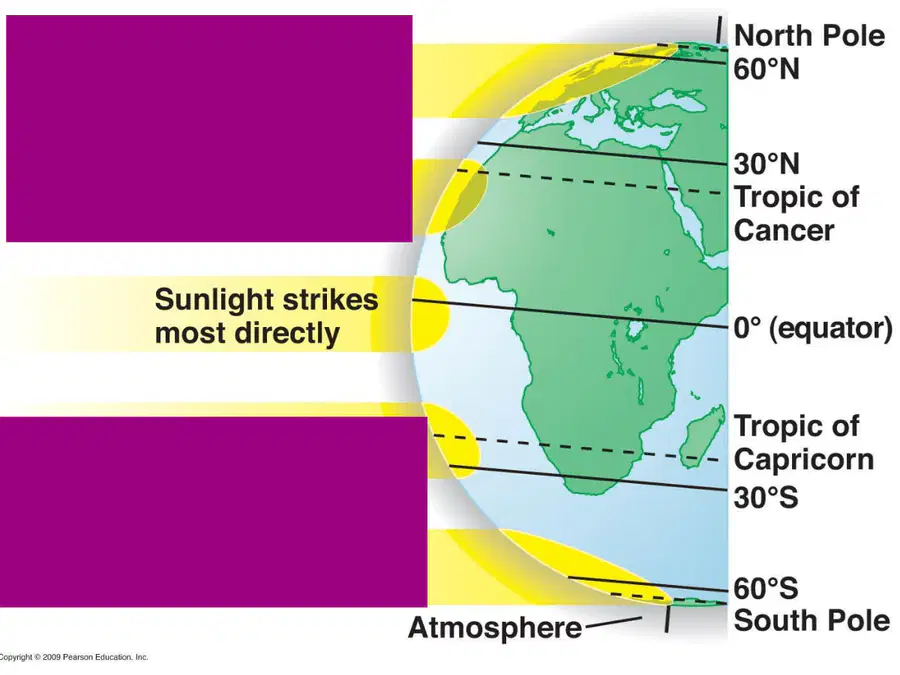
Higher latitudes:
Lower angle of incidence🡪
sun’s rays strike at a lower
angle 🡪 solar energy spread
out over a wider area 🡪 lower
temperatures
Lower latitudes (between 23.5oN
and S of Equator):
Higher angle of incidence🡪 solar
energy is concentrated on a small
area 🡪 higher temperatures
37

38
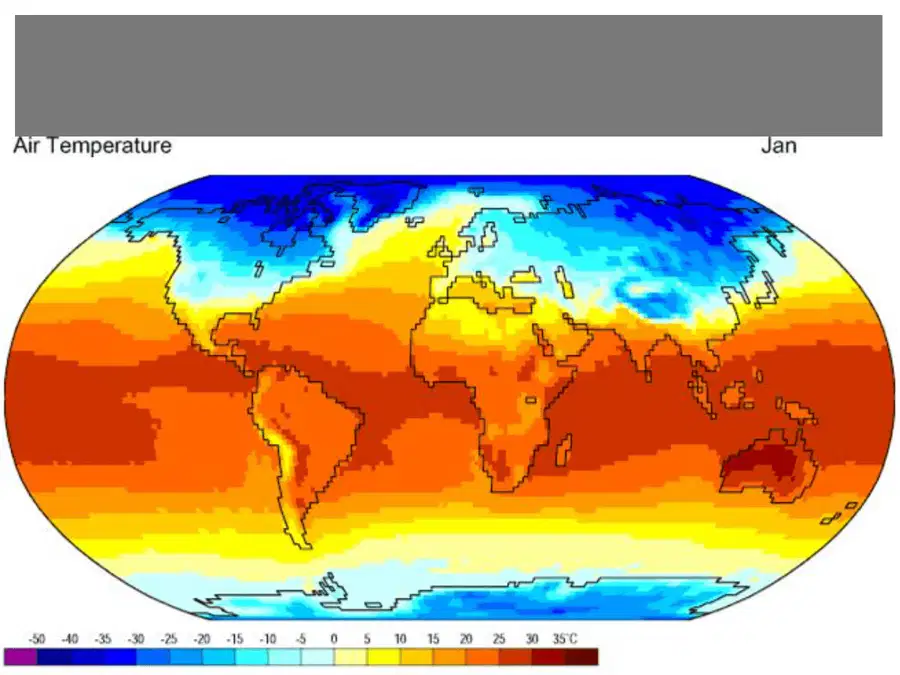
GLOBAL SURFACE TEMPERATURE DISTRIBUTION
39


2. ALTITUDE
◼Example
▪ Beijing, China(40oN of
equator) has temperature
averaging 12oC
▪ Singapore (1oN of equator)
has temperature averaging
29oC
40


FACTORS INFLUENCING TEMPERATURES AT
DIFFERENT LOCATIONS:2) ALTITUDE
◼Altitude: Height of a place in relation to sea
level.
- General decrease of 6.5°C for every 1,000 m increase in
altitude.
40
41

Reason –
Air density
1. Lower air density and pressure at
higher altitude 🡪 lower ability to
absorb and radiate heat 🡪 lower
temperature
2. Higher air density and pressure at lower
altitude🡪 higher ability to absorb and radiate
heat 🡪 higher temperature
42

ATMOSPHERIC STRUCTURE= ALTITUDE &
PRESSURE RELATIONSHIP
Distance from Ground
Gas Molecules
1. Molecules closely
packed at lower heights
– gravity & compaction
2. Higher altitude,
molecules more
spread out
∴Higher altitudes
🡺
less gravity
🡺
lower air
pressure, since air
is less dense.
Static
Situation
43

2. ALTITUDE
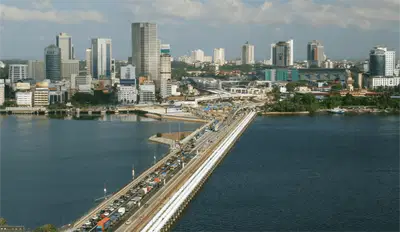
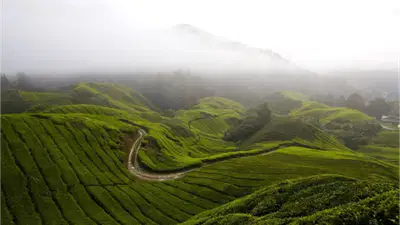
◼Example
▪ Johor Bahru in Malaysia has a
lower altitude of around 30m
above sea level and a higher
mean annual temperature of
27oC
▪ Cameron Highlands in
Malaysia has a higher altitude
of around 1,500m above sea
level and a lower mean
annual temperature of 18oC
44

◼Study Fig. 1, which shows the average monthly
temperature at Mishima, situated at the foot of Mt.
Fuji, and the average monthly temperature at the
peak of Mt. Fuji.
◼With reference to Fig. 1, describe and account
for the effect of altitude on temperature.
PRACTICE 1: LINE GRAPH
45


FIG. 1
46

◼The annual average temp for Mishima (foot of Mt.
Fuji) is much higher at 15.3˚C as compared to -7.1˚C at
the peak of Mt Fuji
◼The peak of Mt. Fuji experiences extremely low
temperatures during the winter months, as temp
ranges between -15˚C to -20˚C while the winter temp
at Mishima ranges from 5˚C to 10 ˚C
◼In summer, the temp at the peak of Mt Fuji ranges
from 0-5 ˚C whereas, at Mishima which is its foot,
summer temp range from 20-25˚C.
DESCRIBE: WRITE WHAT YOU SEE
47

◼This is because the atmosphere is not warmed directly
by the sun, but by heat radiated from the earth’s
surface.
◼In addition, the density of the air decreases with
increasing altitude, so does the ability to trap heat.
◼This is because the molecules in the air which receive
and retain heat become fewer and more widely
spaced as height increases
ACCOUNT FOR : EXPLAIN
48

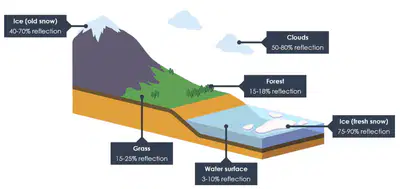
◼Dark surfaces such as soil, mud, forests absorb most of the solar
radiation and radiate more heat.
◼ On the other hand, light-coloured surfaces, such as snow, ice or
clouds, tend to reflect high proportions of solar radiation, instead of
absorbing. Hence, they radiate less heat.
3. TYPE OF SURFACE
49


◼Urban areas tend to have warmer temperatures than
rural areas due to the type of surfaces found at urban
areas.
3. TYPE OF SURFACE
50

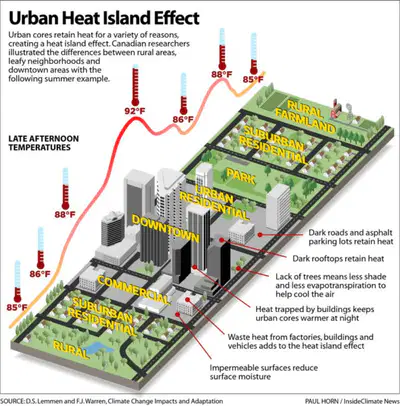
◼Urban environments like the CBD
tend to comprise large areas of
dark surfaces such as tarmac
roads. These darker surfaces are
able to absorb and radiate heat
better than lighter surfaces,
causing air temperatures to rise.
◼ In addition, glass-covered
skyscrapers in the CBD reflect
sunlight to the ground surface,
thereby increasing absorption and
radiation of heat
3. TYPE OF SURFACE
51

• Land absorbs and loses heat faster than the sea hence,
• Seas and oceans takes a longer time to heat up, but once
heated up will retain heat longer.
• Land, on the other hand, heats up very quickly and loses heat
quickly.
FACTORS INFLUENCING TEMPERATURE AT
LOCATIONS: 4) DISTANCE FROM THE SEA
VS
52

Maritime Effect
Criteria
Continental Effect
• Maritime effect is the effect
large ocean bodies have on
coastal area.
• During summer, the air over the
land heats up quickly while the
sea remains cool as the sea
gains heat slower than land.
• The cooler air over the seas
helps lower the temperature of
the areas along the coast,
leading to cooler summers.
Effects of
surface on
climate of area
Summer
Temperature
• Continental effect is
the effect that
continental surface
have on the climate of
inland areas.
• During summer, the
air over the land heats
up quickly leading to
warmer summers.
MARITIME VS CONTINENTAL EFFECT
53
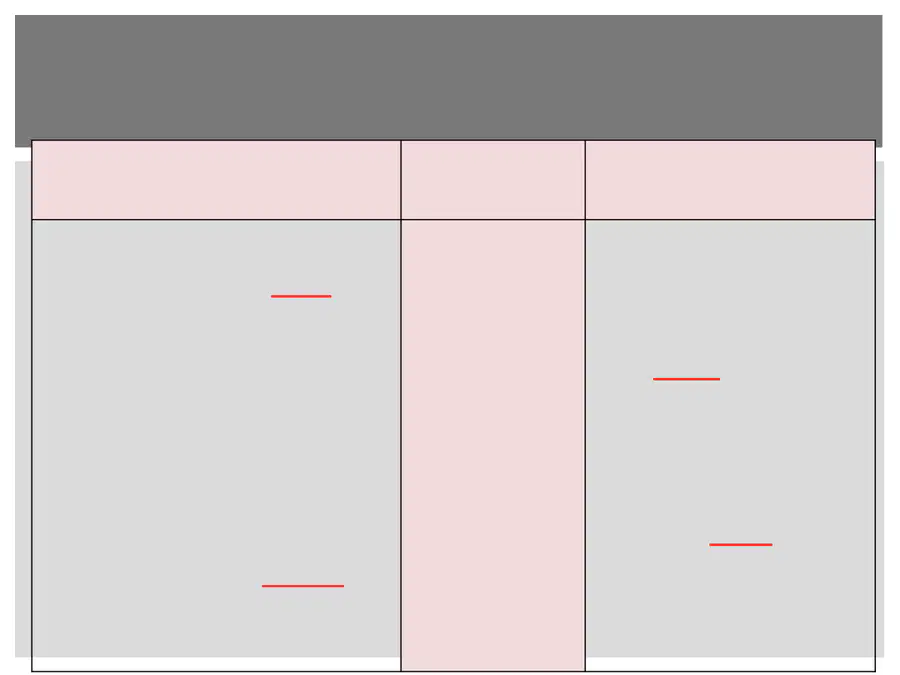
MARITIME VS CONTINENTAL EFFECT
Maritime Effect
Criteria
Continental Effect
∙During winter, the sea
remains relatively warm
compared to the air over the
land because the sea takes a
longer time to lose heat.
• The warmer air over the seas
helps to raise the
temperature of the coastal
areas, leading to warmer
winter.
Winter
Temperature
Temperature
Range
∙During winter the air
over the land loses
heats quickly leading
to colder winters.
• Therefore the annual
temperature range is
usually larger than
coastal areas.
54

55

FACTORS INFLUENCING TEMPERATURES AT
DIFFERENT LOCATIONS (DISTANCE FROM SEA)
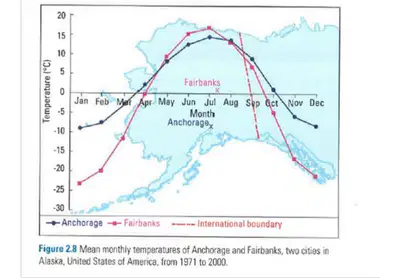
LOCATION
LATITUDE
DISTANCE
FROM SEA
TEMPERATURE
RANGE
ANCHORAGE
61.1919° N
1 KM
(Near Coast)
23°C
FAIRBANKS
64.8378° N
420KM
(Inland)
39°C
The sea heats up and cools downs more
slowly than land which influences the
temperatures of inland and coastal areas.
55
56

◼Anchorage has a smaller annual temperature than
Fairbanks. Anchorage is located near the sea and is
influenced by the maritime effect.
◼During summer, the land heats up more quickly than
the sea, resulting in air over the sea being cooler than
air over the land. The cooler air over the sea helps
lower the temperature in Anchorage.
◼During winter, the air over the sea remains warmer
than the air the land. The warmer air over the sea
increases the temperature in Anchorage.
EXPLAIN THE DIFFERENCE IN THE ANNUAL TEMPERATURE RANGES
OF FAIRBANKS AND ANCHORAGE.
57

◼Due to the maritime effect, Anchorage experiences cooler
summers, warmer winters, and a smaller annual
temperature range than Fairbanks.
◼In contrast, Fairbanks is located inland and is influenced by
the continental effect. Being located further from the sea,
the temperature in Fairbanks is not influenced by the sea.
◼Fairbanks experiences warmer summers and colder
winters.
◼There is therefore a larger difference between summer and
winter temperatures, and Fairbanks experiences a larger
annual temperature range than Anchorage.
EXPLAIN THE DIFFERENCE IN THE ANNUAL TEMPERATURE RANGES
OF FAIRBANKS AND ANCHORAGE.
58


1.3 VARIATION IN
PRECIPITATION
ACROSS THE
EARTH’S
SURFACE
59

In this topic, you will learn:
◼What is the water cycle?
◼How does water move on and below the earth’s
surface?
◼How does temperature affect relative humidity of a
place?
◼How are clouds formed?
◼How is rain formed?
LESSON OBJECTIVES
60

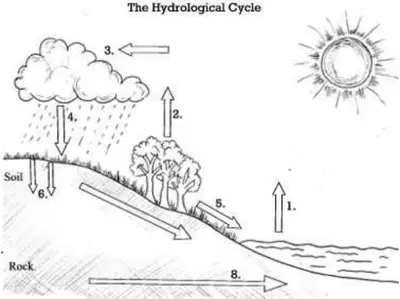
WHAT IS THE WATER CYCLE?
Pair Work:
Each pair will discuss
and annotate the
diagram to illustrate
the hydrological cycle.
61

◼ The rainwater that reaches the earth’s surface
moves on and below the surface in the form of
infiltration, surface runoff and groundwater
flow. These movements of water occur at
different rates, depending on various factors:
1. Type of soil and ground surface
2. Gradient of ground surface
FACTORS AFFECTING THE RATES OF
WATER MOVEMENT
62

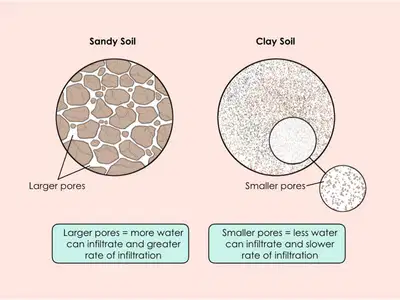
◼The rates of infiltration
and groundwater flow are
faster in soil which has
larger pores (such as
sandy soil) than in soil
which has smaller pores
(such as clayey soil).
◼ The larger pores allow
more water to infiltrate,
and the water moves
much more quickly.
1. TYPE OF SOIL AND GROUND SURFACE
63

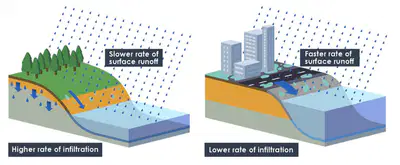
◼ In built-up areas, where ground surfaces are covered in concrete roads
which have tiny pores, the rate of infiltration is lower.
◼ The speed of surface runoff is higher on smoother ground surfaces such
as roads and pavements in built-up areas.
2. HOW BUILT-UP AN AREA IS
64

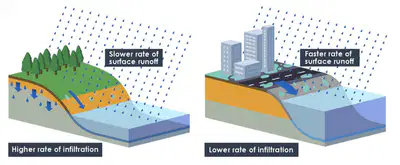
◼ On the other hand, in vegetated areas, the roots of vegetation loosen the
soil, creating larger pores, thereby increasing the rate of infiltration .
◼ The speed of surface runoff is lower on vegetated areas as the stems
and roots of grasses and plants act as barriers and increase the surface
roughness.
2. HOW BUILT-UP AN AREA IS
65

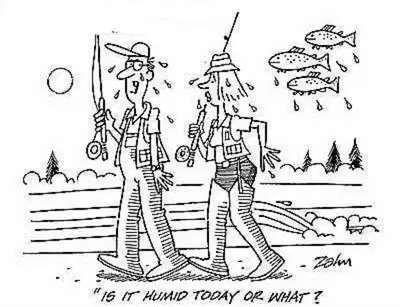
WHAT IS HUMIDITY?
Have you ever heard
tourists complain about the
weather in Singapore?
Very often, you’ll hear
them say this, “The sun is
great but I can’t stand the
humidity!”
66

RELATIVE HUMIDITY
• Relative humidity (RH) refers to the ratio of the
amount of water vapour in the air to the maximum
amount of water vapour the air can hold at a given
temperature.
Actual amt. of water vapour x 100%
Max. amt. of water vapour air can hold
67

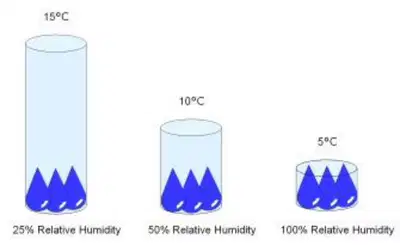
RELATIVE HUMIDITY
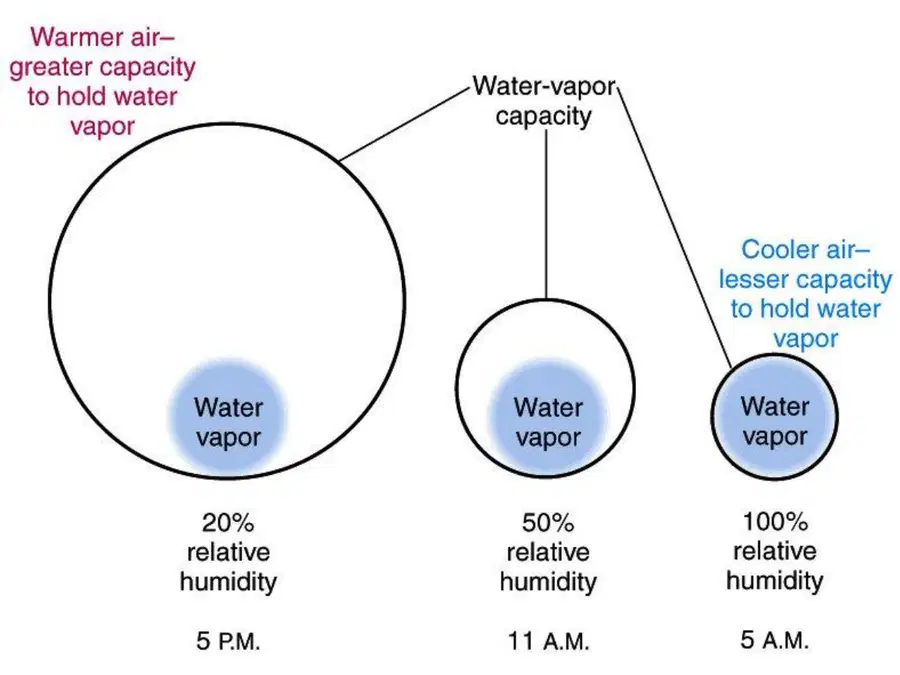
◼Warm air can hold more water vapour than cool air
◼When temperature increases (but amount of water vapour
stays the same)
▪ The air becomes less dense and has more capacity 🡪 able to hold more
water vapour
▪ Therefore, relative humidity decreases
68
69

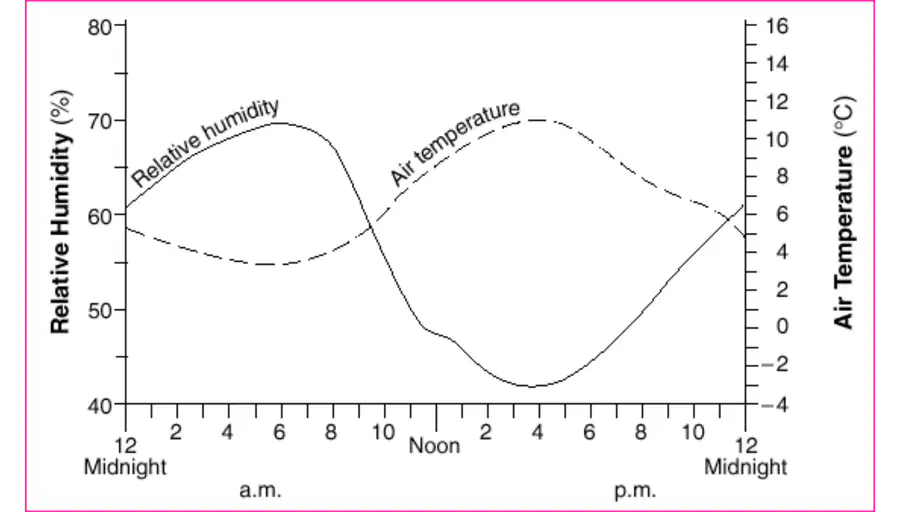
RELATIVE HUMIDITY DECREASES WITH INCREASING
TEMPERATURE AS WARM AIR CAN HOLD MORE WATER
VAPOUR THAN COOL AIR
70

S/N Temp (C)
Max. (g)
Actual (g)
Relative Humidity (%)
1.
-2
4.0
3.5
(3.5 ÷ 4) X 100% = 87.5
2.
20
18.0
15.0
(15 ÷ 18) X 100% = 83.3
3.
2
6.0
2.5
(2.5 ÷ 6) X 100% = 41.7
4.
10
9.3
8.0
(8 ÷ 9.3) X 100% = 86.0
5.
16
13.0
11.0
(11 ÷ 13) X 100% = 84.6
6.
20
18.2
13.0
(13 ÷ 18.2) X 100% = 71.4
CALCULATE THE RELATIVE HUMIDITY USING
THE FORMULA ABOVE
71

71
RELATIVE HUMIDITY (RH)
◼Expressed as a percentage
▪If the air currently holds half the moisture
possible at the present temperature, then the
relative humidity is 50%.
▪When the humidity is 100%, the air holds the
maximum possible, is saturated, and will be at
the dew point temperature.
72

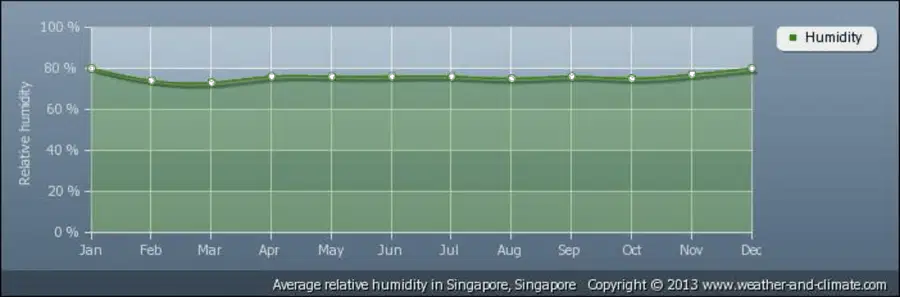
◼Why is Singapore’s humidity high? I thought as temperature
increases, relative humidity decreases?
◼Some of the most humid cities on earth are generally located
closer to the equator, near coastal regions
◼Because of
▪ Proximity to water bodies 🡪 high rates of evaporation
▪ Proximity to the Equator 🡪 high temperatures encourage high rates of
evaporation
73

74

RELATIVE HUMIDITY INCREASES WHEN …
Temperature
decreases but amount
of water vapour
remains the same
Temperature remains
the same but amount
of water vapour
collected increases
Water
vapour
Air
Water
vapour
Air
OR
75
WHAT HAPPENS WHEN TEMPERATURE
DECREASES FURTHER?
When the amount of water
vapour is more than what the air
can hold, the excess water vapour
will condense at dew point
temperature to become water.
Air
Water
vapour
Water
vapour
When the air holds the maximum
amount of water vapour, it is
saturated and Relative Humidity is
100%.
The temperature at which
saturation occurs is called dew
point temperature.
76


76
HOW ARE CLOUDS FORM?
◼As air rises up in the atmosphere, it cools,
reducing the amount of water vapour it can hold.
◼Eventually, the amount of water vapour in the air
exceeds the maximum amount of water vapour
the air can hold (relative humidity becomes
100%, and air is saturated).
◼At this dew point temperature, air condenses
into water droplets on condensation nuclei.
◼Condensation nuclei (e.g. dust and ash particles
from volcanoes)provide surfaces where water
vapor can change into water droplets or solid ice
crystals and form clouds
77

77
PRECIPITATION
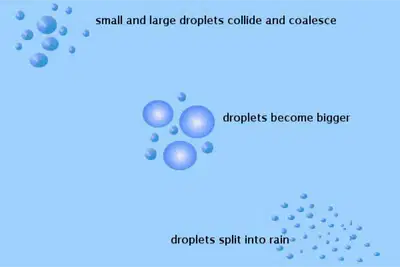
◼Water droplets in the
clouds will collide and
coalesce and become
bigger and heavier.
◼Once the droplets are
large enough (over
0.5mm) they will fall to
the Earth as raindrops,
sometimes breaking
apart as they do so.
78


◼Occurs when the earth’s surface is heated intensely.
◼Common in the tropics(e.g.: Singapore) which receives
a great amount of sunlight.
CONVECTIONAL RAIN
79

79
80

CONVECTIONAL RAIN
◼Most common rainfall type in the tropics.
- Linked to lightning and thunder.
- Short but intense periods of rain.
◼Formation
Sun’s rays heat up earth’s surface and the air above it gains heat
Warm air rises and cools, and condenses on condensation nuclei at
dew point temperature to form clouds
Water droplets in the clouds collide and coalesce, and when they
become large and heavy enough, it falls as rain
80
81
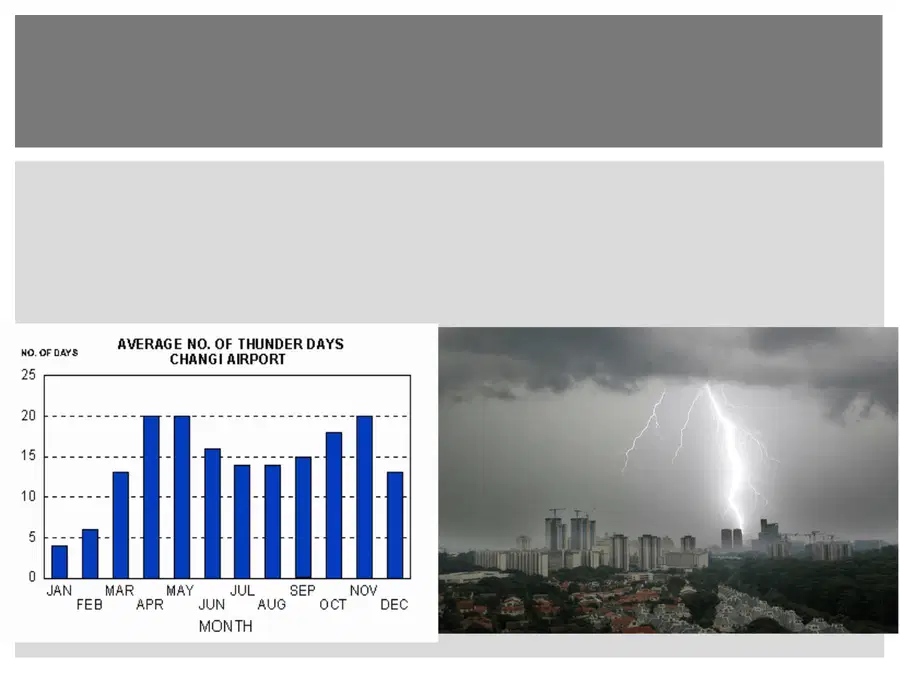
◼As convectional rain is associated with lightning and
thunder, Singapore has one of the highest rate of
lightning activity in the world.
IN SINGAPORE
82

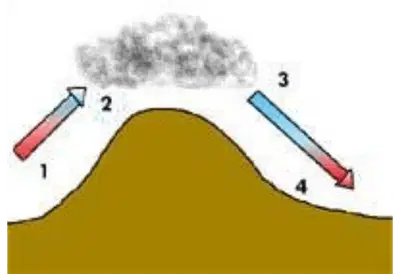
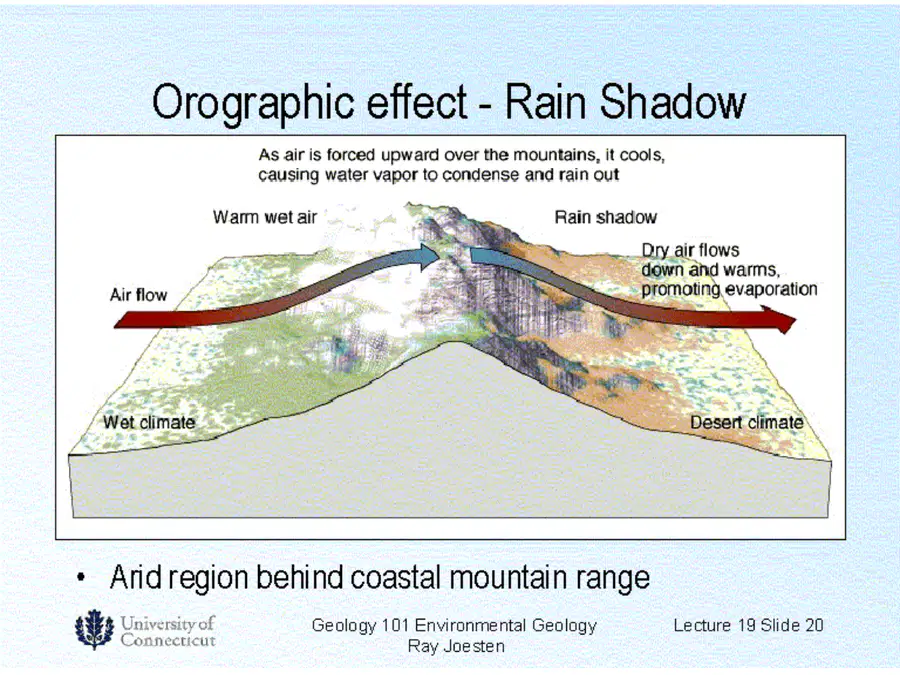
• Prevailing winds pick up moisture over the sea, and push the
moist air up the windward side of a mountain.
• The rising moist air cools and condenses on condensation
nuclei at dew point temperature. Clouds are formed.
• Water droplets in the clouds collide and coalesce, and when
they become large and heavy enough, they fall to the ground
as rain on the windward side.
• As most of the moisture has fallen on the windward side, the
leeward side experiences dry descending air and is thus dry.
RELIEF RAIN
83

RELIEF RAIN
Relief rain can be observed in the Sierra Nevada mountain ranges in California, USA.
The windward side of the mountain ranges receives higher rainfall, and thus has lush
forests. The leeward side is hot and dry, creating the Death Valley desert
84
84
85


1.4 Variation in
wind direction and
wind speed across
earth’s surface
86

In this topic, you will learn:
◼How are winds formed?
◼What determines the speed of wind?
◼Why does wind direction vary across earth’s surface
on a local and regional scale?
LESSON OBJECTIVES
87

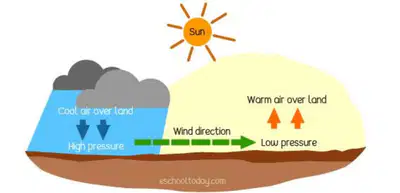
◼Wind
is
the
horizontal
movement of air across the
Earth's surface.
◼In
places
with
higher
temperatures, air is heated,
becomes less dense, and
rises. This results in a void
and
lower
atmospheric
pressure.
◼ In
places
with
lower
temperatures,
air
cools,
becomes denser, and sinks,
which
results
in
higher
atmospheric pressure.
WINDS
88

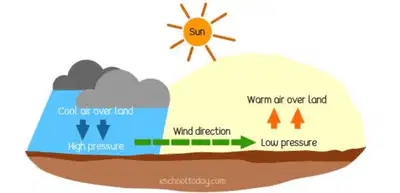
WINDS
◼The
difference
in
pressure between the
two
areas
forms
a
pressure gradient.
◼Air then moves from
an
area
of
high
pressure to an area of
low pressure to fill in
the void. Hence, wind
is formed.
89

Wind speed depends on:
1. Strength of pressure gradient.
❑ Smaller pressure gradient: Smaller difference in pressure between
two areas, leading to slower wind speeds.
❑ Larger pressure gradient leads to faster wind speeds
2. Friction.
❑As moving air comes in contact with variations in the Earth's
topography, it experiences frictional drag which reduces wind
speed.
❑The effect of frictional drag is greatest where there is uneven relief
and rough surfaces on land, e.g. valleys and mountains.
WHAT DETERMINES THE STRENGTH OF
WIND?
90

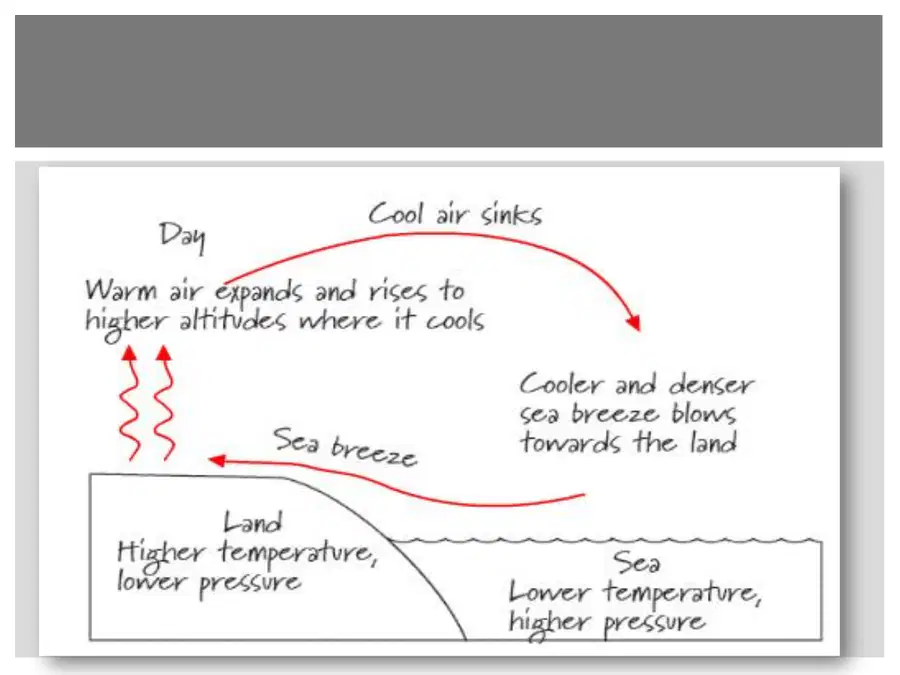
LOCAL WINDS: SEA BREEZE
◼During the day, air over the land is heated up faster
than air over the sea.
◼As warm air rises, a low pressure area is formed.
◼Air over the sea is cooler as the sea heats up slower.
◼The cool air sinks and forms a high pressure area.
◼As air moves from a high pressure area to a low
pressure area, this causes air to move from the sea
towards the land, forming a sea breeze.
91
LOCAL WINDS: SEA BREEZE
92

LOCAL WINDS: LAND BREEZE
◼During the night, the land cools down faster than the
sea.
◼As cool air sinks, a high pressure area is formed.
◼Air over the sea is warmer as the sea loses heat
slower.
◼The warm air rises and forms a low pressure area.
◼As air moves from a high pressure area to a low
pressure area, this causes air to move from the land
towards the sea, forming a sea breeze.
93


LOCAL WINDS: LAND BREEZE
94

MONSOON WINDS
◼Regional wind pattern that reverses direction
seasonally. This will result in seasonal changes in
precipitation.
◼Monsoon winds affected by the Coriolis effect.
- Coriolis effect is a force produced by the earth’s rotation
- Earth’s rotation will deflect the wind’s direction.
◼The Coriolis effect deflects wind to the right at the
northern hemisphere, while it deflects wind to the left
in the southern hemisphere
94
95

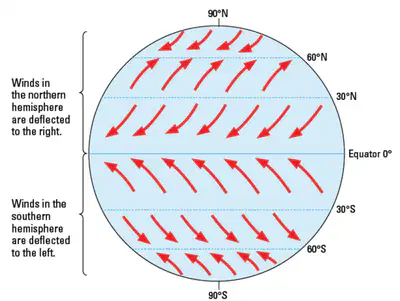
MONSOON WIND — CORIOLIS EFFECT
95
96


97

SOUTH-WEST MONSOON WIND (JUNE-SEPT)
◼The northern hemisphere experiences summer while the
Southern hemisphere experiences winter between June and
September.
◼The land in Central Asia is heated up and air warms and rises,
causing a low pressure area.
◼However the air over Australia cools and sinks, causing a high
pressure area.
◼This results in winds blowing from Australia, towards Central
Asia, forming the Southeast Monsoon winds.
◼However, due to the Coriolis effect, wind is deflected to the
right as it crosses the equator.
◼The Southeast Monsoon winds will become the Southwest
Monsoon winds in SEA due to deflection.
98
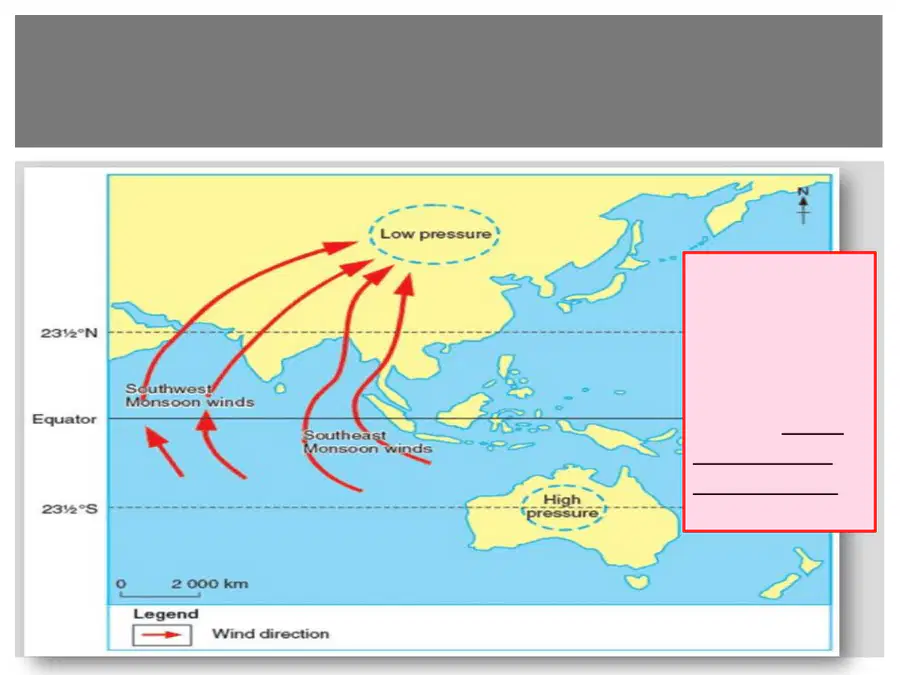
SOUTH-WEST MONSOON WINDS
SW monsoon
blows across the
Indian Ocean,
carrying lots of
moisture,
bringing heavy
rain to Indian
sub-continent
99
100

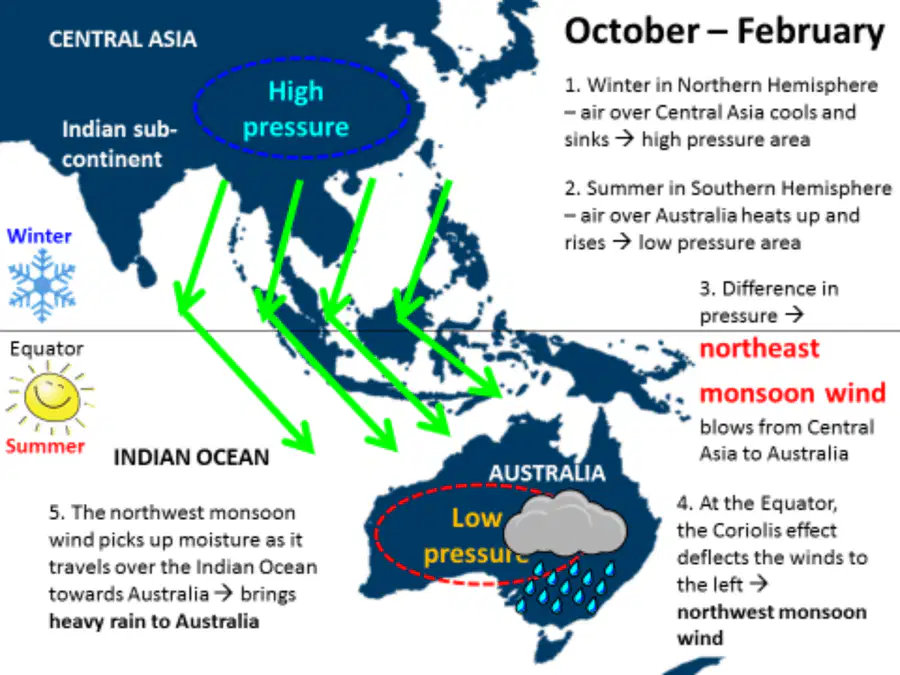
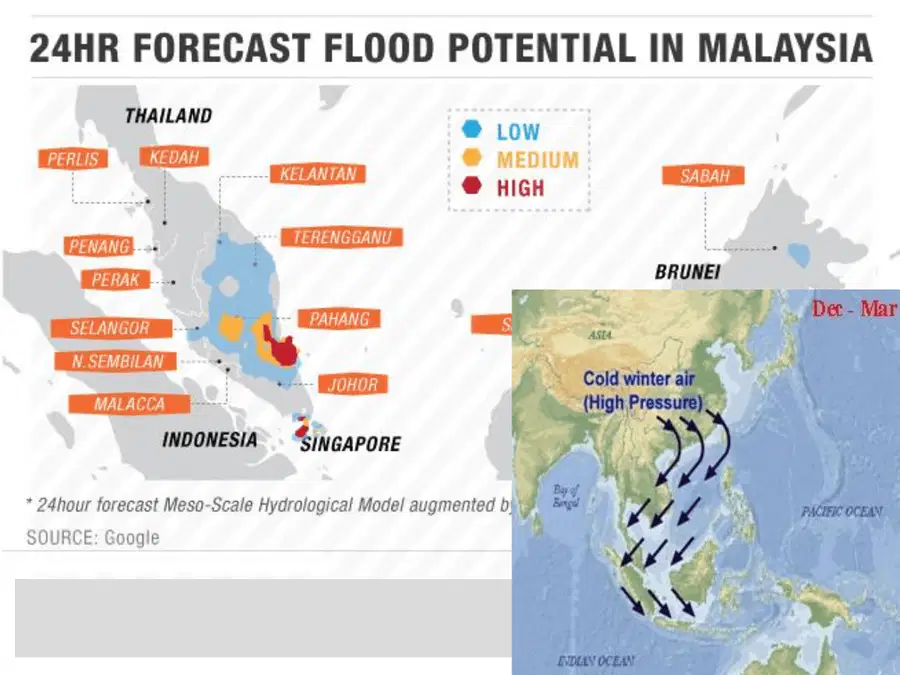
NORTH-EAST MONSOON WINDS (OCT-FEB)
◼The northern hemisphere experiences winter while the
Southern hemisphere experiences summer between October
and February.
◼The land in Australia heats up and air warms and rises, causing a
low pressure area.
◼However the air over Central Asia cools and sinks, causing a high
pressure area.
◼This results in winds blowing from Central Asia, towards
Australia, forming the Northwest Monsoon winds.
◼The Northwest Monsoon winds will become the Northeast
Monsoon winds due to deflection as it crosses the Equator due
to the Coriolis effect.
101
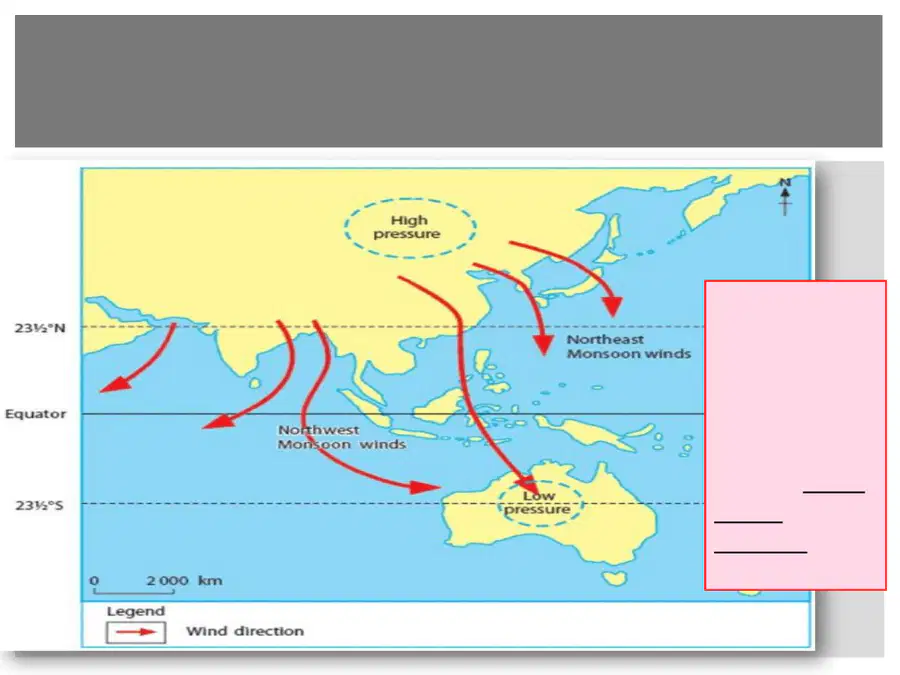
NORTH-EAST MONSOON WINDS
NE monsoon
blows across
the Indian
Ocean, carrying
lots of
moisture,
bringing heavy
rain to
Australia
102
WEATHER AND CLIMATE
Show answer
Auto Play
Slide 1 / 102
SLIDE
Similar Resources on Wayground

101 questions
CRM 1.2 Text 1 Master Lesson
Presentation
•
10th Grade
99 questions
Continuity and Unity of Life
Presentation
•
10th - 12th Grade
102 questions
S2 L2 Vocab Intro
Presentation
•
10th Grade
99 questions
self guided periodic table intro
Presentation
•
11th Grade
100 questions
C1: States of Matter
Presentation
•
9th Grade
93 questions
Circles, radius, inscribed, central, secant, tangents and more
Presentation
•
11th Grade
97 questions
PERÍODE D'ENTREGUERRES
Presentation
•
10th - 12th Grade
97 questions
APHG Unit 3 Review Lesson
Presentation
•
9th Grade
Popular Resources on Wayground
10 questions
Safety Day 2026 – Student Review

Quiz
•
9th Grade
21 questions
Continents and Oceans
Quiz
•
6th Grade
20 questions
Parts of Speech
Quiz
•
5th Grade
16 questions
Subject & Predicate
Quiz
•
5th Grade
25 questions
Multiplication Facts
Quiz
•
5th Grade
12 questions
Map Skills
Quiz
•
3rd Grade
22 questions
Continents and Oceans
Quiz
•
5th Grade
15 questions
Rounding Decimals
Quiz
•
5th Grade
Discover more resources for Geography
13 questions
5 Themes of Geography
Presentation
•
9th - 12th Grade
10 questions
Reteach Unit 4: Latin America Review
Presentation
•
9th - 10th Grade
20 questions
US & Canada Physical and Political Geography
Quiz
•
9th - 12th Grade
7 questions
Prairie, Pacific, and Territories
Presentation
•
9th - 12th Grade
8 questions
The Fight Against Terrorism
Presentation
•
9th - 12th Grade
45 questions
US & Canada Review-B
Quiz
•
9th - 12th Grade
8 questions
Canada: Atlantic and Core Provinces
Presentation
•
9th - 12th Grade