

CAST Pratice

Presentation
•
Chemistry
•
9th - 12th Grade
•
Practice Problem
•
Easy
+24
Standards-aligned

Erin Craven
Used 13+ times
FREE Resource
31 Slides • 19 Questions
1
What to expect with the CAST and How to answer the questions
2
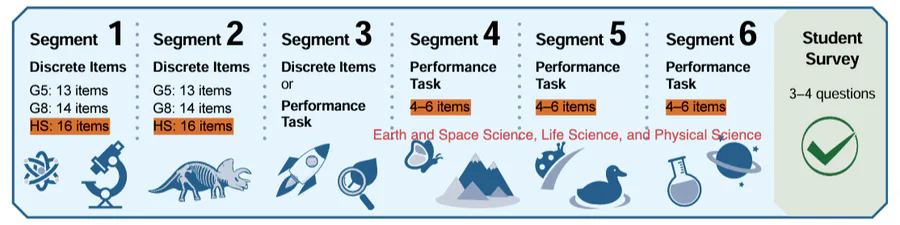
At the end of each segment, you will be prompted to review your answers.
Two types of questions:
Discrete Units: can have more than one item to look at and analyze.
Performance Tasks: has multiple parts. Written portion.
3
There are 6 segments
Segments within a section are presented in random order.
• Segments 1 and 2 contain discrete test items.
• Segment 3 contains either discrete test items or a performance task.
• Segments 4, 5, and 6 are performance tasks, with four to six test items included in each.
You will receive at least one performance task from each of the three science domains: Earth and Space Sciences, Life Sciences, and Physical Sciences.
4
Multiple Choice
How many segments are there on the CAST?
2
4
6
5
Multiple Choice
True or False:
Performance tasks have multiple parts
True
False
6
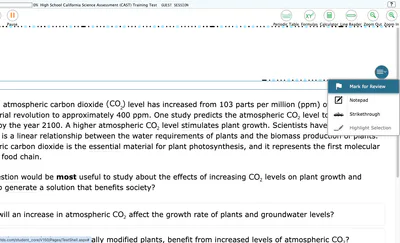
Periodic Table
Formula sheet
Calculator
Use these to help you stay focused while your read or highlight to help you answer questions.
Get to know the TOOLS and USE THEM!!
7
Match
Match the following topics with the discipline
Life Science
Earth and Space Science
Physical Science
Genetics
Volcanic Eruptions
Newton's Law of Gravity
Genetics
Volcanic Eruptions
Newton's Law of Gravity
8
Discrete Units Questions.
Embedded in each question are the following:
Performance Expectation (PE): What we expect you to know or do at this grade.Incorporates SEP, DCI, CCC into topics from ESS, LS, and PE
Science and Engineering Practice (SEP): how we behave as scientist and engineers.
Construct an explanation or design a solution
Performing calculations, engage in an argument from evidence.
Disciplinary Core Ideas (DCI): essential idea about a specific topic in each of the disciplines you should understand.
Human impacts on the Earth's systems,
Crosscutting Concepts (CCC): Interdisciplinary skills we exhibit that bridge science and engineering to the other subjects, like adding or reading.
Cause and Effect
9
They can have only one question attached to the stem or 2 parts.
Discrete Units:
2 maybe 3 segments
Type of questions
Multiple choice
drop down
check box
drag and drop
short answer:
10
Read the question and answers first.
Look at graphs and data tables 2nd. Can you see patterns that help you answer the question? If not then read the question stem.
If you can not find it in the question itself, it might be a DCI question
Short answer: please only answer what is being asked. Don't add any other information. 1-2 sentence max
Strategies for Discrete Units
11
Strategy
Read the question first to determine what the study is focused on. Do you know anything about this?
Look at all the information. I would highlight or write down the question to help stay focused.
Data table and graph:
Identify the two variables being compared.
Determine the relationship.
As one goes... the other goes..
These questions will be focused around a study.
Most likely you will see multiple graphs, or graphs and data tables
Analysis and determine best choice for that study.
Analyze and Interpret Data
12
Some questions will have multiple responses.
The first question is relying on you to make an inference using information given in the question stem.
The second question will require you to know how evolution works.
ANY WORDS YOU DON'T KNOW?? ASK!
13
Dropdown

Based on the graph, if the population density increases from 1 to 500 people/km2, the forest cover will likely
14
Multiple Choice
Part B
The students identified four resource management strategies intended to help preserve forest cover and maintain biodiversity.
The students then ran computer simulations to graphically compare the different resource management strategies.
Which graph shows results for a resource management strategy that will best preserve forest cover as population density increases?
15
Dropdown
Complete the sentence about this change by selecting the correct words from the menus.
If the temperature in the Sierra Nevada Mountains continue to increase, the frequency of the Pgi-4 allele is expected to
16
Multiple Choice
Students use the periodic table to predict reactions between different elements and elemental bromine . An incomplete equation for the reaction between an element and is shown. Bromine atoms have seven valence electrons.
__ + Br2 --> __
Based on the number of valence electrons of elements in a compound, which is a ionic compound that can form in a reaction between and element and Br2?
17
Multiple Choice

Assuming the reaction is complete, which would be the correct number of molecules of A2B that will be produced to the empty box?
18
Law of conservation of matter
Law of conservation of energy
In a closed system matter/energy can not be created or destroyed.
Assume CLOSED systems for everything.
EVERYTHING MUST EQUAL
Big Ideas/Themes
Look for questions that ask
Ps1: Matter and Interactions
19
Law of conservation of matter
Law of conservation of energy
In a closed system matter/energy can not be created or destroyed.
Assume CLOSED systems for everything.
EVERYTHING MUST EQUAL
Big Ideas/Themes
Look for questions that ask you to compare molecules or atoms, or energy in a reaction.
Ps1: Matter and Interactions
20
Sustainability and Human disruption to the ecosystems
Big Ideas/Themes
Look for:
Problems notices. What criteria need to be met to fix.
No solution will meet all the criteria. Big ones: cost (long and short term) least damage to existing or future environment.
TRADE OFF
21
22
Open Ended
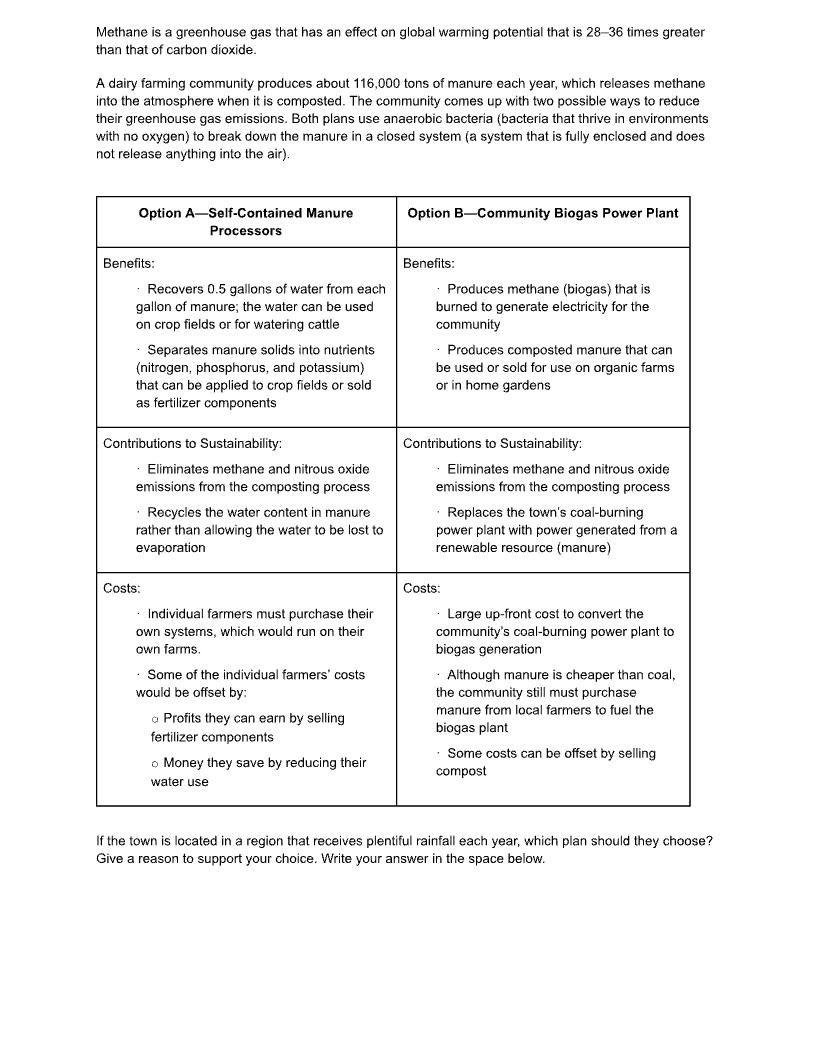
If the town is located in a region that receives plentiful rainfall each year, which plan should they choose? Give a reason to support your choice. Write your answer in the space below.
The correct answer is option ... Though the (give evidence against your answer) .... it is better because (give evidence for your answer)
23
Nitrogen, which is a required component of amino acids, proteins, and DNA, is abundant in Earth’s atmosphere but is not usable by most organisms in its atmospheric form.
The Nitrogen Cycle 1. Microbes in soil convert atmospheric nitrogen to compounds that can be absorbed by plants. 2. Humans and other animals get nitrogen through their diet. 3. Other microbes convert plant and animal waste into atmospheric nitrogen. | Industrial Nitrogen Production Humans use industrial processes to convert atmospheric nitrogen into crop fertilizers. The production of nitrogen fertilizers has enabled global food production to keep pace with increasing world population. · In the 1950s, farmers used about 20 million tons of all types of fertilizer each year. · In 2019, global agricultural production will use more than 118 million tons of nitrogen fertilizer alone. |
Heavy use of nitrogen fertilizers has disrupted the natural nitrogen cycle: · Excess nitrogen in agricultural runoff damages aquatic ecosystems and pollutes drinking water. · Excess nitrogen in agricultur25al soil is converted to nitrous oxide, a greenhouse gas that traps heat more effectively than carbon dioxide. Engineers are seeking ways to meet humanity’s need for food production without continuing to damage the environment. It is likely that a combination of approaches is needed to balance the global nitrogen cycle. Proposed solutions include: |
Woodchip bioreactors—Water contaminated with nitrates flows through a trench filled with woodchips before entering the drainage system. Bacteria colonizing the woodchips convert the nitrates to atmospheric nitrogen. Once installed, these reactors are relatively maintenance-free.
Advanced crop rotation—Keep nitrogen in agricultural fields to be used and reused by different crops. This can be done, for instance, by alternating a shallow-rooted crop with a deep-rooted crop so that nitrogen fertilizer that has moved lower in the soil is used up. Careful selection of crops and crop varieties is important and varies greatly from place to place.
24
Labelling
Which factors apply to each solution?
WB 1
AD yes 2
WB2
WB 3
AD Yes 1
25
Multiple Choice
Students noticed that a nearby pond, fed by a single stream, was filling with sediment. The students want to determine what factors are contributing to the amount and type of sediment entering the pond. Which investigation is most likely to produce data that will help answer their questions?
Measure the depth of the sediments in the center of the pond once a week during the school year.
Collect and emasure the mass of particles carried by the stream in one minute and then in ten minutes
Collect and measure the mass of clay particles, silt particle, sand grans, and small pebbles carried by the stream at different stream flows
Obtain samples from different depths in the sediments at the bottom of the pond and determine how the sizes and amount of particles have changed over time.
26
LS1: From Molecules to Organisms
DNA--> Protein--> Life's Daily Function through specialized cells
Big Ideas/Themes
Look for:
Problems in a DNA sequence: How does this effect the protein? How does this affect the daily activities of the individual?
27
LS2: Ecosystems: interactions, Energy and Dynamics
Big Ideas/Themes
Look for:
Problems in an ecosystem. How does the presence of one organisms affect the presence of another.
Predator/Prey
Parasite/host
Symbotic/Mutualisitic
28
Read the question stem first, then look at the question.
Go back the stem and highlight specifically what the you think relates to what is being asked.
Then look at the answers and compare this to the highlighted portion.
Strategy
Theme : Planning and Carrying out investigation.
As Scientists what we think can be proven through experimentation.
Theme: How Structure affects function
Big Ideas/Theme
29
LS3: Heredity: inheritance and variation of traits
Big Ideas/Themes
Look for:
Problems in genetics, punette square problems
We want to know how you can apply the rules of probability to entire populations.
30
Performance Question
Series of 6 questions
All questions relate to one topic
You will have 3 maybe 4 segments of these questions
31
Big Ideas/Themes
Look for:
Problems in population that is separated from other species, what would you expect to happen.
Natural selection /artificial selection
Genetic drift / Bottle neck
Sexual selection
Extinction
LS4: Biological Evolution: unity and Diversity
32
33
34
35
Open Ended
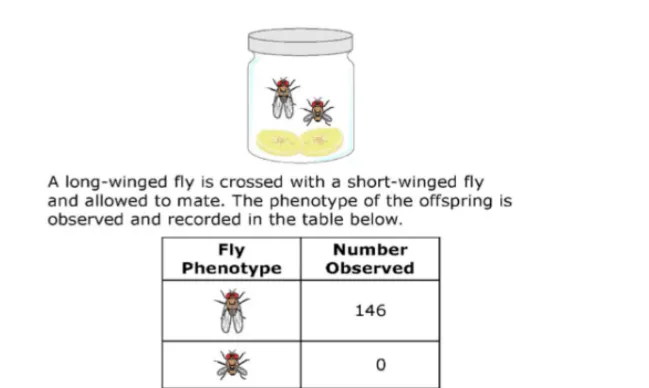
Based on the results in the data table, explain why there are no flies with short wings.
36
37
Fill in the Blanks
Type answer...
38
Fill in the Blanks
Type answer...
39
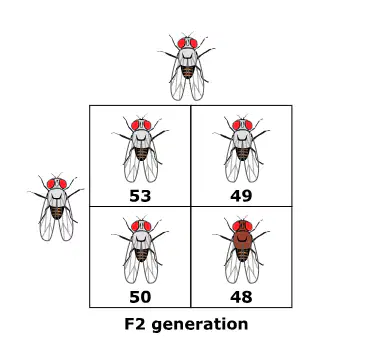
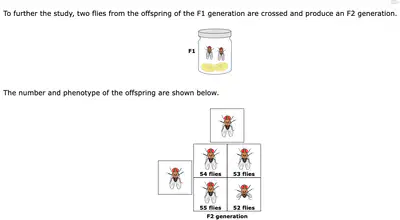
The Punnett square show the possible results of a cross between two flies from the F1 Generation.
B=is domanint white body
b= is recessive brown body
40
Draw
The Punnett square show the possible results of a cross between two flies from the F1 Generation.
On the Pie Chart mark the area off that would contain the Percentage of BB
Percentage of bb
Percentage of Bb
Draw lines from the middle to the outside and label the area with the correct genotype
41
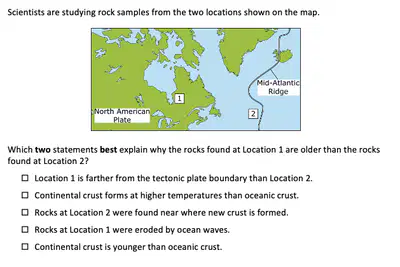
This question requires you to know about the processes that occur at the Mid-Atlantic ridge.
42
Multiple Select
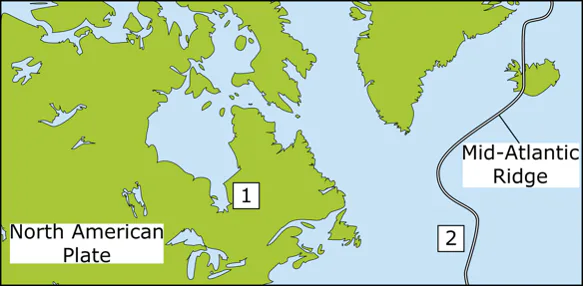
Scientists are studying rock samples from the two locations shown on the map. Which two statements best explain why the rocks found at Location 1 are older than the rocks found at Location 2?
Location 1 is farther from the tectonic plate boundary than Location 2.
Continental crust forms at higher temperatures than oceanic crust.
Rocks at Location 2 were found near where new crust is formed.
Rocks at Location 1 were eroded by ocean waves
Continental crust is younger than oceanic crust.
43
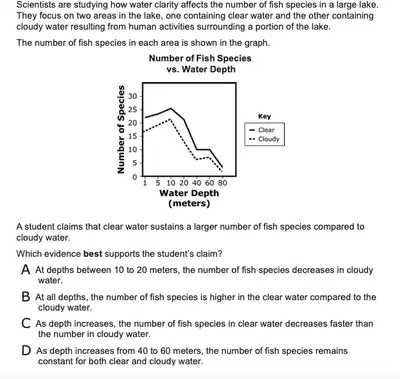
Double line graphs are used to compare trends or patterns between two different subjects.
What claim is the student making?
How do the two types of water compare?
44
Multiple Choice
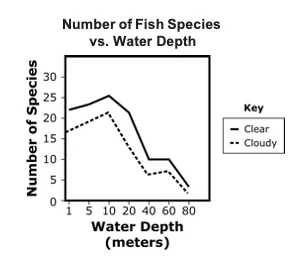
Scientists are studying how water clarity affects the number of fish species in a large lake. They focus on two areas in the lake, one containing clear water and the other containing cloudy water resulting from human activities surrounding a portion of the lake.
The number of fish species in each area is shown in the graph. A student claims that clear water sustains a larger number of fish species compared to cloudy water.
Which evidence best supports the student’s claim?
At depths between 10 to 20 meters, the number of fish species decreases in cloudy water
At all depths, the number of fish species is higher in the clear water compared to the cloudy water.
As depth increases, the number of fish species in clear water decreases faster than the number in cloudy water.
As depth increases from 40 to 60 meters, the number of fish species remains constant for both clear and cloudy water.
45

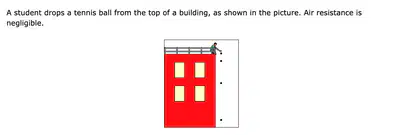
For this you need to find the equation in the tool section.
Identify the variables in the equation
F=mgh
In the picture where is the tennis ball showing potential energy? Where is the tennis ball showing Kinetic energy?
Law of conservation these two energies equal.
Start you explanation there. This should not be more than 2-3 sentences.
46
Open Ended
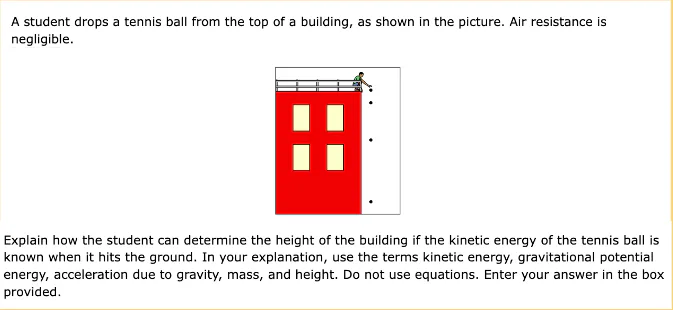
Pe=mgh
Without using the equation. Explain in words how you could determine the height of the building.
47
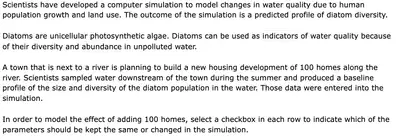
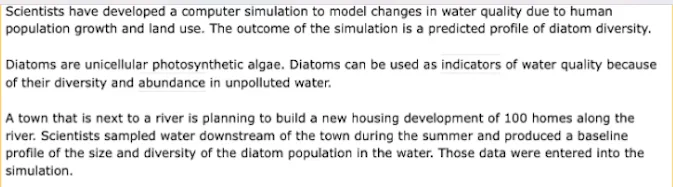
1. What is it asking you to determine?
2. What is(are) the parameter(s)?
3. What would change with a 100 homes?
4. What would not change with a 100 homes?
48
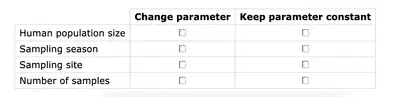
Categorize
Sampling season
Human population size
Sampling site
Number of Samples
After reading the introduction:
To model the effect of adding 100 homes. Which of the options would keep parameter the same which one would change the parameters?
49
50
What to expect with the CAST and How to answer the questions
Show answer
Auto Play
Slide 1 / 50
SLIDE
Similar Resources on Wayground

46 questions
Trigonometric Ratios
Presentation
•
9th - 12th Grade
40 questions
Balancing and 5 Types of Chemical Reactions
Presentation
•
9th - 12th Grade
47 questions
Elkhorn History Images
Presentation
•
KG
43 questions
Chemistry Unit 8 Lesson 1: The Mole and Intro to Stoich
Presentation
•
10th - 12th Grade
44 questions
Intermolecular and Intramolecular Forces
Presentation
•
9th - 12th Grade
42 questions
Review - 1st 6wks
Presentation
•
9th - 12th Grade
41 questions
Nuclear Chemistry
Presentation
•
9th - 12th Grade
44 questions
History of Atomic Theory
Presentation
•
10th - 12th Grade
Popular Resources on Wayground
15 questions
Grade 3 Simulation Assessment 1

Quiz
•
3rd Grade
22 questions
HCS Grade 4 Simulation Assessment_1 2526sy
Quiz
•
4th Grade
16 questions
Grade 3 Simulation Assessment 2
Quiz
•
3rd Grade
19 questions
HCS Grade 5 Simulation Assessment_1 2526sy
Quiz
•
5th Grade
17 questions
HCS Grade 4 Simulation Assessment_2 2526sy
Quiz
•
4th Grade
20 questions
Equivalent Fractions
Quiz
•
3rd Grade
24 questions
HCS Grade 5 Simulation Assessment_2 2526sy
Quiz
•
5th Grade
20 questions
Math Review
Quiz
•
3rd Grade
Discover more resources for Chemistry
22 questions
Solubility Curve Practice
Quiz
•
10th Grade
10 questions
Exploring Properties and Models of Acids and Bases

Interactive video
•
6th - 10th Grade
19 questions
Review Set 3 - Moles & Chemical Formulas
Presentation
•
10th Grade
20 questions
Types of Chemical Reactions
Quiz
•
9th - 12th Grade
20 questions
Stoichiometry Practice
Quiz
•
10th Grade
10 questions
Identifying Types of Chemical Reactions
Interactive video
•
6th - 10th Grade
20 questions
Redox Reactions
Quiz
•
10th - 12th Grade
20 questions
pH and pOH Calculations
Quiz
•
10th - 11th Grade