Search Header Logo
ULTIMATE STAAR REVIEW

ULTIMATE STAAR REVIEW

Assessment

Presentation

Biology

9th Grade

Medium

Created by

ERICA VEGA

Used 15+ times

FREE Resource

57 Slides • 96 Questions

1

media

2

media

3

Multiple Choice

What organelle is found in all eukaryotic cells but NOT in prokaryotic cells?

1

cell wall

2

nuclues

3

cell membrane

4

cytoplasm

4

Multiple Choice

Question image

4A Students use a microscope to look for structures present in four different cells. The students placed an X for each structure that was viewed for each cell on the table shown.


Which cell that was viewed is most likely a prokaryote?

1

Cell W

2

Cell X

3

Cell Y

4

Cell Z

5

media

6

Multiple Choice

____________ & _________________ are organelles that definitely arose from endosymbiosis.
1
Rough ER & Smooth ER
2
Mitochondria & Flagellum
3
Chloroplast & Mitochondria
4
Chloroplast and Golgi apparatus

7

Multiple Choice

The theory of Endosymbiosis explains
1
The origin of eukaryotes
2
How species develop
3
How bacteria live
4
Why cells rely on one another

8

Multiple Choice

What evidence does not support the evolution of chloroplasts and mitochondria from prokaryotic cells?

1

fossil record

2

double membrane of organelles

3

similar methods of reproduction

4

presence of circular DNA

9

media

10

Multiple Choice

Question image

which two processes is this diagram showing us?

1

energy conversions and synthesis of new molecules

2

synthesis of new molecules and homeostasis

3

transport of molecules and energy conversions

4

homeostasis and transport of molecules

11

Multiple Choice

How does the cell membrane help to maintain the health of the cell?

1

By providing support and structure for the cell

2

By regulating the transport of materials in and out of the cell

3

By manufacturing protein to provide energy for the cell

4

By storing food as future energy for the cell

12

Multiple Choice

A scientist is investigating cell transport. She observes molecules being transported into a cell through proteins present in the cell membrane. These proteins do not use energy to transport the molecules. Which of the following best explains the type of cell transport observed by the scientist?

1

Active transport because membrane proteins were used

2

Diffusion because the molecules were entering the cell

3

Facilitated diffusion because the proteins were not using energy

4

Osmosis because the molecules were moving against the concentration gradient

13

Multiple Choice

The cell membrane is semi-permeable. What does that mean?

1

that the cell membrane lets ALL things in and out of the cell

2

that the cell membrane lets NO things in and out of the cell

3

that the cell membrane lets SOME things in and out of the cell

14

media

15

media

16

media

17

Multiple Choice

Is a virus considered living or non-living?
1
Living
2
Non-Living
3
Neither

18

Multiple Choice

4C: Which of these describes a difference between viruses and cells?

1

Cells contain protein, and viruses only contain carbohydrates

2

Viruses have flagella, and cells have only cilia

3

Cells reproduce independently, and viruses require a host to reproduce

4

Viruses have membranes made of proteins, and cells have membranes made of nucleic aci

19

Multiple Choice

Question image
What do viruses have in common with living cells? They both...
1
store genetic information
2
have chloroplasts
3
use glucose for cellular respiration
4
have endoplasmic reticulum

20

media

21

Multiple Choice

Some examples of things that can cause the cell cycle to become abnormal are

1

carcinogens

2

UV radiation

3

Viruses

4

All of the above

22

Multiple Choice

Question image

Here is the cell cycle. 

When cells leave the cell cycle, they exit during G1 phase and enter G0 phase, a resting period. Most normal cells can leave G0 phase and re-enter the cell cycle at G1 before entering S phase. Cancer cell are different because they cannot enter G0 phase and are likely to do which of the following?

1

Fail to complete S phase

2

Mutate during G1 phase

3

Repeat the cell cycle continuously 

4

Die after completing mitosis

23

media

24

Multiple Choice

Cancer is caused by

1

Out of control DNA replication

2

Out of control cell cycle caused by damaged DNA

3

Out of control cell cycle caused by cyclins

4

Tumors

25

media

26

Multiple Choice

Undifferentiated cells are called:

1

stem cells

2

nerve cells

3

eye cells

4

skin cells

27

Multiple Choice

Cell expression is regulated by:

1

internal factors

2

external factors

3

both

28

Multiple Choice

All your cells have the same:

1

shape

2

size

3

DNA

4

Transcription factors

29

media

30

Multiple Choice

Question image

6A In 1952 Rosalind Franklin took the x-ray photograph shown, which gave the world its first look at DNA.


By studying this photograph, scientists gained knowledge about the —

1

role of DNA in protein synthesis

2

mutation of nucleotide sequences in DNA

3

sequence of DNA that makes up the human genome

4

double-helix structure of DNA

31

Multiple Choice

6A: Which part of a DNA molecule is responsible for the direct coding of specific traits in an organism?

1

The number of hydrogen bonds that hold the strands of DNA together

2

The number of carbons in the DNA molecule

3

The sequence of nucleotide bases in the DNA molecule

4

The sequences of phosphates along each DNA strand

32

Multiple Choice

6A A segment of a DNA strand is shown.


3’ AGGTCAGGT 5’


Which of these is the correct complementary DNA strand for the segment shown?

1

5’ AGGTCAGGT 3’

2

5’ ACCUGAGGU 3’

3

5’ TGGACTGGA 3’

4

5’ TCCAGTCCA 3’

33

media

34

Multiple Choice

DNA replication results in

1

2 completely new DNA molecules

2

2 DNA molecules that each contain a strand of the original

3

1 new DNA molecule and 1 old

4

1 new molecule of DNA

35

Multiple Choice

Why does DNA replicate?
1
To create another copy for the new cell
2
To create a duplicate copy in case the original gets damaged
3
To create a new copy to replace the damaged original

36

Multiple Choice

A process in which DNA has the unique ability to make an exact copy of itself.
1
Replication
2
Translation
3
Transcription

37

media

38

Multiple Choice

Question image

Researchers combined sequences of fruit-fly DNA from a gene for a particular trait with frog DNA. The mixture was heated to separate the DNA strands. Cooling allowed the single strands to form pairs. The researchers observed that some of the fruit-fly DNA paired with frog DNA. The results provide evidence that -

1

similar nucleotides are present in both fruit-fly and frog DNA

2

fruit flies and frogs can be made to develop some of the same physical traits

3

heat can cause mutations in the DNA sequences of organisms

4

the replication of genetic material can occur at any temperature

39

Multiple Choice

Which of these components are found in the cells of all living organisms?

1

estrogen and testosterone

2

hemoglobin and lymphocytes

3

cytosine and guanine

4

cellulose and chlorophyll

40

media

41

media

42

Multiple Choice

Question image

6C: The initial steps in gene expression are modeled above. Double-stranded DNA first unwinds into two strands. Which process and product are represented in Diagram 2?

1

Process: transcription; product: mRNA

2

Process: translation; product: protein

3

Process: replication; product: tRNA

4

Process: recombination; product: polymerase

43

Multiple Choice

Question image

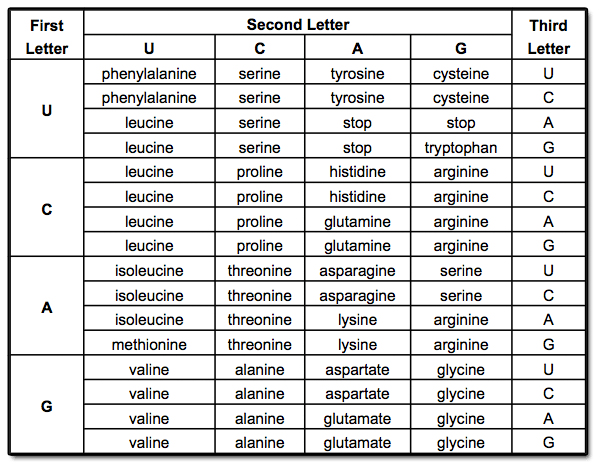
What amino acid is represented by the codon UUA?

1

Phenylalanine

2

Tyrosine

3

Leucine

4

Stop codon

44

Multiple Choice

Transcribe the following DNA to mRNA


TAC ATT CGA AAA

1

ATG TAA CGA TTT

2

AUG UAA GCU UUU

3

AUG UAA GCU AAA

4

AUG UTT GCU UUU

45

media

46

media

47

Multiple Choice

Question image

DNA molecule segment is : TTA-CGC-AAG

The mutated DNA segment is TTC-GCA-AG. This is an example of ___ mutation.

1

Substitution

2

Deletion

3

Insertion

4

Inversion

48

Multiple Choice

Question image

What mutation has occurred here?

T-G-A-C-C-A

T-G-A-G-C-A

1

Substitution

2

Deletion

3

Insertion

4

Frameshift

49

media

50

Multiple Choice

Meiosis makes which kind of cells?

1

sex cells

2

skin cells

3

eye cells

4

hair cells

51

Multiple Choice

6G: During meiosis, homologous chromosomes exchange genetic material. This exchange of genetic material:

1

increases the genetic variation

2

reduces the diploid number to the haploid number

3

increases the haploid number to the diploid number

4

reduces the probability of mutations

52

Multiple Choice

Question image

What is the significance of crossing over during meiosis?

1

Genes from the mother and the father combine to increase the variety of traits expressed by their offpsring

2

Gametes duplicate and alter the number of chromosomes present at the end of meiosis

3

Gametes begin with 48 chromosomes and still have 48 chromosomes at the end of meiosis

4

Genes replicate and ensure that the offspring have the same traits as the parents.

53

media

54

media

55

Multiple Choice

Question image
T - tall and t = short
In the punnett square below, what belongs in the missing square
1
tt
2
Tt
3
Bb
4
TT

56

media

57

media

58

Multiple Choice

Cross Two Homozygous plants
(
RRYY x rryy)
R = round seeds, r  = wrinkled seeds Y = yellow seeds, y = green seeds
What percent will have Round and Yellow seeds? 
1
0%
2
25%
3
50%
4
100%

59

media

60

media

61

media

62

media

63

media

64

Multiple Choice

If two organisms have similar traits of DNA they are probably
1
share a common ancestor
2
share a common environment
3
share a common population
4
speciation

65

Multiple Choice

The opossum and kangaroo both incubate their young in a pouch. This provides evidence that they---
1
are descended from a common ancestor
2
Have very similar skeletal structures
3
belong to the same species
4
must range great distances to eat

66

Multiple Choice

Similar structures with different purposes found in different species are known as _____

1

vestigial structures

2

DNA

3

homologous structures

4

the fossil record

67

media

68

Multiple Choice

Only populations can evolve.
Individuals can not evolve.
1
True
2
False

69

Multiple Choice

Which of the following is an example of natural selection?

1

Birds migrating south for the winter

2

Hamster with different colors of fur

3

Butterflies come in many different varieties

4

A purple insect is more likely to survive in a field of purple colored flowers than an orange insect

70

media

71

Multiple Choice

Yellow toucan birds seek out one another to make babies together and tend to avoid the green toucan birds.
1
Genetic Drift
2
Non-random mating
3
Gene flow
4
Mutation

72

Multiple Choice

Five hundred years after the deer had established a flourishing population in the park, a few of them venture back to their original woods and have babies with the deer there.
1
Genetic Drift
2
Mutations
3
Non-random mating
4
Gene flow

73

Multiple Choice

Question image
What does the image represent?
1
Gene flow
2
Gene drift
3
Mutation
4
Adaptation

74

media

75

Multiple Choice

Question image
The 8 levels of classification, most broad to most specific.
1
Domain, Genus, Family, Order, Class, Phylum, Kingdom, Species
2
Domain, Species, Kingdom, Genus, Phylum, Family, Class, Order
3
Domain, Kingdom, Phylum, Class, Order, Family, Genus, Species
4
Order, Kingdom, Species, Domain, Phylum, Family, Class, Genus

76

Multiple Choice

The scientific name for an organism is made from the:
1
class and family name
2
genus and species name
3
domain and kingdom name
4
kingdom and phylum name

77

Multiple Choice

Which of the following organisms are most DISTANTLY related?

1

organisms that share a domain

2

organisms that share a family

3

organisms that share a genus

4

organisms that share a species

78

media

79

Multiple Choice

Plants and animals belong to which domain?

1

bacteria

2

archaea

3

eukarya

80

Multiple Choice

Question image

This is Yellowstone National Park, where hot springs like these are found. These springs are HOT and only certain types of bacteria can live there. In which domain do bacteria these bacteria belong?

1

bacteria

2

archaea

3

eukarya

81

media

82

media

83

Multiple Choice

I am prokaryotic and am found everywhere. What kingdom do I belong to?

1

Eubacteria

2

Archaebacteria

3

Fungi

4

Protista

84

Multiple Choice

Members of this kingdom are multicellular and heterotrophic.
1
Plantae
2
Protista
3
Animalia
4
Achaebacteria

85

media

86

Multiple Choice

Question image
An illustration and a dichotomous key are given. What is the correct classification for this organism?
1
Class Insecta
2
Order Amblygygi
3
Order Araneae
4
Order Scorpiones

87

media

88

Multiple Choice

Question image
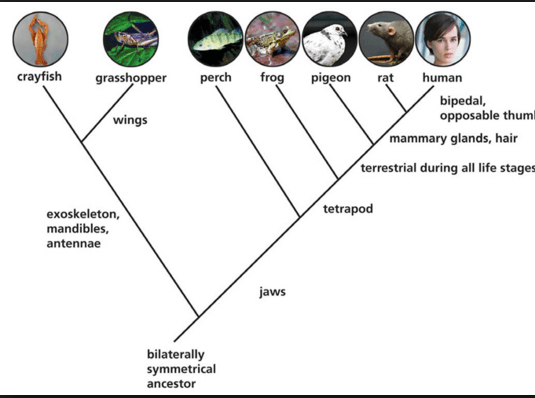
According to the cladogram, which organism is most distantly related to the human?
1
crayfish
2
grasshopper
3
perch
4
frog

89

Multiple Choice

Question image
On the cladogram, which feature do all organisms inherit?
1
A
2
B
3
C
4
D

90

media

91

Multiple Choice

What is a function of carbohydrates?

1

provide short term energy

2

provide the structure in muscles

3

provide long term energy

4

store genetic information

92

Multiple Choice

Proteins are made of monomers called

1

saccharides

2

nucleotides

3

amino acids

4

fatty acids

93

Multiple Choice

What is the function of proteins?

1

They are used for cell to cell communication

2

They insulate the body, are used for short term energy and are found in glycogen

3

They are used as the structural components of the body (muscles and organs)

4

They create the cell membrane

94

media

95

Multiple Choice

Which biomolecule is correctly paired with its function?

1

Lipids - express genes

2

Protein - form enzymes

3

Carbohydrates - create hormones

4

Nucleic acids - insulate animal tissue

96

Multiple Choice

Question image

Which is the most valid conclusion based on this graph?

1

Enzymes are not affected by temperature.

2

Enzymes work most effectively at low temperatures.

3

Raising the temperature always makes an enzyme work better

4

Enzyme function decreases after a certain optimal temperature

97

media

98

media

99

Multiple Choice

What is the main purpose of cellular respiration?

1

make glucose

2

make energy

3

make sunlight

4

use carbon dioxide

100

Multiple Choice

Products are

1

inputs

2

outputs

3

waste

4

ingredients

101

Multiple Choice

Reactants are

1

inputs

2

outputs

3

waste

102

Multiple Choice

Question image

Analyze the graphic above. What are the chemicals represented by the Y?

1

H2O +O2

2

H2O + CO2

3

C6H12O6 + O2

4

C6H12O6 + CO2

103

media

104

media

105

Multiple Choice

What 2 systems: Controls the production of sex cells

1

Excretory and Reproductive

2

Endocrine and Reproductive

3

Endocrine and Muscular

4

Endocrine and Respiratory

106

Multiple Choice

What 2 systems: Transports white blood cells throughout the body to fight disease

1

Excretory and nervous

2

Circulatory and immune

3

Respiratory and nervous

4

Digestive and immune

107

media

108

media

109

media

110

media

111

media

112

Multiple Choice

Question image

10B: A student conducted an investigation to study phototropism in grasses. The only different between the control group and the experimental group was light conditions. The control group was provided full light, while the experimental group was shaded on one side. The diagrams show the average heights and positions of blades of grass in the investigation. Which statement best explains why the grass tips of the experimental group bent toward the light?

1

Water evaporated faster on the side of the plant having full light

2

Light sensors in the grass tips stimulated a hormone in the shoot system

3

The xylem in the root system absorbed more nutrients from the shaded side

4

The side facing the light has a greater chance of absorbing carbon dioxide from the atmosphere

113

Multiple Choice

Question image

10B: Plant roots have extensions called root hairs. These root hairs are important in the homeostasis of the plant. Which statement best explains the importance of the root hairs to the stems and leaves of the plant?

1

Root hairs convert minerals into glucose for immediate use by cells

2

Root hairs decrease the need for osmosis and diffusion in vascular tissue

3

Root hairs prevent water loss in leaves through transpiration and gas exchange

4

Root hairs increase the surface area of the roots for nutrient and water absorption

114

media

115

Multiple Choice

Which is NOT a microorganism?

1

fungi

2

bacteria

3

pollen

4

protist

116

media

117

Multiple Choice

Primary succession occurs in areas with:

1

very little soil

2

lots of soil

3

no soil

4

soil that has been disturbed

118

Multiple Choice

Which of the following best describes primary succession?

1

Volcano wipes out ecosystem that gradually grows back from ash covered soil

2

Volcano creates a new island of rock that must break down to form an ecosystem

3

Forest fire burns down forest that must bounce back over time

4

Tornado destroys a crop that must slowly grow back over time.

119

media

120

media

121

Multiple Choice

How is commensalism different from mutualism?

1

In commensalism, one species benefits while the other is unharmed; in mutualism, both species benefit

2

In commensalism, one species is harmed while the other benefits; in mutualism, both species benefit

3

In commensalism, neither species is harmed; in mutualism, one species is harmed

4

In commensalism, both species benefit; in mutualism, one species is harmed

122

Multiple Choice

Which of the following is an example of symbiosis?

1

A mother bear taking care of her cub

2

A married couple who agree to split their rent and share housework duties

3

A worm living in a cow's intestine.

4

One chimp cleaning and grooming the hair of another chimp.

123

media

124

Multiple Choice

Question image
What are plants called in a food chain?
1
Producers
2
Consumers
3
Decomposers
4
Scavengers

125

Multiple Choice

Question image
Which of these organisms would receive energy from the snake?
1
Plant
2
Rabbit
3
Mouse
4
Hawk

126

Multiple Choice

Question image
Which of these organisms would receive energy from the snake?
1
Plant
2
Rabbit
3
Mouse
4
Hawk

127

media

128

Multiple Choice

Question image

How much energy is transferred from one trophic level to the next in an energy pyramid?

1

1%

2

10%

3

100%

4

90%

129

Multiple Choice

Cannot make its own food

1

Autotroph

2

Producer

3

Heterotroph

4

Biomass

130

Multiple Choice

Makes its own food

1

Herbivore

2

Carnivore

3

Heterotroph

4

Autotroph

131

media

132

Multiple Choice

Consider the following food chain:

Algae > Mayfly > Minnow > Trout

In a polluted ecosystem, which organism would likely have the HIGHEST level of toxic chemicals in its body?

1

Algae

2

Mayfly

3

Minnow

4

Trout

133

media

134

Multiple Choice

Which ecological nutrient cycle relies heavily on bacteria to "fix" an important nutrient by converting it from atmospheric gas to a form that can be absorbed by plants?

1

Carbon Cycle

2

Nitrogen Cycle

3

Phosphorus Cycle

135

media

136

Multiple Choice

The pollution of local waterways and aquatic ecosystems by excess nutrients from fertilizers can lead to algae blooms and the death of aquatic organisms in a process known as...

1

Eutrophication

2

Fertilization

3

Nutrification

4

Denitrification

137

media

138

Multiple Choice

Which ecological nutrient cycle relies on photosynthesis and respiration?

1

Carbon Cycle

2

Nitrogen Cycle

3

Phosphorus Cycle

139

media

140

Multiple Select

Question image

Which is true about stable ecosystems?

1

Healthy ecosystems have high biodiversity.

2

Stable ecosystems have more consumers than they can support.

3

Stable ecosystems have too many producers.

141

Multiple Choice

Question image
Which of the following would be the most likely effect, if there were a sudden increase in the cricket population?
1
There would be a decrease in the small bird population.
2
There would be a decrease in the grass/flowers population.
3
There would be a decrease in the mice population.
4
There would be an increase in the grass/flowers population.

142

Multiple Select

Which of the following alleles is homozygous recessive? Select two answers.

1
Tt
2
tt
3
TT
4

BB

5

bb

143

Multiple Choice

The following items are examples of __________.

Items: eye color, hair color, height

1

homozygous alleles

2

genotype

3

heterozygous alleles

4

phenotype

144

Multiple Choice

Crossing over creates new combinations this causes

1

increase cell numbers

2

increase in genetic variation

3

decrease in genetic variation

145

Multiple Choice

How Many chromosomes are in a Diploid Cell?

1

21

2

45

3

46

4

23

146

Multiple Choice

How many chromosomes are in a Haploid Cell?

1

21

2

12

3

23

4

46

147

Multiple Select

What do all living organisms have in common ? select all that apply.

1

Base pairing

2

Exact DNA sequence

3

Codons

4

Amino acids

5

Proteins

148

Multiple Choice

Question image

The similarities in embryonic development shown in the diagrams suggest that these organisms -

1

develop the same exact way

2

may have evolved from the same common ancestor

3

are all the same species

4

have the same adaptations as adults

149

Multiple Choice

The science of describing, classifying, and naming living things is called:

1

Geology

2

Biology

3

Taxonomy

4

Chemistry

150

Multiple Choice

A scientific name consists of 
1

Genus and Order

2

Genus and Domain

3

Genus and species

4

Kingdon and Phylum

151

Multiple Choice

Question image
If B = brown hair and b = blonde hair, what is the probability of brown hair?
1
25%
2
50%
3
0%
4
75%

152

Multiple Choice

Amount of energy in a food pyramid transferred from one level to the next

1

0%

2

10%

3

78%

4

100%

153

Multiple Choice

Which of the following statements are true?
1
All microorganisms are bad
2
All microorganisms are good
3
Some microorganisms are harmful, while some can be helpful
4
Microorganisms are too small to do anything to anyone
media

Show answer

Auto Play

Slide 1 / 153

SLIDE