

Phy Science Final Exam Review

Presentation
•
Science
•
9th - 12th Grade
•
Hard

John Oglesby
Used 3+ times
FREE Resource
51 Slides • 66 Questions
1
Final Exam Review
2
Periodic Table and Atomic Structure 14 questions x 2 pts = 28 pts
Periodic Table Organization
Atomic Structure
Protons/Neutrons/Electrons
Atoms/Ions/Isotopes
Chemical Reactions 4 questions x 2 pts = 8 pts
Writing and Balancing Equations
Moles & Molar Conversions 2 questions x 4 pts = 8 pts
Moles to grams, gr to moles
Energy 4 questions x 5 pts = 20 pts
Newtons Laws 4 Questions x 2 pts = 8 pts
Essay (Chem Eqns & Reaction types) 2 questions x 5 pts = 10 pts
Last Question Easy 18 pts
3
14 questions x 2 pts each = 28 pts
PT Organization
Atomic Structure - Atomic Number, Atomic Mass,
Atoms / Ions / Isotopes
4

5

6
Multiple Choice
What is a group
Up and down row on the table
Up and down column on the table
Side to side row on table
Side to side column on the table
7
Multiple Choice
What is a period
Up and down row on the table
Up and down column on the table
Side to side row on table
Side to side column on the table
8
Multiple Choice
What group is carbon in?
1
2
13
14
15
9
Multiple Choice
Are the alkline earth metals more or less reactive than the alkali metals
More
Less
10

11

12
Multiple Choice
Which element is a Halogen?
Argon
Iodine
Calcium
Sodium
13
Multiple Choice
Which element is a Noble Gas?
Neon
Chlorine
Sodium
Phosphorus
14
Multiple Choice
Group 1
Alkali Metals
Alkaline Earth Metals
Rare Earth Metals
Noble Gases
Halogens
15
Multiple Choice
Group 17
Alkali Metals
Alkaline Earth Metals
Rare Earth Metals
Noble Gases
Halogens
16
Multiple Choice
Alkali Metals have how many valence electrons
1
2
6
8
17
Multiple Choice
Halogens have how many valence electrons
1
2
7
8
18
Multiple Choice
Noble Gases have how many valence electrons
1
2
6
8
19
The electrons in an atom’s outermost orbitals; determine the chemical properties of an element.
-Each group of representative elements (1,2, 13-18) have an assigned amount of valence electrons.

20
Fill in the Blanks
How many valence electrons does Magnesium have?
Type answer...
21
Fill in the Blanks
How many valence electrons does Bromine have?
Type answer...
22
Multiple Choice
What charge of ion will Chlorine form?
1-
1+
7-
2-
23
Multiple Choice
What charge of ion will Sodium form?
1-
1+
7-
2-
24
Day 1
What are the sub-atomic particles?
Where do they live?
What is their relative mass?
What is their charge?
What is Atomic Number?
What is Mass Number?
What is an Isotope
What is an Ion
25


26


27


28


29


30


31
Multiple Choice
The negatively charge (-) particle of an atom.
proton
electron
neutron
32
Multiple Choice
The no charge (n0) particles of an atom.
Proton
Electron
Neutron
33
Multiple Choice
The positively charge (+) particles of an atom
Proton
Electron
Neutron
34
Multiple Choice
Protons and neutrons are found inside nucleus
True
False
35
Multiple Choice
nucleus
proton
isotope
molecule
36


The number of Protons DEFINES the element.
Helium has 2 PROTONS. Helium will never have 3 protons. If it did...it would be LITHIUM!
37
Multiple Choice
The atomic number of Hydrogen (H) is
1
2
3
4
38
Multiple Choice
The atomic number of Nitrogen (N) is
7
6
8
9
39
Multiple Choice
The atomic number of Cobalt (Co) is
27
26
25
24
40
Fill in the Blanks
How many protons does Carbon have?
Type answer...
41
P +1
e -1
Net Charge is 0
42


43
Multiple Choice
How many electrons does a neutral atom of Nitrogen have?
14
7
8
6
44
Multiple Choice
What is the charge of a proton, and what is its location in an atom?
Neutral charge, located in nucleus.
Positive charge, located in nucleus.
Neutral charge, located in the orbitals/cloud.
Positive charge, located in the orbitals/cloud.
45
Multiple Choice
WHAT IS THE ATOMIC NUMBER OF OXYGEN?
16
8
15.9999
9
46
47

48
As you can see to the right there are certain ways elements and isotopes are represented as symbols. There is the element symbol (the biggest part). Then the upper number will the the mass number (number of protons + number of neutrons) and the lower number is just the atomic number (number of protons).

49


50
Multiple Choice
You find out that an atom has 5 protons, 6 neutrons, and 5 electrons. What is this atom's atomic number?
5
6
11
1
51
DIFFERENT than Mass Number
Average of all of the isotopes of an atom found in nature.

52
Multiple Choice
What is the atomic number of Nitrogen
7
14
28
5
53
Multiple Choice
What is the atomic number of carbon
18
12
5
6
54
Multiple Choice
What is the atomic mass of carbon
6 g/mole
12 g/mole
18 g/mole
23 g/mole
55
4 Questions x 2 Pts each = 8 Pts
Writing Chemical Equations
Balancing Chemical Equations
Types of Chemical Reactions
56
8E: Write and balance chemical equations using the law of conservation of mass.
57
58


59
Multiple Select
Which of the following elements are considered diatomic? Check all.
Phosphorous
Nitrogen
Iodine
Carbon
60
Drag and Drop
Nitrogen reacts with Hydrogen to form Ammonia (NH3).
61
Drag and Drop
62
Drag and Drop

63
Drag and Drop

64
Multiple Choice
Which is the correct chemical equation for the following: Barium Chloride combined with sodium sulfide yields barium sulfide and sodium chloride
BaCl + NaS → BaS+ NaCl
BaCl2 + Na2S → BaS+ NaCl
BaS+ NaCl → BaCl + NaS
BaCl2 + Na2S → BaS+ NaCl2
65

66
This equation is BALANCED on both sides.
Notice that there are 4 Hydrogens and 2 Oxygens on each side.
The full-size numbers to the LEFT of the elements/compounds are called COEFFICIENTS and are the ONLY VALUES YOU CAN CHANGE.
The small numbers to the right of the elements are called SUBSCRIPTS and MUST STAY THE SAME in the equation.
67

68

69
70
We can ONLY ADD using coefficients.
71

72

73
Multiple Choice
Mg + __HCl ---> MgCl2 + H2
74
Multiple Choice
Is the following equation balanced?
Al + O2 ---> 2Al2O3
YES
NO
75
Multiple Choice
What coefficients are needed to balance the equation?
___Al + ___ O2 ---> 2Al2O3
3,2
3,4
4 , 3
4,2
76
Multiple Choice
What coefficients are needed to balance the following chemical equation?
__H2O → __H2 + __O2
1, 1, 1
2, 2, 2
2, 2, 1
2, 2, 3
77
Multiple Choice
What coefficients are needed to balance the following chemical equation?
__Zn + __HCl → __ZnCl2 + __H2
1,1,1,1
1,2,1,1
2,1,2,2
2,1,2,1
78
Multiple Choice
4Fe + 3O2 --> 2Fe2O3
79
Access Types of Chemical Reactions Notes from Google Drive!

80

81

82

83

84

85
Multiple Choice
86
Multiple Choice
Al(OH)3 → Al2O3 + H2O
87
Multiple Choice

What type of reaction involves 2 substances combining to form 1 new compound?
Decomposition Reaction
Single Displacement Reaction
Double Displacement Reaction
Synthesis Reaction
88
Multiple Choice
2Na +S → Na2S
Double Replacement
Decomposition
Combustion
Synthesis
89
Multiple Choice

90
Multiple Choice

Identify the type of chemical reaction
Synthesis
Decomposition
Single replacement
Double replacement
Combustion
91
Multiple Choice

Identify the type of chemical reaction
Synthesis
Decomposition
Single replacement
Double replacement
Combustion
92

93
Multiple Choice
What reaction has the following general formula:
A + CD --> C + AD
Combination
Decomposition
Single Displacement
Double Displacement
Combustion
94
Multiple Choice
What type of reaction is the following:
3CuS +2Al −> Al2S3+3Cu
Combination
Decomposition
Single Displacement
Double Displacement
Combustion
95
Multiple Choice
96
GPE & KE
97

98

99
Math Response
A 16-kg barbell is now 0.5 m above the floor. What is it's Gravitational Potential Energy in Joules?
100
Multiple Choice
What kind of energy would you find in an object high above the ground?
Gravitational Potential
Kinetic
Thermal
Chemical
101
Multiple Choice
102
Multiple Choice
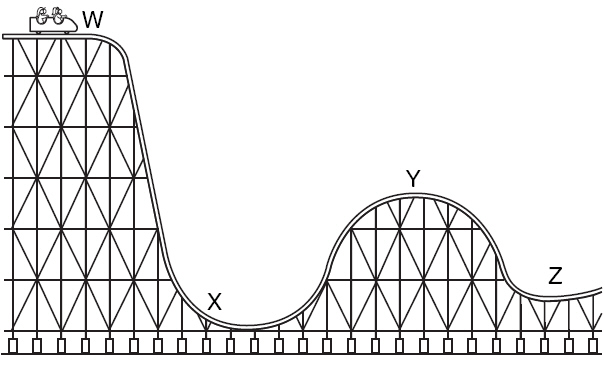
103

104
Math Response
Calculate the gravitationals PE of a 2.5 kg monkey hanging from a branch 7 m above the jungle floor
GPE = 2.5 x 9.8 x 7m = ___J
105

106
Math Response
Use the formula KE = 0.5 x mass x velocity x velocity
how much KE in a 0.15 kg baseball the is thrown at 35 m/s
KE = 0.5 x 0.15kg x 35 m/s x 35 m/s
107

108

What is the kinetic enrgy of a 44 kg cheetah running at a speed of 31 m/s
Use Formula KE = 0.5 x m x v x v
Calculate Kinetic energy
109
Physical Science 9A

110

111
Open Ended
A baseball accelerates downward at 9.8 m/s2. With negligible air resistance and a net force of 1.4 N, what is the baseball’s mass?
F=ma112
Multiple Choice
An object accelerates 8 m/s2 when a force of 40 newtons is applied to it. What is the mass of the object?
4 kg
20 kg
0.2 kg
5 kg
113
Multiple Choice
When force is 20 N, mass is 5 kg, what is acceleration?
F = ma
25 m/s2
100 m/s2
5 m/s2
4 m/s2
114
Multiple Choice
An object of mass 10 kg is accelerated upward at 2 m/s2. What force is required?
20 N
5 N
2 N
0 N
115
Multiple Choice
Which object has greater inertia?
116
Multiple Choice
What is inertia?
Inertia is an object’s resistance to change in motion.
Inertia is anything that makes a moving object slow down or stop.
117
Multiple Choice
What will happen to an object if it is put into motion in space?
It will stop eventually due to friction.
It will continue to move until it is acted on by an unbalanced force.
It will speed up over time.
It will slow down over time.
Final Exam Review
Show answer
Auto Play
Slide 1 / 117
SLIDE
Similar Resources on Wayground

114 questions
Algebra 2 - Unit 2 Polynomial Operation Review P3
Presentation
•
10th Grade
114 questions
OP 1.1 Build Up to the Civil War
Presentation
•
11th Grade
109 questions
human eye
Presentation
•
11th Grade
112 questions
Higher Learning-ICEV online
Presentation
•
9th - 12th Grade
116 questions
RETOMADA PROVA PAULISTA
Presentation
•
9th - 12th Grade
115 questions
Unit 8 Review Option
Presentation
•
KG - University
114 questions
Unit 4 Critical Concepts in Healthcare_HST
Presentation
•
11th Grade
118 questions
INTERNET_EVOLUTIE
Presentation
•
9th Grade - University
Popular Resources on Wayground
10 questions
Safety Day 2026 – Student Review

Quiz
•
9th Grade
21 questions
Continents and Oceans
Quiz
•
6th Grade
20 questions
Parts of Speech
Quiz
•
5th Grade
16 questions
Subject & Predicate
Quiz
•
5th Grade
25 questions
Multiplication Facts
Quiz
•
5th Grade
12 questions
Map Skills
Quiz
•
3rd Grade
22 questions
Continents and Oceans
Quiz
•
5th Grade
15 questions
Rounding Decimals
Quiz
•
5th Grade
Discover more resources for Science
10 questions
Exploring Chemical and Physical Changes

Interactive video
•
6th - 10th Grade
20 questions
Atomic Structure
Quiz
•
9th Grade
10 questions
Exploring the Electromagnetic Spectrum for Middle School Science
Interactive video
•
6th - 10th Grade
10 questions
Exploring Force and Motion Concepts
Interactive video
•
6th - 10th Grade
10 questions
Exploring Air Masses and Weather Fronts
Interactive video
•
6th - 10th Grade
14 questions
Periodic Trends
Interactive video
•
11th Grade
10 questions
Exploring the States of Matter
Interactive video
•
6th - 10th Grade
10 questions
Exploring Forces: Net Force, Normal Force, Gravity, and Friction
Interactive video
•
6th - 10th Grade