Search Header Logo
  1. Resource Library
  2. Science
  3. Chemistry
  4. Physical Properties
  5. Chemistry: Physical Properties/ M.v.d.w.
Chemistry: Physical Properties/ M.V.D.W.

Chemistry: Physical Properties/ M.V.D.W.

Assessment

Presentation

Science

8th Grade

Medium

NGSS
MS-PS1-4, MS-ESS1-2, MS-ESS2-4

+14

Standards-aligned

Created by

Felicia Powers

Used 2+ times

FREE Resource

6 Slides • 19 Questions

1

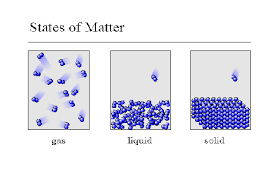
​States of Matter

Remember:

  • The movement of particles

  • Arrangement of particles

  • shape and volume

Some text here about the topic of discussion

media

2

Match

Match the arrangement to the state of matter

Solid

Gas

Liquid

Plasma

3

Multiple Choice

Question image
At higher temperatures
1
particles in an object have less energy
2
particles in an object move faster
3
a gas contracts

4

Reorder

Water can occur as liquid water, water vapor, or ice. The water molecules move at different speeds when they are in each state. Reorder them from fastest to slowest.

water vapor

liquid water

ice

1
2
3

5

Multiple Choice

What takes place when water changes from a solid to a liquid?

1

Condensation

2

Melting

3

Freezing

4

Evaporation

6

Multiple Choice

Question image
The phase change from water vapor to liquid water is known as...
1
evaporation
2
precipitation
3
condensation
4
sublimation

7

​Mass & Weight

Remember:

  • How to measure mass (scale/TBB)

  • Mass= Amount of Matter

  • Weight= Amount of gravity on

    an object. Scale is used to measure

Some text here about the topic of discussion

media
media

8

Multiple Choice

What statement is true?

1

Mass never changes. Weight does.

2

Weight never changes. Mass does.

3

Both mass and weight change because they are affected by gravity.

4

Neither mass nor weight change. They are always the same.

9

Multiple Select

What do you use to measure the mass of an object?

1
2
3
4

10

Multiple Choice

Weight is the measure of the force of ______ on an object.

1

Density

2

Mass

3

Matter

4

Gravity

5

Velocity

11

Volume

Remember:

  • Volume (Ruler/ Water Displacement)

  • Volume= mL or cm3

  • Volume= Amount of Space​

Some text here about the topic of discussion

media

12

Multiple Select

What do you use to measure the volume of an object?

1
2
3
4

13

Dropdown

Volume measure the amount of ​
and mass measures of the amount of ​​
. Volume of irregular object is measured through ​
. Volume of a regular object is measured using ​
.

14

​Density

Remember:

  • How to calculate Density= M/V

  • ​Object floats if density is less than 1g/ml

  • ​Object sinks if density is more than 1g/ml

Some text here about the topic of discussion

media

15

Multiple Choice

Jack has a rock. The rock has a mass of 14g and a volume of 2cm3. What is the density of the rock?
1

7 mL

2

7 g/cm3

3

28 g/cm3

4

1/7 g/cm3

16

Multiple Choice

Question image

If an object has a density of 1.15 g/mL and you put it into water, will it sink or float?  

1

sink

2

float

17

Remember:

  • ​Physical Properties: Observed, Measured, and Tested.

  • ​Different kinds of physical properties

  • Physical Properties: ​Doesn't change the identity of the substance.

Some text here about the topic of discussion

media

18

Multiple Choice

Physical properties are
1

Properties that can be observed without changing the identity of the substance

2

Properties that describe how a substance changes into a completely different substance

19

Multiple Choice

Question image
Blue Color: Chemical or Physical Property
1
Chemical Property
2
Physical Property

20

Multiple Choice

Question image
When a liquid reaches the temperatures of its ___, it can become a gas.
1
melting point
2
freezing point
3
boiling point
4
density

21

Multiple Choice

Question image
When a solid reaches the temperatures of its ___, it can become a liquid.
1

melting point

2

freezing point

3

boiling point

4

density

22

Multiple Choice

Which of the following objects is not an electrical conductor?

1

Paper clip

2

Coin

3

Eraser

4

Iron nail

23

Some text here about the topic of discussion

media

24

Multiple Select

Question image

Select all the size-independent (characteristic) properties. These are properties that CANNOT change.

1

Mass

2

Magnetism

3

Electric Conductor

4

Density

25

Multiple Select

Question image

Select all the size dependent (Non-characteristic) properties. These are properties that CAN change.

1

Mass

2

Weight

3

Volume

4

Density

​States of Matter

Remember:

  • The movement of particles

  • Arrangement of particles

  • shape and volume

Some text here about the topic of discussion

media

Show answer

Auto Play

Slide 1 / 25

SLIDE