

Empirical Rule Lesson

Presentation
•
Mathematics
•
11th Grade
•
Medium
Standards-aligned

Lauren Hall
Used 7+ times
FREE Resource
31 Slides • 6 Questions
1
(68-95-99.7 Rule)
You will be filling in your notes in your packet, so please have that out as you go through this powerpoint.
2

Turn to this page in your notes, first!
Shapes
3

This distribution is "Skewed Right"
(The tail is on the right)
There is a lot of low numbers, and not a lot of high numbers.
Examples:
# of siblings people have
# of pets people have
4

This distribution is "Symmetrical"
or
"Normal"
There is a lot of average/middle values
Examples:
IQ level
PSAT Scores
5

This distribution is "Skewed Left"
(The tail is on the left)
There is a lot of high numbers, and not a lot of
low numbers.
Examples:
Grades on an easy test
6
Multiple Choice
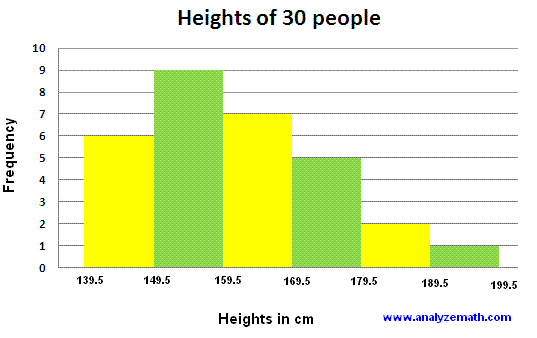
How would you describe this data?
Skewed Left
Skewed Right
Symmetrical
7
Multiple Choice
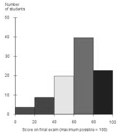
8
Multiple Choice

9
Multiple Choice

What is the shape of the distribution?
Skewed Left
Skewed Right
Symmetrical
10
Multiple Choice

What is the shape of the distribution?
Skewed left
Skewed right
Symmetrical
11
Multiple Choice

This data is
symmetrical
skewed right
skewed left
12

Turn to this page in your notes!
We are going to dive into "Normal" Shapes and what makes data normal
Empirical Rule
13

68%
1
95%
2
3
99.7%
14
The mean is always in the middle of our picture/distribution. Then we use the standard deviations to "jump" from value to value.
15
Turn to this page in your notes!
Empirical Rule

16

(step 1)
Focus on the tick marks on the bottom of the curve
(step 2)
Write the mean (from the problem) in the middle
70
17
(step 3)
Find the standard deviation (in the problem) is 5
(step 4)
Count by 5's along the bottom line (each tick mark)
70
75
80
85
65
60
55
18
Flip back to this page :)
Empirical Rule
19

68%
According to the definition above this picture, 68% of our data falls within one standard deviation (jump) from the mean. This, inturn, means each section is worth 34% & 34%
34
34
20
95%
According to the definition above this picture, 95% of our data falls within two standard deviations (jumps) from the mean. This, inturn, means the next two sections are worth 13.5% & 13.5%
34
34
13.5
13.5
21
99.7%
According to the definition above this picture, 99.7% of our data falls within three standard deviations (jumps) from the mean. This, inturn, means the next two sections are worth 2.35% & 2.35%
34
34
13.5
13.5
2.35
2.35
22
According to the definition above this picture, our whole curve is worth 100%. This, inturn, means the very last two sections are worth .15% & .15%
Adding ALL of these percents up means the curve adds up to 100%
34
34
13.5
13.5
2.35
2.35
.15
.15
23
Flip back to this page!
Empirical Rule
24
The percents are the SAME exact percents EVERY time. So we can use the percents from the previous slides to fill in these gaps...
click next to see this!
70
75
80
85
65
60
55
25
We need to put these percentages here before each problem.
70
75
80
85
65
60
55
34%
34%
13.5%
13.5%
2.35%
2.35%
.15%
.15%
26
70
75
80
85
65
60
55
34%
34%
13.5%
13.5%
2.35%
2.35%
.15%
.15%

To answer this question, add up the percents that are between the values of 65 and 75 on our number line!
27
70
75
80
85
65
60
55
34%
34%
13.5%
13.5%
2.35%
2.35%
.15%
.15%
Answer: 34% + 34% = 68%
28
70
75
80
85
65
60
55
34%
34%
13.5%
13.5%
2.35%
2.35%
.15%
.15%

Answer: 13.5%
29
70
75
80
85
65
60
55
34%
34%
13.5%
13.5%
2.35%
2.35%
.15%
.15%

Answer: 13.5% + 34% = 47.5%
30
70
75
80
85
65
60
55
34%
34%
13.5%
13.5%
2.35%
2.35%
.15%
.15%

Answer: .15%
31

24
28
32
36
20
16
12
Example 2 - Step 1 - Find mean and standard deviation and label the curve
32
24
28
32
36
20
16
12
34%
34%
13.5%
13.5%
2.35%
2.35%
.15%
.15%
Example 2 - Step 2 - Fill in percents
33
24
28
32
36
20
16
12
34%
34%
13.5%
13.5%
2.35%
2.35%
.15%
.15%
Answer: 13.5% + 34% + 34% + 13.5% = 95%

34
24
28
32
36
20
16
12
34%
34%
13.5%
13.5%
2.35%
2.35%
.15%
.15%
Answer: 2.35%

35
24
28
32
36
20
16
12
34%
34%
13.5%
13.5%
2.35%
2.35%
.15%
.15%
Answer: 13.5% + 2.35% = 15.85%

36
24
28
32
36
20
16
12
34%
34%
13.5%
13.5%
2.35%
2.35%
.15%
.15%
Answer: 34% + 13.5% + 2.35% + .15% = 50%

37
on DeltaMath to finish and
practice this material
(68-95-99.7 Rule)
You will be filling in your notes in your packet, so please have that out as you go through this powerpoint.
Show answer
Auto Play
Slide 1 / 37
SLIDE
Similar Resources on Wayground

28 questions
5.3 Trigonometric Ratios
Presentation
•
12th Grade
30 questions
Inverse Functions
Presentation
•
11th Grade
30 questions
Invers Fungsi
Presentation
•
11th Grade
33 questions
DETERMINAN MATRIKS
Presentation
•
11th Grade
34 questions
Multiplying Polynomials/ Pascal's Triangle
Presentation
•
11th Grade
28 questions
Theorems of Limits of functions
Presentation
•
11th Grade
30 questions
SIMULADOR M4 2P
Presentation
•
11th Grade
33 questions
Direct, Inverse and Joint Variation
Presentation
•
10th Grade
Popular Resources on Wayground
10 questions
Safety Day 2026 – Student Review

Quiz
•
9th Grade
21 questions
Continents and Oceans
Quiz
•
6th Grade
20 questions
Parts of Speech
Quiz
•
5th Grade
16 questions
Subject & Predicate
Quiz
•
5th Grade
25 questions
Multiplication Facts
Quiz
•
5th Grade
12 questions
Map Skills
Quiz
•
3rd Grade
22 questions
Continents and Oceans
Quiz
•
5th Grade
15 questions
Rounding Decimals
Quiz
•
5th Grade
Discover more resources for Mathematics
12 questions
Identify Rigid Transformations
Quiz
•
8th - 12th Grade
10 questions
Complementary, Supplementary, Vertical, and Linear Pairs
Quiz
•
9th - 12th Grade
22 questions
Identify Vertical and Horizontal Translations
Quiz
•
9th - 12th Grade
10 questions
Graphing Inequalities on a Number Line
Quiz
•
9th - 12th Grade
17 questions
Identifying Parallel And Perpendicular Lines
Quiz
•
9th - 12th Grade
18 questions
Integer Operations
Quiz
•
5th - 12th Grade
18 questions
Parallel lines cut by a transversal
Quiz
•
9th - 11th Grade
14 questions
Evaluate Linear Functions and Their Applications
Quiz
•
9th - 12th Grade