

5.8.24

Presentation
•
Science
•
3rd Grade
•
Practice Problem
•
Hard

Martinee Stewart
Used 2+ times
FREE Resource
21 Slides • 0 Questions
1


HISD 3rd Grade Science
Forces and Motion
M3 L22
May 8, 2024
2

14
Forces and Motion
LO: SWBAT obtain information about the use of
magnets to solve problems.
DOL: Given a scenario, SW identify and explain
how magnets can be used to solve problems in
at least 2 of 3 questions.
TEKS SCI 3.5A Measure, test, and record physical properties of matter, including temperature, mass, magnetism, and the ability to sink or float.
TEKS SCI 3.6B Demonstrate and observe how position and motion can be changed by pushing and pulling objects such as swings, balls, and wagons.
TEKS SCI 3.6C Observe forces such as magnetism and gravity acting on objects.
3

15
Essential Understandings &
Guiding Questions
How can an object move without being
touched?
How can we use magnets to solve problems?
4

16
Lesson Vocabulary
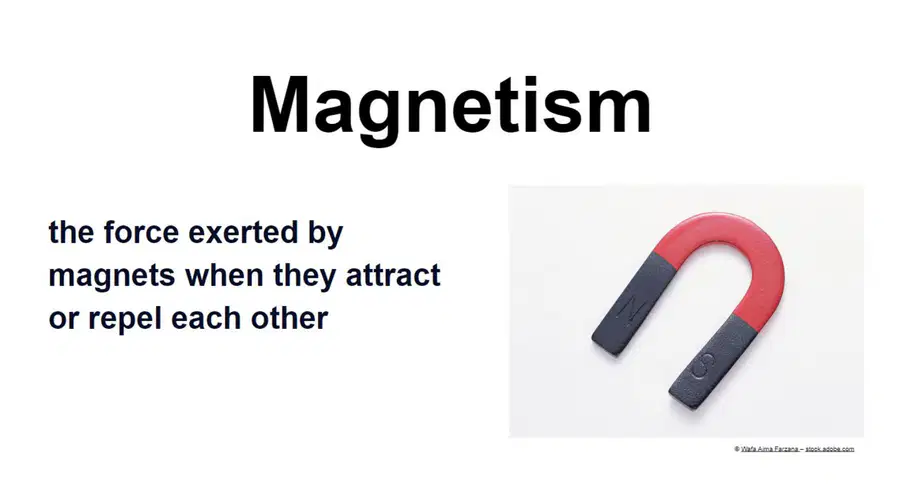
magnetism
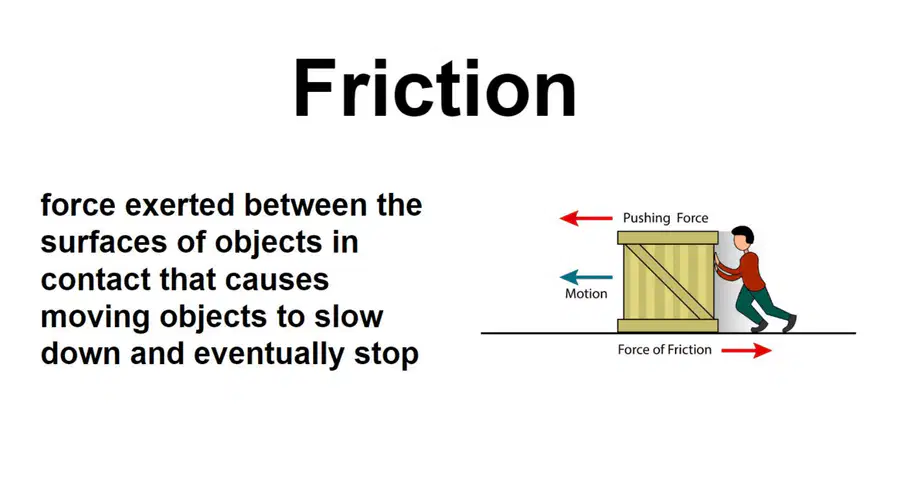
friction
gravity
force
motion
5

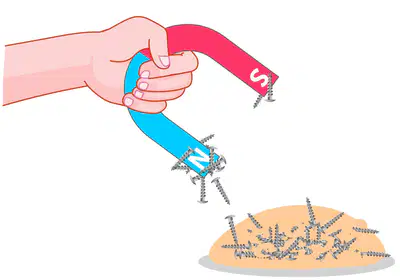

How do we use magnets to solve problems in
our classroom?
How do you use magnets to solve problems at
home?
6


What problem do you
think is solved by this
wristband?
What properties of magnets do you think
make them useful for this solution?
7

What is the main idea of this text?
“So Repulsive, It’s Attractive!” by Nick D’Alto (2009)
What if a speeding express train had no wheels, no motor, and didn’t even touch the tracks as it whizzed by? In a
magnetic levitation (or maglev) system, the train is lifted slightly from its tracks (called a guideway) using powerful
magnets. The train is propelled forward using more magnets. By reducing friction (the train itself has almost no moving
parts) these flying trains promise to move us in ways that are smoother, more energy efficient, and more eco-friendly
than conventional railroads and highways. And all at incredible speed.
Why Not More Maglevs?
Elevated maglevs can travel above existing roads, avoiding gridlock. Plus maglevs are nearly as fast as airplanes, in
all kinds of weather. So why aren’t we all riding these futuristic trains right now? Part of the challenge involves the
unusual magnets needed to make most maglev systems work. To produce enough force to lift a loaded train, many
maglev designs rely on electrical-powered magnets, called electromagnets. These are powerful, but also costly and
complex to operate. Other maglevs lift using superconducting magnets; also powerful, but often requiring special
refrigeration to work properly. To compete with other forms of travel, maglev must make both technological and
business sense.
Engineers and inventors are working on the technical challenges right now. If you become a transportation engineer,
you might one day work on the design of a “flying” train. Why not get started now?
8

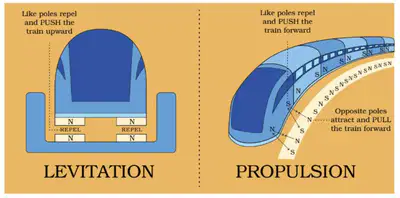
“So Repulsive, It’s Attractive!” by Nick D’Alto (2009)
What if a speeding express train had no wheels, no motor, and didn’t even touch the tracks as it
whizzed by? In a magnetic levitation (or maglev) system, the train is lifted slightly from its tracks (called
a guideway) using powerful magnets. The train is propelled forward using more magnets. By reducing
friction (the train itself has almost no moving parts) these flying trains promise to move us in ways that
are smoother, more energy efficient, and more eco-friendly than conventional railroads and highways.
And all at incredible speed.
Why Not More Maglevs?
Elevated maglevs can travel above existing roads, avoiding gridlock. Plus maglevs are nearly as fast as
airplanes, in all kinds of weather. So why aren’t we all riding these futuristic trains right now? Part of the
challenge involves the unusual magnets needed to make most maglev systems work. To produce
enough force to lift a loaded train, many maglev designs rely on electrical-powered magnets, called
electromagnets. These are powerful, but also costly and complex to operate. Other maglevs lift using
superconducting magnets; also powerful, but often requiring special refrigeration to work properly. To
compete with other forms of travel, maglev must make both technological and business sense.
Engineers and inventors are working on the technical challenges right now. If you become a
transportation engineer, you might one day work on the design of a “flying” train. Why not get started
now?
9

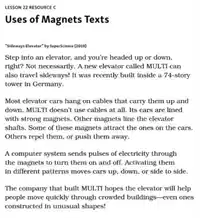



10


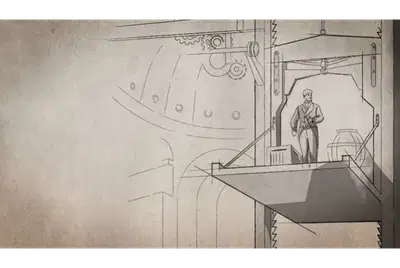
What did you notice about the solution
in each video?
11



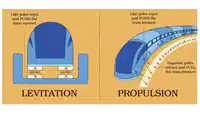

How are
magnets used
in each
solution we’ve
discussed
today?
Discuss the similarities and differences in
how magnets are used in each solution.
12

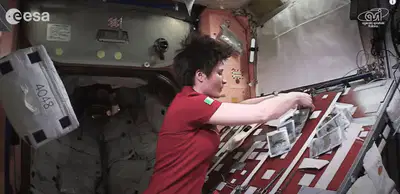
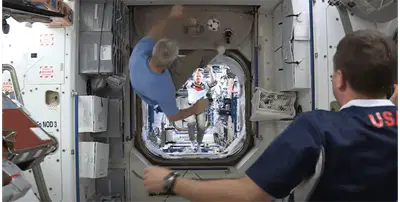
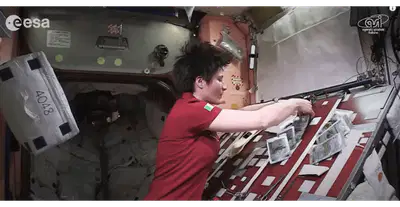
What properties of magnets might make them useful on
board the International Space Station?
What property of magnets do you think the astronaut in
the video uses to help her prepare her dinner?
What evidence do you have to support your answer?
13

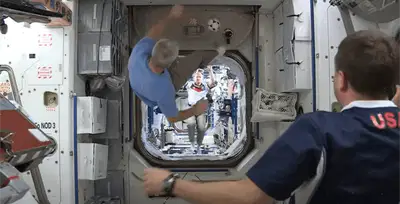
Do you think
astronauts might
be able to use
magnetic force to
keep objects
such as soccer
balls in place?
14

15

16



Gravity
the force that pulls objects
toward Earth and causes
objects with mass to
attract to one another
17

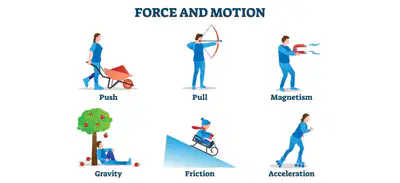
Force
a push or pull that acts on
an object which may cause
a change in an object’s
motion
18



Motion
the act or process of
moving
19

What problems do you think astronauts
encounter in space?
How do you think magnets could be used to
solve problems such as these?
20

32
DOL: Given a
scenario, SW
identify and explain
how magnets can
be used to solve
problems in at least
2 of 3 questions.
21

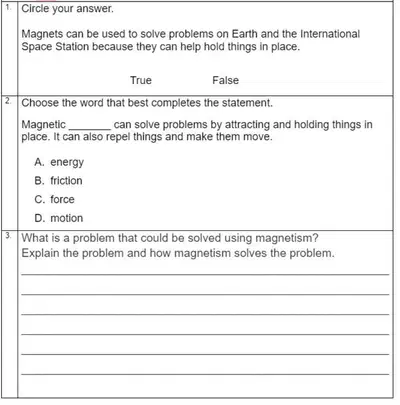

Demonstration of Learning
HISD 3rd Grade Science
Forces and Motion
M3 L22
May 8, 2024
Show answer
Auto Play
Slide 1 / 21
SLIDE
Similar Resources on Wayground

16 questions
Optics and Light Energy
Presentation
•
3rd Grade
19 questions
The Sun, Earth, and Moon
Presentation
•
3rd Grade
16 questions
Fossil Match
Presentation
•
3rd - 4th Grade
20 questions
States of Matter Review
Presentation
•
3rd Grade
15 questions
Comets Assteroids and Meteors
Presentation
•
3rd Grade
15 questions
Science - LESSON 2 - Models Review Lesson
Presentation
•
3rd Grade
18 questions
Matter Review
Presentation
•
3rd Grade
18 questions
Georgia's Swamp & Marshes Habitat-Part 1
Presentation
•
3rd Grade
Popular Resources on Wayground
10 questions
HCS SCI 03 Summer School Assessment 1

Quiz
•
3rd Grade
15 questions
HCS SCI 05 Summer School Assessment 1 Review
Quiz
•
5th Grade
22 questions
Day 9 Equations and Inequalities Review
Quiz
•
9th Grade
10 questions
Writing and Identifying Ratios Practice
Quiz
•
5th - 6th Grade
7 questions
PYRAMID PERSPECTIVES part 1
Presentation
•
9th - 12th Grade
12 questions
Understanding the Fourth of July
Quiz
•
9th Grade
15 questions
Soccer World Cup Quiz Questions
Quiz
•
7th Grade