

5/20 Lesson

Presentation
•
Science
•
8th Grade
•
Medium

Aneisha Turner
Used 1+ times
FREE Resource
28 Slides • 6 Questions
1


HISD 8th Grade Science
Common Ancestry:
Homologies
May 20, 2024
2

2
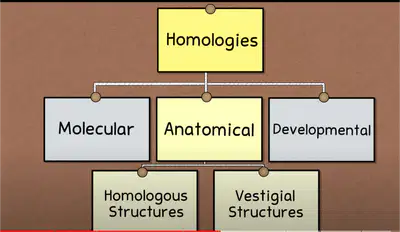
Learning Objective: SWBAT analyze and evaluate how evidence of
common ancestry among groups is provided by homologies, including
anatomical, molecular, and developmental.
Demonstration of Learning:Given a set of 5 questions, students
analyze and evaluate how evidence of common ancestry among groups is
provided by homologies, including anatomical, molecular, and developmental
by answering at least 4 out of 5 questions correctly.
BIOL 7A: Analyze and evaluate how evidence of common ancestry among groups is provided by the fossil record, biogeography, and homologies,
including anatomical, molecular, and developmental.
What are we learning today?
3


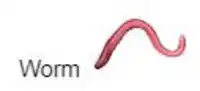
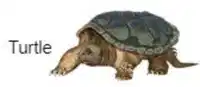
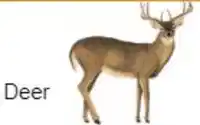
3
Do Now
Which two organisms do you think are most closely related? Provide a
explanation for your answer. Write answer on Response Card!
COMPLETE SENTENCE.
4

4
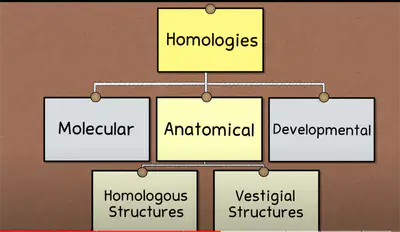
Guiding Question
How do homologies, including anatomical, molecular,
and developmental provide evidence of common
ancestry among organisms?
5


5
All living organisms are connected to each other from an
common ancestor.
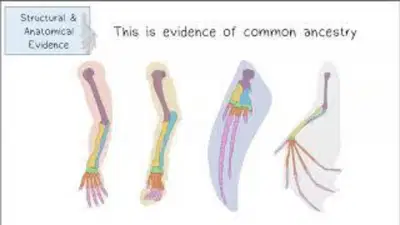
Homologous structures show similar anatomical structures.
Similar embryological developments show common ancestry.
Similar DNA and amino acid sequences show common ancestry.
Key Points to Remember
Complete the Key Points
to Remember section at
the top of the student
activity page.
6



6
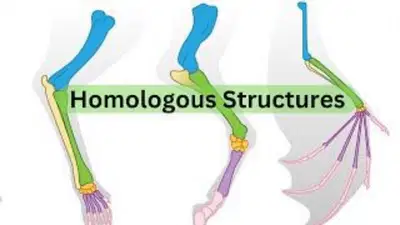
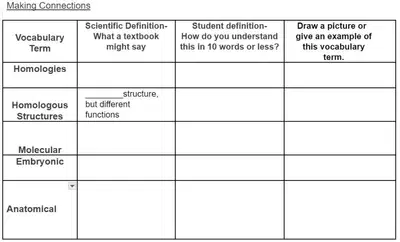
Homologous Structures
Complete the
Homologous Structures
section in the Making
Connections table
provided on your student
activity page. Talk with parttner.
Are humans, cats, horses, dolphins, and bats related?
7

7
Let’s Discuss:Homologous Structures
Take five minutes to complete
the following on the Making
Connections Table on your
student activity page:
-Provide an example of
homologous structures
-Create student definition
- Discuss and answer the
question, Are humans, cats,
horses, dolphins and bats
related?
Are humans, cats, horses, dolphins, and bats related?
Human, cat, horse, bat, and dolphin all came from a common ancestor
8



8
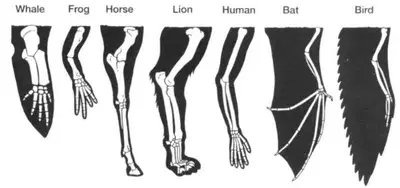
Let’s Analyze:Homologous Structures
The diagram to the left shows the
forelimbs of seven different animals.
With a partner, analyze the diagram to
answer questions #1-2 in the Let’s
Analyze: Homologous Structure
section of your student activity page.
1. Compare the human upper limb with
the forelimbs of the lion, the bat and
the whale. Record your observations.
2. Which of the animals shown in the
diagram has a forelimb most like the
human arm? Describe the
observations that lead you to this
conclusion.
9
Multiple Choice
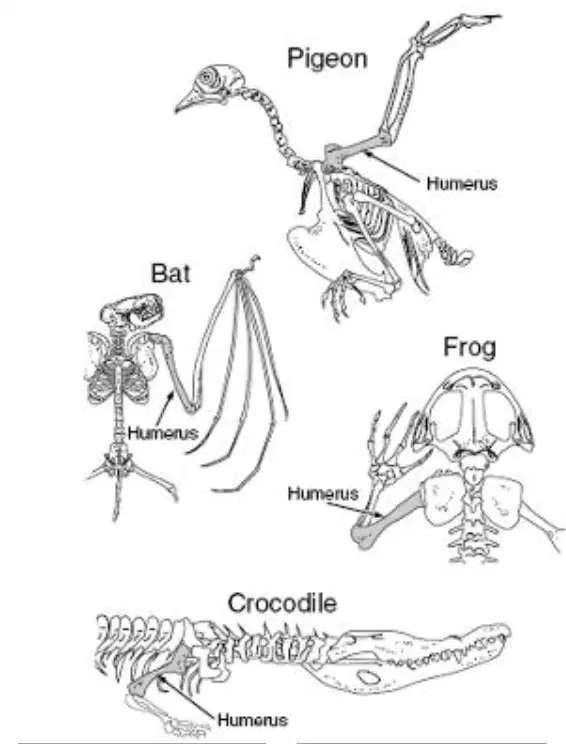
The limbs of several organisms are shown in the illustration
to the right. The structural similarity shown in the limbs of the
organisms suggest that –
the humerus is attached by immovable joints
only mammals have a functional humerus
the humerus is the same size in all organisms
the organisms have common ancestors
10



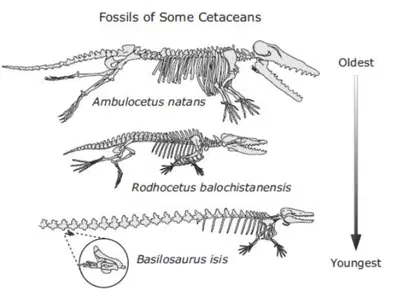
Cetaceans are whales and their relatives. The
diagram shows some fossils of cetaceans.
Which statement provides the best evidence that
Ambulocetus natans is an ancestor of
Basilosaurus isis?
A. Homologous structures occur in each
fossil.
B. Similar nitrogenous bases are found in the
DNA of each fossil.
C. The fossils were found in different locations.
D. The youngest fossil is larger than the older
fossils.
13
Let’s Apply-Whiteboards
11
Multiple Choice

Cetaceans are whales and their relatives. The
diagram shows some fossils of cetaceans.
Which statement provides the best evidence that
Ambulocetus natans is an ancestor of
Basilosaurus isis?
Homologous structures occur in each
fossil.
imilar nitrogenous bases are found in the
DNA of each fossil.
The fossils were found in different locations.
The youngest fossil is larger than the older fossil
12



15
Short Constructed Response
Homologous and
analogous structures
are two terms used by
scientists in evolution.
Which of these is
associated with the
fact that the bones in
the wing of a bird, the
flipper of a whale, and
the arm of a human all
have similar anatomy?
Justify your response.
The term _______________ structures is associated with the fact
that the bones in the wing of a bird, the flipper of a whale, and the
arm of a human all have similar anatomy because
__________________________.
13



17
How do homologous
structures provide
evidence for common
ancestry?
Let’s Discuss
Homologous structures are
similar in anatomical structures,
but different in function. Analysis
of homologous structures can be
used to infer the evolutionary
relationships among organisms.
14


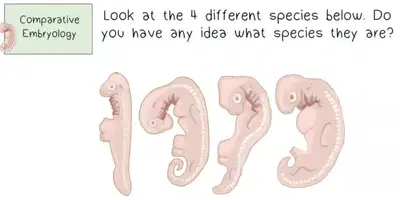

Embryonic Comparison
Observe the four images
to the left.
Take 2 minutes to
discuss at your table
what species each
image #1-4 could
represent.
#1
#2
#3
#4
15



Embryonic Comparison
Embryonic Images #1-4
represent:
#1-fish
#2-turtle
#3-chicken
#4-human
16
Open Ended
True or False:
Analogous structures show
close ancestral
relationships.
17

21
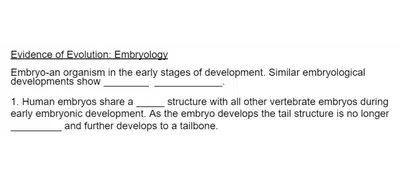
Similar embryological developments show common ancestry.
Embryonic Comparisons
View the Evidence of
Evolution video. Next,
complete the Evidence of
Evolution: Embryology
section of your student
activity page.
18


22
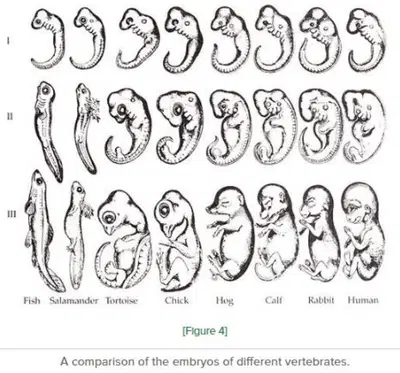
Embryonic Comparison- Turn and Talk
Observe the three stages of embryonic
development for the eight vertebrates
shown to the left.
Compare similar structures visible
during the stage of early development.
Discuss the following with your
partner:
1. How would you explain the fully
developed structures now formed in
Stage III (advance embryonic
development)?
What evidence in the illustration can
you find to support your explanation?
Provide your explanation in the
Embryonic Comparisons: section
question #1-2 in the student activity
page.
19


23
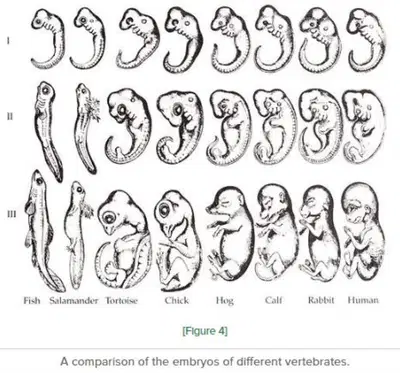
The similarity in the early stages of
development in vertebrate
embryos, such as the presence of
gill slits, is an example of:
A.
Molecular homology
B.
Structural homology
C.
Developmental homology
D.
Analogous structures
Let’s Check Your Understanding-White boards
20
Multiple Choice
The similarity in the early stages of
development in vertebrate
embryos, such as the presence of
gill slits, is an example of:
Molecular homology
Structural homology
Developmental homology
Analogous structures
21




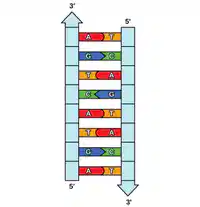
Let’s Learn: Amino Acid and DNA Sequencing
View the Evolution
Evidence in Amino Acids
Sequence Lab video to
learn how to analyze a
DNA or amino sequence
to determine
evolutionary
relationships and
common ancestry.
Ready, Let’s Try…
22




26
Brainstorm some of the similarities and differences between
humans and each of the following organisms:
●Tuna
●Gray Whale
●Snapping Turtle
●Rhesus monkey
●Chicken or Turkey
●Neurospora
●Pig, Cow, Sheep
●Baker’s Yeast
●Silkworm moth
●Candida
●Screwworm fly
Molecular Comparisons: Humans and Other Organisms-Turn and Talk
What are some of the
criteria scientists might
use to determine how
closely related, in
evolutionary time, two
organisms are?
Discuss with a partner
and answer the question
under Let’s Brainstorm of
theReal-World
Connections: Predicting
Evolutionary
Relationships section of
the student activity page.
23

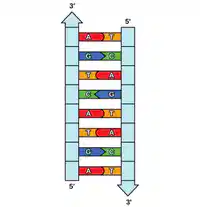


27
Predicting Evolutionary Relationships Activity
Infer evolutionary relationships among the following species
listed below and humans. Similar DNA and amino acid
sequences show common ancestry.
●Tuna
●Gray Whale
●Snapping Turtle
●Rhesus monkey
●Chicken or Turkey
●Neurospora
●Pig, Cow, Sheep
●Baker’s Yeast
●Silkworm moth
●Candida
●Screwworm fly
Molecular Comparisons: Humans and Other Organisms
Compare the sequence of
amino acids in a gene
shared between humans
and eleven other organisms
utilizing the handout
provided on your table.
Discuss with your table and
answer questions #1-3
under Real-World
Connections: Predicting
Evolutionary Relationships
Activity section of the
student activity page.
24

28
Sheep and pigs have
more enzymes in common
than sheep and frogs do.
What conclusions can we
draw from this finding?
Let’s Apply-Response Card
25


30
Check for Understanding-Whiteboard
Which of the following statements best describes an evidence scientists must have used to explain why the chestnut-sided warbler, Dendroica pensylvanica, and the cerulean warbler, Dendroica cerulea, are classified as closely related species?
A.
They eat the same types of insects.
B.
They have similar DNA sequences.
C.
They show similarities in their nesting behaviors.
D.
They live in the same types of woodland habitats.
Justify your answer
26
Multiple Choice
Which of the following statements best describes an evidence scientists must have used to explain why the chestnut-sided warbler, Dendroica pensylvanica, and the cerulean warbler, Dendroica cerulea, are classified as closely related species?
They eat the same types of insects.
They have similar DNA sequences.
They show similarities in their nesting behaviors.
They live in the same types of woodland habitats.
27


32
Explain how molecular
homologies can help
scientist infer patterns of
evolutionary relationships
(common ancestry)?
SCR Response
The number of differences and
______of amino acid and DNA
sequences are analyzed. You can
infer, the more _______ in the
___ or amino acid sequence, the
more closely ______a species is to
another.
28

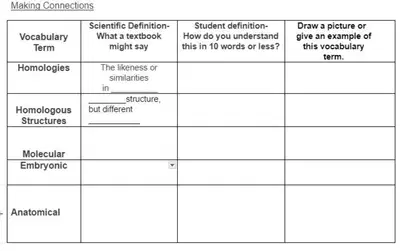
33
Based on what you
learned today,
complete the
molecular and
embryonic sections in
the Making
Connections Chart.
Let’s Review
29

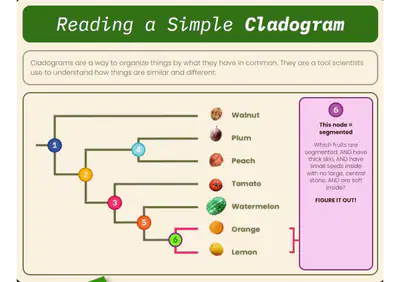

34
Cladogram: Links groups of organisms by showing how evolutionary lines of
descent, also called lineages, branched off from common ancestors.
Reading a Cladogram
Collaborate with your
partner to complete the
interactive Reading a
Simple Cladogram. Select
each number 1-6 and to
learn more.
Complete the Cladogram
main points at the bottom of
page 3 on your student
activity page.
30


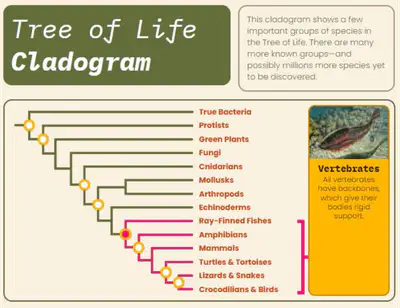
35
Cladogram: The closer the branches, the more closely related an
organism is to each other. If two organisms are located on different
branches or far from each other, you can conclude they are not closely
related.
Interpreting Cladograms: Closely Related or Least Related
Collaborate with your
partner to complete the
interactive Tree of Life
Cladogram. Select the
yellow circles to view
additional info for each
branch.
Complete the Cladogram
main points at the bottom of
page 3 on your student
activity page.
31


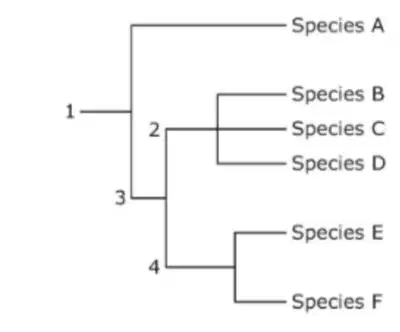
A phylogenetic tree based on genetic similarities is shown. Which numbered
location on the phylogenetic tree identifies characteristics shared by Species
B,C, and D?
A.
Location 1
B.
Location 2
C.
Location 3
D.
Location 4
39
Let’s Apply-Whiteboards
32
Multiple Choice
A phylogenetic tree based on genetic similarities is shown. Which numbered
location on the phylogenetic tree identifies characteristics shared by Species
B,C, and D?
Location 1
Location 2
Location 3
Location 4
33



44
SCR Response
How do you think
analyzing and
evaluating
homologies can
express common
ancestry?
34


46
Demonstration of Learning
Given a set of 5
questions, analyze and
evaluate how evidence of
common ancestry among
groups is provided by
homologies, including
anatomical, molecular,
and developmental
by answering at least 4
out of 5 questions
correctly.
HISD 8th Grade Science
Common Ancestry:
Homologies
May 20, 2024
Show answer
Auto Play
Slide 1 / 34
SLIDE
Similar Resources on Wayground

28 questions
Wave Interactions
Presentation
•
8th - 9th Grade
24 questions
Forces that Shape the Earth
Presentation
•
8th Grade
24 questions
Continental Drift and Plate Tectonics Lesson
Presentation
•
8th Grade
24 questions
The Nature of Science
Presentation
•
8th Grade
27 questions
Moon Phases
Presentation
•
8th Grade
28 questions
Rock Cycle
Presentation
•
8th Grade
26 questions
8th Grade 1-7: Using Graphs in Science
Presentation
•
8th Grade
25 questions
Water Quality EOG Review
Presentation
•
8th Grade
Popular Resources on Wayground
10 questions
Safety Day 2026 – Student Review

Quiz
•
9th Grade
21 questions
Continents and Oceans
Quiz
•
6th Grade
20 questions
Parts of Speech
Quiz
•
5th Grade
16 questions
Subject & Predicate
Quiz
•
5th Grade
25 questions
Multiplication Facts
Quiz
•
5th Grade
12 questions
Map Skills
Quiz
•
3rd Grade
22 questions
Continents and Oceans
Quiz
•
5th Grade
15 questions
Rounding Decimals
Quiz
•
5th Grade
Discover more resources for Science
20 questions
Newton's Laws of Motion
Quiz
•
8th Grade
15 questions
potential and kinetic energy
Quiz
•
8th Grade
21 questions
Newton's Laws of Motion
Quiz
•
8th Grade
20 questions
Elements, Compounds and Mixtures
Quiz
•
8th Grade
10 questions
Exploring Chemical and Physical Changes

Interactive video
•
6th - 10th Grade
20 questions
Physical vs Chemical Changes
Quiz
•
8th Grade
20 questions
Conduction, convection, and Radiation Practice
Quiz
•
8th Grade
21 questions
Waves and Wave Properties
Quiz
•
6th - 8th Grade