
Intro to Ecosystems

Presentation
•
Science
•
7th Grade
•
Medium

Jayden Campbell
Used 10+ times
FREE Resource
15 Slides • 5 Questions
1
2
3
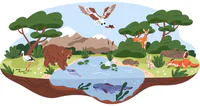
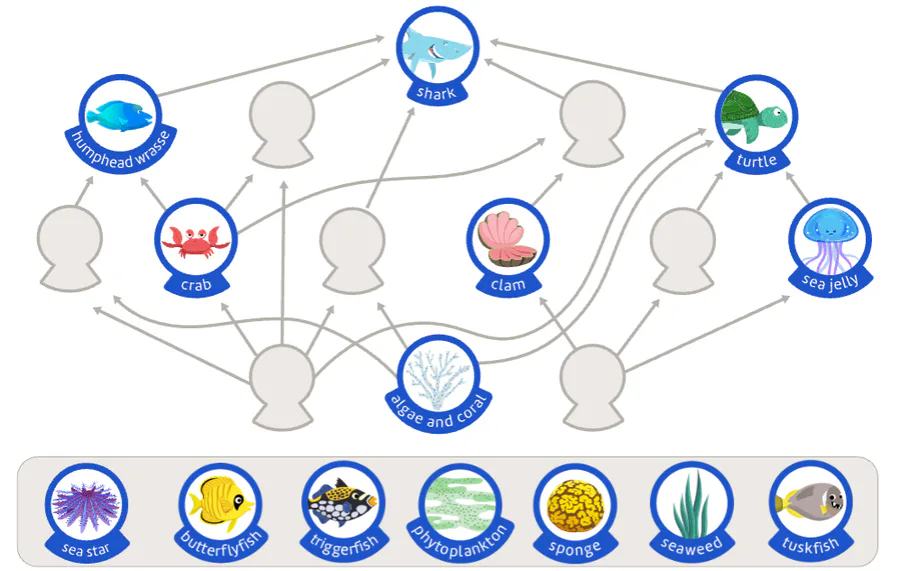
All living things need energy to survive. Producers such as plants get their energy from sunlight. Consumers like us get energy by eating other living things. So one way that living things interact with each other is by eating and being eaten. These interactions are shown by food chains and food webs.
Living things also interact with their physical environment. For example, many animals breathe air, swim in water or use rocks and sand for shelter. A collection of living things that interact with each other and with their environment is called an ecosystem.
The branch of science that studies ecosystems is called ecology.
4
5
Multiple Choice
An ecosystem is a collection of both living things and non-living things, interacting with each other in a shared environment.
True
False
Unsure
6
Multiple Choice
Ecology is the study of?
The internal structures of living things
Organisms interacting with each other and their environment
Describing, classifying, and naming organisms
The chemical reactions that take place in living things
7
Ecosystems
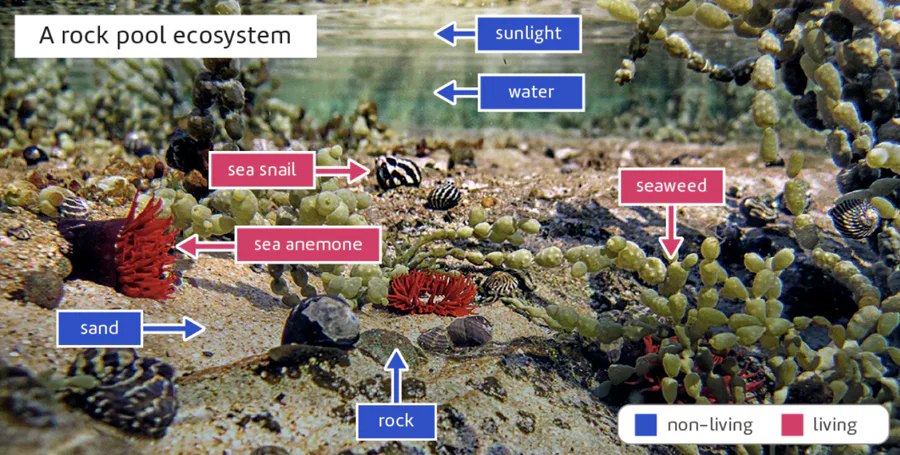
Ecosystems have a wide range of scales. They can be as large as a rainforest or as small as a rock pool. As long as there are living things interacting with each other and with their physical environment, there is an ecosystem.
An ecosystem can also form part of a larger ecosystem. For example, a rock pool forms part of a larger coastal ecosystem.
8
An ecosystem needs both living and non-living components to function. Scientists use special terms to describe the interactions between these components
9
Biotic
Living things in an ecosystem are called biotic factors. This word comes from the Greek "bio-" meaning life. Examples of biotic factors include animals, plants and bacteria.
10
Abiotic
Non-living things in an ecosystem are called abiotic factors. The prefix "a-" means not, so "abiotic" means not living. Abiotic factors include air, water, temperature, currents and other features of the physical environment.
11
Labeling
Label the following.
Biotic
Abiotic
Biotic
Biotic
Abiotic
Abiotic
12
Book work activity
Describe two interactions between a biotic and abiotic factor in a marine ecosystem. One example has been provided for you below.
Seagrass - Sunlight - Seagrass absorbs sunlight to carry out photosynthesis.
13
Book work activity
Plastic pollution can be found in many marine ecosystems.
Describe whether plastic waste could be considered part of these ecosystems – as another abiotic factor. Explain your answer.
14
When you dive beneath the surface of the ocean it becomes clear that marine ecosystems are very different from land ecosystems. All of the living things are adapted to life underwater. The abiotic factors they interact with include sand, waves and ocean currents.
But there are also many similarities between life on land and under the sea. Producers are needed to carry out photosynthesis. This converts the Sun's energy into stored energy in sugars that can then provide food for consumers. On land, the most common producers are plants. In the ocean, this important role is played mainly by algae.
15
Algae are a diverse group of organisms, including:
seaweed: large, multicellular organisms that look like plants
phytoplankton: microscopic organisms that float near the water surface
algae in coral: microscopic organisms that live inside the tissues of corals, providing them with sugars in return for a safe place to live
Note: Phytoplankton also include some types of bacteria that are able to photosynthesize.
16
Another difference between land and marine ecosystems is the surrounding sea water. The properties of sea water vary from place to place and with water depth. The survival of many marine organisms depends on:
water temperature
the amount of dissolved salt, or salinity
the amount of acid, as measured with the pH scale – a pH of 7 is neutral, less than 7 is acidic and greater than 7 is basic, or alkaline
17
Coral reef ecosystems are very sensitive to these conditions. They grow best with:
a water temperature of 23–29°C
a salinity of 32–40 parts per thousand (ppt)
a pH of 8.4–8.6
18
Multiple Choice
Salinity is a measure of?
Water depth
How acidic or basic something is
The amount of dissolved salt
Water temperature
19
Multiple Choice
Select which of the following pH values of sea water is best suited to a coral reef ecosystem
3.5 - strongly acidic
6.5 - weakly acidic
8.5 - weakly alkaline
12.5 - strongly alkaline
20
Show answer
Auto Play
Slide 1 / 20
SLIDE
Similar Resources on Wayground

14 questions
4.15 Biome Review
Presentation
•
7th Grade
19 questions
Ecological Layers
Presentation
•
7th Grade
12 questions
Interdependence and Competition
Presentation
•
7th - 8th Grade
17 questions
Food Chain vs Food Web
Presentation
•
6th Grade
13 questions
Food Webs and Energy Pyramid Review
Presentation
•
6th - 8th Grade
16 questions
Texas Revolution Leaders
Presentation
•
7th Grade
15 questions
7th Science- Human Impact (Land Edition)
Presentation
•
7th Grade
14 questions
Levels of Organization
Presentation
•
7th Grade
Popular Resources on Wayground
10 questions
Safety Day 2026 – Student Review

Quiz
•
9th Grade
21 questions
Continents and Oceans
Quiz
•
6th Grade
20 questions
Parts of Speech
Quiz
•
5th Grade
16 questions
Subject & Predicate
Quiz
•
5th Grade
25 questions
Multiplication Facts
Quiz
•
5th Grade
12 questions
Map Skills
Quiz
•
3rd Grade
22 questions
Continents and Oceans
Quiz
•
5th Grade
15 questions
Rounding Decimals
Quiz
•
5th Grade
Discover more resources for Science
10 questions
Exploring Chemical and Physical Changes

Interactive video
•
6th - 10th Grade
14 questions
Week 1 Falcon Flex Fast and Curious
Quiz
•
7th Grade
42 questions
Explore Plate Tectonics and Boundaries
Quiz
•
7th Grade
21 questions
Waves and Wave Properties
Quiz
•
6th - 8th Grade
16 questions
Photosynthesis and Cellular Respiration Review
Quiz
•
7th Grade
20 questions
Food Webs + Energy Pyramids
Quiz
•
7th Grade
9 questions
Biology: Cell Structure
Interactive video
•
7th Grade
8 questions
Diffusion and Osmosis Review
Presentation
•
6th - 8th Grade