Search Header Logo
ATOMIC GRADE 7 REVIEW

ATOMIC GRADE 7 REVIEW

Assessment

Presentation

Science

Practice Problem

Hard

Created by

Noble Teacher

FREE Resource

36 Slides • 19 Questions

1

media

2

media

3

media

4

media

5

media

6

media

7

media

8

media

9

media

10

media

11

media

12

media

13

media

14

media

15

media

16

Multiple Choice

Question image

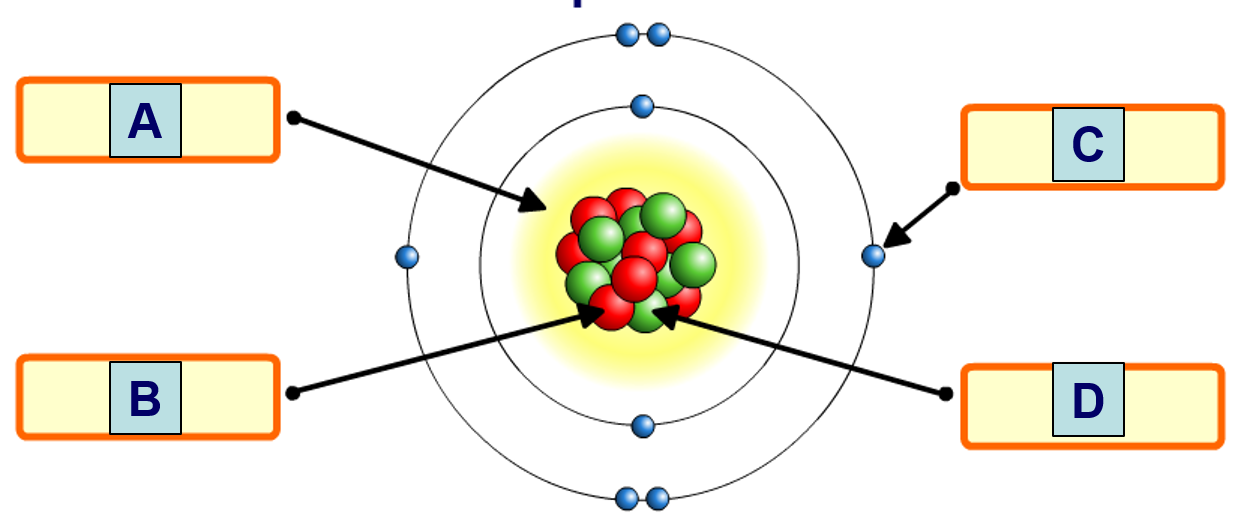
Which of the following is the nucleus?

1

A

2

B

3

C

4

D

17

Multiple Choice

Question image

What particle is B?

1

electron

2

proton

3

nucleus

4

neutron

18

Fill in the Blank

Question image

If B is proton, so what is D then?

19

Multiple Choice

Question image

One particle in an atom is electron, which one is it?

1

A

2

B

3

C

4

D

20

Atomic Mass and Mass Number

Module 3 - Physical Science

media

21

The Periodic Table of Elements

  • The Periodic Table is an organizational tool used by scientists to place elements into different categories.

  • Elements are the building blocks of matter, each having different chemical and physical properties.

  • Today, we will be looking at what atoms are composed of, and how we describe those atoms.

media

22

Review

  • The atomic number is the number of protons in the element.

  • The atomic mass is the number of protons and neutrons in one atom of that element.

  • All elements are electrically neutral, meaning they have ZERO NET CHARGE. This means that the number of protons (positive charges) are equal to the number of neutrons (negative charges)

media

23

Review

  • The element Helium (He) has an Atomic Number of 2. This means that all Helium atoms have exactly two protons.

  • Since the atom is electrically neutral, that means the atom also has exactly two electrons.

  • How do we determine how many neutrons there are in an atom?

media

24

Review

  • Atomic Mass = Protons + Neutrons

  • We round the atomic mass to the nearest whole number, 4

  • Since we already determined that Helium has two protons, that means: 4=2+Neutrons

  • There must be 2 Neutrons in one atom of Helium

media

25

Let's Practice Together!

  • What is the Atomic Number?

  • What is the Atomic Mass?

  • How many protons are in a Lithium Atom?

  • How many electrons are in a Lithium Atom?

  • What is the rounded Atomic Mass?

  • How many neutrons are in a Lithium Atom?

media

26

Let's Practice Together!

  • What is the Atomic Number? 3

  • What is the Atomic Mass? 6.941

  • How many protons are in a Lithium Atom? 3

  • How many electrons are in a Lithium Atom? 3

  • What is the rounded Atomic Mass? 7

  • How many neutrons are in a Lithium Atom? 7-3=4

media

27

Multiple Choice

Question image

What is the Atomic Number for Beryllium (Be)?

1

4

2

9.012

3

9

4

5

28

Multiple Choice

Question image

What is the Atomic Mass for Beryllium (Be)?

1

4

2

9.012

3

9

4

5

29

Multiple Choice

Question image

How many Protons are in one atom of Beryllium (Be)?

1

4

2

9.012

3

9

4

5

30

Multiple Choice

Question image

How many Electrons are in one atom of Beryllium (Be)?

1

4

2

9.012

3

9

4

5

31

Multiple Choice

Question image

What is the Rounded Mass of Beryllium (Be)?

1

4

2

9.012

3

9

4

5

32

Multiple Choice

Question image

How many neutrons are in one atom of Beryllium (Be)?

1

4

2

9.012

3

9

4

5

33

Elements, Compounds and Mixtures

​U1L1

media

34

Elements

  • There are more than 100 different different elements

  • An element is a type of atom with the same number of protons

  • The term element is also used to describe a substance that is made of the same type of atom

  • Elements are pure chemical substances. 

media

35

​Compound

  • Elements can chemically combine to form new, pure chemical substances. 

  • A chemical substance that is made of two or more different elements that chemically combine together is called a compound

  • The force between compounds is STRONGER than between mixtures​

media
media

36

Mixture

  • A compound is NOT the same as a mixture

  • A mixture is a physical combination of two or more different chemical substances.

  • A compound is a chemical combination of two or more different chemical substances (specifically, elements)

  • Unlike an element and compound, a mixture is NOT a pure chemical substance

media
media

37

media

38

Multiple Choice

Question image

This is an example of a(n)...

1

Element

2

Compound

3

Mixture

4

Atom

39

Multiple Choice

Question image

This is an example of a(n)...

1

Element

2

Compound

3

Mixture

4

Molecule

40

Multiple Choice

Question image

A(n) _____ is a type of atom with the same number of protons

1

Element

2

Compound

3

Mixture

4

Molecule

41

Multiple Choice

Question image

A chemical substance that is made of two or more DIFFERENT elements that chemically combine together

1

Element

2

Compound

3

Mixture

4

Molecule

42

media

All of the known elements of the world can be found on the periodic table.

In different combinations, they are the building blocks of all matter!​

Elements

43

media

Compounds are two or more DIFFERENT elements chemcially bonded together. This means that they cannot be separated easily. ​

Compounds

44

media

A mixture is a material made up of two or more different substances which are not chemically bonded. This means that the substances keep their original properties.

Mixtures

45

media

General properties of a mixture:

● The components of a mixture can be easily separated

● The components each keep their original properties

Characteristics of Mixtures

46

Multiple Select

Which of the following are examples of Mixtures?

1

The atmosphere

(N + O + Ar + H2O...)

2

Carbon Dioxide (CO2)

3

Oxygen

(O2)

4

Lemonade

(sugar, lemon juice, water)

5

Anything on the Periodic Table

47

Multiple Select

Which of the following are examples of ELEMENTS? Choose all that are correct.

1

Oxygen (O)

2

Water

(H2O)

3

Flourine

(F)

4

Lemonade

5

Sulfur Dioxide (SO2)

48

Multiple Select

Which of the following are examples of compounds? Check all that apply.

1

Salt

(NaCl)

2

Salt Water

(NaCl and H2O)

3

Sugar

(C6H12O6)

4

Carbon Dioxide

(CO2)

49

Chemical Compounds

By David Stanford

50

Chemical Compounds

The element names are represented by a single uppercase letter or an uppercase letter followed by a lowercase letter.

Example: Ne (neon), C (carbon), Pb(lead)​

Some text here about the topic of discussion

51

Chemical Compounds

Subscripts are the numbers written on the lower right side of the element symbol, this tells you the number of atoms of that element.

Example: O2 (two atoms of oxygen)

Some text here about the topic of discussion

52

Chemical Compounds

If an element symbol has no subscript there is only one atom of that element in that molecule.

Example: O2 (two atoms of oxygen) O (one atom of oxygen)

H2O (2 atoms hydrogen and 1 atom oxygen)​

Some text here about the topic of discussion

53

Chemical Compounds

If an element symbol has no subscript there is only one atom of that element in that molecule.

Example: O2 (two atoms of oxygen) O (one atom of oxygen)

H2O (2 atoms hydrogen and 1 atom oxygen)​

Some text here about the topic of discussion

54

Multiple Choice

How many atoms of oxygen are in H2O?

1

1

2

2

3

3

4

4

55

Multiple Choice

How many atoms of hydrogen are in H2O?

1

1

2

2

3

3

4

4

media

Show answer

Auto Play

Slide 1 / 55

SLIDE