
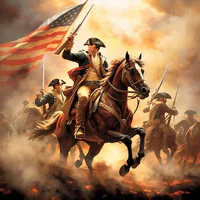
Road to Independence

Presentation
•
Social Studies
•
11th Grade
•
Practice Problem
•
Medium

Brittany Dawson
Used 3+ times
FREE Resource
10 Slides • 4 Questions
1

The Road to Independence
2

Britain:
Thirteen Colonies and parts of Canada
France:
New France, Canada (modern-day Quebec and parts of Ontario), the Great Lakes region, and the Mississippi River Valley down to Louisiana.
Spain:
Florida, including parts of present-day southeastern United States.
Territories west of the Mississippi River
North American Territories Before the French and Indian War

3
Multiple Choice

What was the main cause of the French and Indian War?
The French and British claimed the same land.
The French and Indians claimed the same land.
The Indians and British claimed the same land.
The Indians wouldn't sell their land.
4

Ends the French and Indian War
Gives Britain control of all territories east of the Mississippi River and Canada
Treaty of Paris 1763

5

British gained Canada and territory west of the Appalachian Mountains.
Proclamation of 1763 restricted colonial expansion beyond the Appalachians.
Territorial Changes
Colonists felt restricted from lands they fought to acquire.
Disagreement over British control and policies post-war.
Colonial Dissatisfaction

6
Multiple Choice

How did the Proclamation of 1763 contribute to the outbreak of the American Revolution?
It forced colonists to relocate to the west of the Appalachian Mountains.
It angered colonists who saw it as an unjustified intrusion into their affairs.
It forced colonists to accept British and Hessian troops into their homes.
It imposed a series of new taxes on colonial merchants.
7


The French and Indian War was expensive for Britain because they had to pay for troops, supplies, and battles in North America. By the end of the war, Britain was in a lot of debt.
To pay off this debt and cover the costs of running their larger empire, Britain decided to tax their American colonies.
Wars are Expensive!!!
British Views: The British Parliament thought the colonies should help pay for the war since they had benefited from it. So, they created several taxes and laws.
Colonist Views
These new taxes were very unpopular in the colonies. The anger they caused helped lead to the American Revolution.
Different Views on Colonial Taxes
The Sugar Act (1764): Put taxes on sugar and molasses.
The Stamp Act (1765): Made colonists buy stamped paper for legal documents and newspapers.
The Townshend Acts (1767): Taxed everyday items like tea, glass, and paint.
Taxes imposed on the Colonists
8
Poll

Make a Prediction:
Why do you believe the colonists were upset about the newly imposed taxes?
Colonists were angry because they didn't benefit from the taxes.
Colonists didn't like the taxes because they felt their rights were being violated.
Colonists resisted the taxes because they thought it hurt their ability to make money.
9
Their Rights Were Violated!!!!
Colonists felt their rights were violated because they had no say in British laws that taxed them. They believed they should have elected representatives in Parliament to make decisions about taxes affecting them. This lack of representation led to frustration and a desire for more control over their own governance.

10

11
In 1774, the British Parliament passed the Intolerable Acts to punish the Massachusetts colony for the Boston Tea Party.
These acts included the Boston Port Act, which closed the port of Boston, and the Massachusetts Government Act, which restricted town meetings.
The acts were meant to assert British authority and control over the American colonies.
The Intolerable Acts

12


These committees facilitated communication among the colonies.
They unified the colonies by sharing information about British actions and organizing collective responses.
They shaped public opinion and mobilized colonial resistance.
Committees
of Correspondence
Published in January 1776, Thomas Paine's pamphlet "Common Sense" argued for American independence from Britain.
Paine's clear and persuasive writing influenced many colonists, encouraging them to support the revolutionary cause.
"Common Sense" helped shift public opinion towards the idea of full independence from British rule.
Thomas Paine’s Common Sense
13
Multiple Choice

The first Committee of Correspondence was created after England passed which tax?
Sugar Act
Townshend Act
Tea Act
Stamp Act
14
The Sons of Liberty, led by figures like Samuel Adams, organized protests and acts of resistance against British policies.
The Daughters of Liberty supported the boycott of British goods, making homemade items to replace British imports.
These groups played a key role in mobilizing colonial opposition to the Intolerable Acts and other British measures.
Sons and Daughters of Liberty

The Road to Independence
Show answer
Auto Play
Slide 1 / 14
SLIDE
Similar Resources on Wayground

11 questions
Teenager 5 Session 24: Pronunciation & Speaking
Presentation
•
KG
11 questions
Anticipation Guide "A Rose for Emily"
Presentation
•
11th Grade
10 questions
Homework: United States & WWII (1937-1940) and Quarantine Speech
Presentation
•
11th Grade
10 questions
New Password B2 Vocabulary
Presentation
•
11th Grade
12 questions
Living Things
Presentation
•
KG
11 questions
Repaso 1_DD HH_P1
Presentation
•
11th Grade
10 questions
FIRST CONDITIONAL (review)
Presentation
•
10th - 11th Grade
Popular Resources on Wayground
10 questions
Safety Day 2026 – Student Review

Quiz
•
9th Grade
21 questions
Continents and Oceans
Quiz
•
6th Grade
20 questions
Parts of Speech
Quiz
•
5th Grade
16 questions
Subject & Predicate
Quiz
•
5th Grade
25 questions
Multiplication Facts
Quiz
•
5th Grade
12 questions
Map Skills
Quiz
•
3rd Grade
22 questions
Continents and Oceans
Quiz
•
5th Grade
15 questions
Rounding Decimals
Quiz
•
5th Grade
Discover more resources for Social Studies
39 questions
Unit 7 Key Terms
Quiz
•
11th Grade - University
38 questions
Unit 6 Key Terms
Quiz
•
11th Grade - University
38 questions
The Progressive Era
Quiz
•
11th Grade
25 questions
Progressive Era
Quiz
•
11th Grade
25 questions
Gilded Age Gallery Walk
Presentation
•
9th - 12th Grade
20 questions
How The Constitution Has Changed
Quiz
•
11th Grade
25 questions
Mastery Quiz SSUSH 11-14
Quiz
•
11th Grade
30 questions
Q1 US History Check
Quiz
•
11th Grade