Search Header Logo
TEAS Test Study Guide - Chemistry

TEAS Test Study Guide - Chemistry

Assessment

Presentation

Biology

University

Practice Problem

Easy

Created by

SN Goebel

Used 4+ times

FREE Resource

16 Slides • 119 Questions

1

TEAS Test Study Guide - Chemistry

2

Multiple Choice

Question image

What is the study of matter, especially its chemical reactions, but also its composition, structures and properties?

1

Biology

2

Physics

3

Chemistry

4

Geology

3

Multiple Choice

Question image

What are the three states of matter?

1

Solid, liquid, gas

2

Plasma, gas, solid

3

Liquid, gas, plasma

4

Solid, plasma, liquid

4

Multiple Choice

Question image

Which of the following is the definition of a chemical reaction?

1

The physical change of a substance without changing its composition

2

A process that rearranges the atoms of one or more substances to form one or more different substances

3

The combining of two or more substances to form a new substance

4

The breaking down of a substance into simpler substances

5

Multiple Choice

Question image

What is the purpose of balancing chemical equations?

1

To ensure that the total number of atoms on each side of the equation is the same

2

To make the equation more accurate

3

To follow a standard procedure in chemistry

4

To fulfill a requirement in chemical experiments

6

Multiple Choice

Question image

What are the smallest units of an element that retain the element's chemical properties?

1

Cells

2

Tissues

3

Organs

4

Atoms

7

Multiple Choice

Question image

What is an element?

1

A type of atom

2

A substance that can be broken down into simpler substances by chemical means

3

A substance that cannot be broken down further into simpler substances by chemical means

4

A substance that can be broken down into simpler substances by physical means

8

Multiple Choice

Question image

Which of the following is NOT a subatomic particle?

1

Electron

2

Proton

3

Protein

4

Neutron

9

Multiple Choice

Question image

Which subatomic particle determines the type of element?

1

Photon

2

Electron

3

Neutron

4

Proton

10

Multiple Choice

Question image

What is the total number of protons in an element called?

1

Atomic mass

2

Electron count

3

Atomic number

4

Neutron count

11

Multiple Choice

Question image

What is the atomic mass of an element?

1

The total number of atoms in an element.

2

The total number of neutrons in an element.

3

The average mass of an atom of an element, taking into account all of its isotopes.

4

The number of protons in an atom of an element.

12

Multiple Choice

Question image

How do you calculate the number of neutrons in an atom?

1

Add the number of electrons to the atomic number.

2

Divide the atomic number by the atomic mass.

3

Subtract the atomic number (# of protons) from the atomic mass.

4

Multiply the atomic number by the atomic mass.

13

Multiple Choice

Question image

What is an isotope?

1

An isotope is a form of an element that has a different number of protons.

2

An isotope is a form of an element that has a different number of protons and neutrons.

3

An isotope is a form of an element that has a different number of electrons.

4

An isotope is a form of an element that has the same number of protons but a different number of neutrons.

14

Multiple Choice

Question image

Where is most of an atom's mass located?

1

In the nucleus

2

In the atomic orbitals

3

In the outer energy shells

4

In the electron cloud

15

Multiple Choice

Question image

Where do the electrons of an atom reside?

1

Nucleus

2

Neutrons

3

Electron shells (orbitals)

4

Protons

16

Multiple Choice

Question image

Which of the following best defines the valence shell?

1

The nucleus of an atom

2

The innermost shell of an atom

3

The region where protons are found

4

The outermost shell of an atom that contains electrons

17

Multiple Choice

Question image

Why is the valence shell important in chemical bonding?

1

It determines the temperature at which an atom reacts

2

It determines the color of an atom

3

It determines the number of neutrons an atom has

4

It determines the types of chemical bonds an atom can form

18

Multiple Choice

Question image

What happens when an atom's valence shell is full?

1

The atom becomes stable and less reactive

2

The atom loses all its electrons

3

The atom becomes highly reactive

4

The atom becomes larger in size

19

Match

Question image

Match the main properties of subatomic particles with their correct descriptions:

Positive charge, located in the nucleus

No charge, located in the nucleus

Negative charge, located in the orbitals

Proton

Neutron

Electron

20

Multiple Choice

Question image

Which of the following statements best describes ions?

1

Ions are atoms or molecules that have gained or lost neutrons, resulting in a change in their atomic mass.

2

Ions are atoms or molecules that have gained or lost electrons, resulting in a net positive or negative charge.

3

Ions are atoms or molecules that have gained or lost electrons, resulting in a change in their atomic structure.

4

Ions are atoms or molecules that have gained or lost protons, resulting in a change in their atomic number.

21

Multiple Choice

Question image

What are compounds?

1

Substances that cannot be chemically broken down into simpler substances.

2

Substances that have a fixed composition.

3

Substances made up of two or more different elements chemically combined.

4

Substances made up of only one element.

22

Multiple Choice

Question image

What is a molecule?

1

A molecule is a group of atoms bonded together, representing the smallest fundamental unit of a chemical compound that can take part in a chemical reaction.

2

A molecule is a type of cell found in the human body.

3

A molecule is a tiny particle that can only be seen through a microscope.

4

A molecule is a basic unit of energy in the human body.

23

media
media
media

Metals give up electrons, they become positively charged ions; Non-metals gain those electrons and become negatively charged ions. The oppositely charged ions become attracted to each other forming a bond.
Ionic bonds happen between metals and nonmetals

​​Ionic

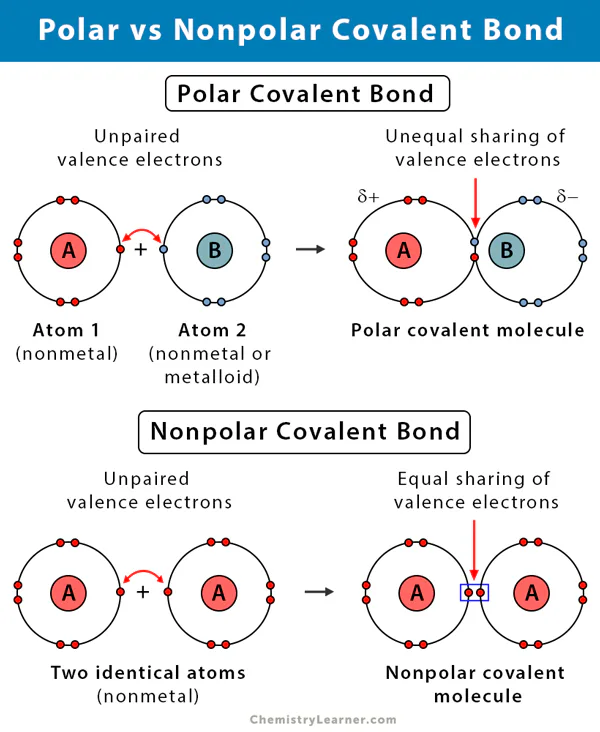
​​Occur when atoms with only partially filled valence shell electrons, come together to share electrons; only nonmetals participate in covalent bonds

​​Covalent

​it is a polar covalent bond. The hydrogen covalent bonds with another electronegative atom (like oxygen or nitrogen). the other molecule becomes partially negative while the hydrogen becomes partially positive. It's the opposite charges that cause the atoms to bond together

​​Hydrogen

​Three Main Types of Bonds

24

Multiple Choice

Question image

Which of the following best describes a covalent bond?

1

Unequal sharing of electrons between two non-metal atoms

2

Attraction between metal cations and delocalized electrons

3

Sharing of electrons between two non-metal atoms

4

Transfer of electrons from a metal to a non-metal

25

Multiple Choice

Question image

Which of the following is NOT a characteristic of covalent bonds?

1

They can form single, double, or triple bonds

2

They result in a stable molecule

3

They are strong bonds

4

They form between a metal and a nonmetal

26

Multiple Choice

Which of the following molecules is an example of a compound held together by covalent bonds?

1

Calcium carbonate (CaCO3)

2

Sodium chloride (NaCl)

3

Water (H2O)

4

Magnesium oxide (MgO)

27

Multiple Choice

Question image

What type of covalent bond occurs when two atoms share more than two pairs of electrons?

1

Triple bond

2

Single bond

3

Ionic bond

4

Double bond

28

Multiple Choice

Question image

How many electrons are shared in a single covalent bond?

1

3 electrons

2

4 electrons

3

1 electron

4

2 electrons

29

Multiple Choice

Question image

What is the name given to a covalent bond in which electrons are shared equally between atoms?

1

Ionic bond

2

Hydrogen bond

3

Polar covalent bond

4

Nonpolar covalent bond

30

Multiple Choice

Question image

What are polar covalent bonds?

1

Bonds formed between atoms with different valence electrons, resulting in the formation of ions.

2

Bonds formed between atoms with opposite charges, resulting in a transfer of electrons.

3

Bonds formed between atoms with different electronegativities, resulting in an unequal sharing of electrons.

4

Bonds formed between atoms with similar electronegativities, resulting in an equal sharing of electrons.

31

Multiple Choice

Question image

What is electronegativity?

1

A measure of an atom's ability to attract electrons in a chemical bond.

2

A measure of an atom's ability to donate electrons.

3

The measure of an atom's size.

4

The measure of an atom's atomic mass.

32

Multiple Choice

Question image

What are hydrogen bonds?

1

Physical bonds formed by hydrogen molecules.

2

Ionic bonds formed between hydrogen and oxygen atoms.

3

Strong covalent bonds that hold hydrogen atoms together.

4

Weak electrostatic attractions between a hydrogen atom and an electronegative atom.

33

media

34

Multiple Choice

Hydrogen bonds occur between a hydrogen atom and which other atom?

1

Carbon

2

Sodium

3

Potassium

4

Nitrogen, oxygen, or fluorine

35

Multiple Choice

Question image

Which property of water helps to moderate temperature changes in the body?

1

Low heat of fusion

2

High specific heat

3

Low boiling point

4

High vapor pressure

36

Multiple Choice

Which term refers to the amount of energy needed to change the temperature of a substance by 1 degree Celsius (It determines how quickly a substance heats up or cools down)?

1

Conduction

2

Radiation

3

Specific Heat

4

Latent Heat

37

Multiple Choice

Question image

Which property of water makes it an effective solvent?

1

Viscosity

2

Transparency

3

Surface tension

4

Polarity

38

Multiple Choice

Question image

Which property of water allows it to have a high surface tension?

1

Tension

2

Adhesion

3

Capillarity

4

Cohesion

39

Multiple Choice

Question image

Which property of water allows it to stick to the sides of a glass?

1

Adhesion

2

Cohesion

3

Surface tension

4

Capillary action

40

Multiple Choice

Question image

What is the main difference between cohesion and adhesion of water?

1

Cohesion is the attraction between water molecules and other substances, while adhesion is the attraction between two different water molecules.

2

Cohesion is the attraction between water molecules, while adhesion is the attraction between water molecules and other substances.

3

Cohesion is the attraction between water molecules, while adhesion is the attraction between two different water molecules.

4

Cohesion is the attraction between water molecules and other substances, while adhesion is the attraction between water molecules.

41

Multiple Choice

Question image

Which property of water allows it to store large amounts of heat without a significant temperature change?

1

Surface tension

2

High heat capacity

3

Cohesion

4

Adhesion

42

Multiple Choice

Question image

Which of the following best describes the process of capillary action of water?

1

The movement of water across a semipermeable membrane

2

The absorption of water by plant roots

3

The breakdown of water molecules into hydrogen and oxygen

4

The ability of water to move up through small tubes against gravity

43

media
media

44

Multiple Choice

Question image

What is the main difference between hydrophilic and hydrophobic substances when placed in water?

1

There is no difference between hydrophilic and hydrophobic substance reactions in water.

2

Hydrophilic substances and hydrophobic substances behave the same when placed in water.

3

Hydrophilic substances dissolve or mix well with water, while hydrophobic substances repel water and do not mix with it.

4

Hydrophilic substances repel water and do not mix with it, while hydrophobic substances dissolve or mix well with water.

45

Multiple Choice

Question image

What are ionic bonds?

1

A type of bond formed between two metals.

2

A type of chemical bond formed between two ions with opposite charges.

3

A type of bond formed between two nonmetals.

4

A type of bond formed between two atoms with the same charge.

46

Multiple Choice

Question image

Which of the following elements commonly form ionic bonds?

1

Noble gases.

2

Nonmetal and nonmetal.

3

Metal and metal.

4

Metal and nonmetal.

47

Multiple Choice

Question image

In an ionic bond, what happens to the electrons?

1

Electrons are transferred from the metal to the nonmetal.

2

Electrons are eliminated.

3

Electrons are shared between the metal and the nonmetal.

4

Electrons are neutralized.

48

Multiple Choice

What is the overall charge of an ionic compound?

1

Positive.

2

It varies depending on the elements involved.

3

Neutral.

4

Negative.

49

Multiple Choice

Question image

Which type of substances conduct electricity in solution?

1

Ionic substances

2

Covalent substances

3

Polar covalent substances

4

Metallic substances

50

Multiple Choice

Question image

How are ions formed?

1

Ions are formed by the action of hormones in the endocrine system.

2

Ions are formed when atoms gain or lose electrons, resulting in a change in their overall charge.

3

Ions are formed through a process called osmosis.

4

Ions are formed through the breakdown of proteins in the body.

51

Multiple Choice

Question image

What happens to the charge of an atom when it gains an electron?

1

The charge of the atom remains the same.

2

The charge of the atom becomes more positive (cation)

3

The charge of the atom becomes more negative (anion).

4

The charge of the atom becomes neutral.

52

Multiple Choice

Question image

What happens to the charge of an atom when it loses an electron?

1

Its charge becomes neutral

2

Its charge remains the same

3

It becomes negatively charged (anion)

4

It becomes positively charged (cation)

53

Multiple Choice

Question image

Which of the following best describes a salt?

1

A special type of rock found deep within the Earth.

2

A type of seasoning used to enhance the taste of food.

3

A compound formed from the reaction between an acid and a base, consisting of positive and negative ions.

4

A form of crystallized water.

54

Multiple Choice

Question image

What is pH?

1

The amount of water in a solution

2

The concentration of hydroxide ions in a solution

3

A measure of acidity or alkalinity of a solution

4

The concentration of hydrogen ions in a solution

55

Multiple Choice

Question image

What pH level is considered alkaline?

1

Above 7

2

7

3

Between 2 and 12

4

Below 7

56

Multiple Choice

Question image

What pH level is considered acidic?

1

Above 7

2

7

3

Between 2 and 12

4

Below 7

57

Multiple Choice

Question image

What pH level is considered neutral?

1

Above 7

2

7

3

Between 2 and 12

4

Below 7

58

Multiple Choice

Question image

According to the Arrhenius theory, what defines an acid?

1

Substance that produces hydroxide ions (OH-) in water

2

Substance that accepts electrons

3

Substance that releases carbon dioxide (CO2)

4

Substance that produces hydrogen ions (H+) in water

59

  • Arrhenius theory states that an acid is a substance that produces hydronium ions when it is dissolved in water.

  • It also states that a base is a substance that produces hydroxide ions when dissolved in water.

Arrhenius Theory

media

60

Multiple Choice

Question image

According to the Arrhenius theory, what defines a base?

1

Substance that produces hydrogen ions (H+) in water

2

Substance that donates electrons

3

Substance that releases oxygen (O2)

4

Substance that produces hydroxide ions (OH-) in water

61

  • Acids are substances that donate a positive hydrogen ion to another substance in a chemical reaction.

  • A base is the substance that receives that hydrogen ion.

Bronsted-Lowry Acid-Base Theory

media

62

Multiple Choice

Question image

What is the main concept of the Bronsted-Lowry acid-base theory?

1

Acids accept protons, while bases donate protons.

2

Acids accept electrons, while bases donate protons.

3

Acids donate protons, while bases accept protons.

4

Acids donate electrons, while bases accept protons.

63

  • An acid is a substance which is capable of accepting a pair of electrons from another substance during the process of bond formation

  • A base is a substance which can provide a pair of electrons to form a new bond.

Lewis Acid-Base Theory

media

64

Multiple Choice

Question image

What happens in a Lewis acid-base reaction?

1

The Lewis acid accepts a hydrogen ion from the Lewis base.

2

The Lewis acid accepts a pair of electrons from the Lewis base.

3

The Lewis acid donates a hydrogen ion to the Lewis base.

4

The Lewis acid donates a pair of electrons to the Lewis base.

65

Multiple Choice

Question image

Why is pH described as a logarithmic scale?

1

Each unit change represents a tenfold change in acidity or alkalinity

2

Each unit change represents a hundredfold change in acidity or alkalinity

3

Each unit change represents a linear change in acidity or alkalinity

4

Each unit change represents a twofold change in acidity or alkalinity

66

Multiple Choice

Pure water has the pH of 7. Black coffee has the pH of 5. Black coffee is how many times more acidic than pure water?

1

1 time more acidic

2

10 times more acidic

3

100 times more acidic

4

1000 times more acidic

67

  • Take the two pH values and subtract

  • The answer tells you how many zeros to add to one (1)

    Problem:

  • 7-5 = 2

  • add 2 zeros to 1 - it becomes 100

  • Black coffee is 100 times more acidic than pure water.

Solution: Pure water has the pH of 7. Black coffee has the pH of 5. Black coffee is how many times more acidic than pure water?

68

Fill in the Blanks

69

Multiple Choice

Question image

The body has a natural mechanism to control pH levels. This mechanism is known as:

1

Alkaline control

2

Acidic equilibrium

3

pH regulation

4

Acid-base balance

70

Multiple Choice

Which of the following is NOT an organ involved in acid-base balance regulation?

1

Lungs

2

Kidneys

3

Liver

4

Pancreas

71

Multiple Choice

What is the normal pH range for arterial blood in the human body?

1

6.5-7.0

2

7.35-7.45

3

7.55-7.70

4

8.0-8.5

72

Multiple Choice

Question image

What happens to the pH level of blood when carbon dioxide levels increase?

1

It increases (becomes more alkaline)

2

It remains constant

3

It decreases (becomes more acidic)

4

It has no effect on pH

73

Multiple Choice

Question image

Which of the following is a buffer system that helps regulate acid-base balance in the body?

1

Bicarbonate buffer system

2

Sulfur buffer system

3

Nitrogen buffer system

4

Phosphate buffer system

74

Multiple Choice

A _________ is a region of material that is chemically uniform, physically distinct, and (often) mechanically separable.

1

phase

2

acid

3

base

4

bond

75

Fill in the Blanks

76

  • A phase is a set of states of a chemical system that have similar bulk structural properties, over a range of conditions, such as pressure or temperature.

  • The main states of matter are solids, liquids, gases and plasmas.

Phases of Matter

media

77

Multiple Choice

Question image

Which phase of matter has an indefinite shape and definite volume?

1

solid

2

plasma

3

gas

4

liquid

78

Multiple Choice

Question image

Which phase of matter has a definite shape and volume?

1

solid

2

plasma

3

gas

4

liquid

79

Multiple Choice

Question image

What are the properties of a liquid?

1

It has no definite volume but definite shape.

2

It has definite volume and definite shape.

3

It has no definite volume and no definite shape.

4

It has definite volume but no definite shape.

80

Multiple Choice

Question image

What is the plasma state of matter?

1

The gaseous state in which matter expands to fill the entire volume of its container.

2

The solid state in which matter maintains a fixed shape and volume.

3

The fourth state of matter in which atoms or molecules are highly ionized and form a superheated gas-like state.

4

The liquid state in which matter takes the shape of its container.

81

Multiple Choice

Question image

What is a redox reaction?

1

A reaction that only involves reduction

2

A reaction that involves synthesis and decomposition

3

A chemical reaction that involves both reduction and oxidation

4

A reaction that only involves oxidation

82

Multiple Choice

Which process occurs during reduction in a redox reaction?

1

Electrons are gained

2

Protons are gained

3

Electrons are lost

4

Protons are lost

83

  • An oxidizer will remove electrons from another substance

  • A reducing agent will gain the electrons lost from the oxidizer

  • Mnemonic: LEO says GER - Loss of electrons: oxidation; Gain of electrons: reduction

Redox is a concept related to the ability of atoms of various substances to lose or gain electrons

media

84

Multiple Choice

Question image

What is oxidation in a redox reaction?

1

The process of combining two or more substances

2

The gain of electrons by a substance

3

The loss of electrons by a substance

4

The production of energy in a chemical reaction

85

Multiple Choice

Question image

What happens to the atoms during a chemical reaction?

1

Bonds between atoms break and form, resulting in different substances with different properties

2

Atoms are destroyed

3

Atoms are created

4

Atoms remain unchanged

86

Multiple Choice

What is a chemical equation?

1

A representation of a physical change in matter.

2

The process of converting chemical substances into simpler substances.

3

The process of converting physical substances into chemical substances.

4

A representation of a chemical reaction using chemical formulas and symbols.

87

Multiple Choice

Question image

In a chemical equation, what do the coefficients represent?

1

In a chemical equation, what do the coefficients represent?

2

The physical state of each substance.

3

The temperature at which the reaction occurs.

4

The number of atoms or molecules of each substance involved in the reaction.

88

Multiple Choice

Which of the following is an example of a chemical equation?

1

2NaCl

2

H2O

3

C6H12O6

4

2H2 + O2 → 2H2O

89

Multiple Choice

What is the difference between a chemical equation and a chemical formula?

1

A chemical equation includes numbers, while a chemical formula does not.

2

A chemical equation represents a chemical reaction, while a chemical formula represents a single compound or element.

3

A chemical equation shows the structure of a substance, while a chemical formula does not.

4

A chemical equation involves energy changes, while a chemical formula does not.

90

Multiple Choice

Question image

What does it mean to balance a chemical equation?

1

Balancing equations involves changing the chemical formula of the reactants.

2

Balancing a chemical equation involves adjusting the coefficients of the reactants and products to have an equal number of atoms on both sides.

3

Balancing equations refers to equalizing the concentration of the reactants and products.

4

Balancing equations means adding more reactants to the left side of the equation.

91

Multiple Choice

Which of the following best describes a chemical reaction mechanism?

1

The process of colliding molecules resulting in the formation of new substances.

2

The overall description of a chemical reaction, including the reactants and products.

3

The total mass of reactants being equal to the total mass of products.

4

The series of steps that shows how reactants are transformed into products.

92

Multiple Choice

Question image

Which statement best describes equilibrium in a chemical reaction?

1

The concentrations of reactants and products remain constant over time.

2

The concentrations of reactants and products continuously change over time.

3

The reaction does not reach completion, and reactants and products still exist.

4

All reactants are consumed, and no products are formed.

93

Multiple Choice

Question image

When does dynamic equilibrium occur in a chemical reaction?

1

When the rate of the forward reaction is faster than the rate of the reverse reaction.

2

When the rate of the forward reaction is equal to the rate of the reverse reaction.

3

When the rate of the reverse reaction is faster than the rate of the forward reaction.

4

When the concentrations of reactants and products are equal.

94

Multiple Choice

Which of the following best describes a catalyst?

1

A substance that speeds up a chemical reaction without being consumed or permanently changed

2

A substance that slows down a chemical reaction

3

A substance that gets consumed in a chemical reaction

4

A substance that permanently changes during a chemical reaction

95

Multiple Choice

Question image

What are catalysts made of?

1

Protein

2

Carbohydrates

3

Lipids

4

Enzymes

96

Multiple Choice

Which of the following is NOT a characteristic of catalysts?

1

They can be affected by temperature and pH

2

They can be reused multiple times

3

They are consumed during a chemical reaction

4

They are specific to certain reactions

97

Multiple Choice

Question image

What is the periodic table of elements?

1

It is a list of elements in alphabetical order.

2

It is a tabular arrangement of chemical elements, organized based on their atomic number, electron configuration, and recurring chemical properties.

3

It is a chart that shows the elements according to their boiling points.

4

It is a list of elements sorted by their mass.

98

  • The elements in the blocks are based on which sub-shell the last electron resides.

  • It represents the valence shell electron's location in its atomic orbital.

  • For example, if the last electron goes in the s orbital, then the element is an s block element

The periodic table can be broken down into 4 rectangular blocks

media

99

Multiple Choice

Question image

What do the s, p, d, and f blocks represent on the periodic table?

1

Different types of elements

2

Different types of chemical reactions

3

Different types of atomic masses

4

Different types of atomic orbitals

100

Multiple Choice

Question image

What is the atomic number?

1

The number of neutrons in an atom

2

The total number of subatomic particles in an atom

3

The number of electrons in an atom

4

The number of protons in an atom

101

media
  • The chemical elements on the periodic table are arranged in order of increasing atomic number, which refers to the number of protons of an element.

Atomic Number

102

media
  • The periodic table contains only chemical elements

  • Mixtures, compounds or small atomic particles of elements are not included.

103

Multiple Choice

Question image

What is a period on the periodic table?

1

A period is a group of elements with similar properties.

2

A period is a horizontal row on the periodic table.

3

A period is a subatomic particle with a negative charge.

4

A period is a vertical column on the periodic table.

104

Multiple Choice

Question image

What is the purpose of a period on the periodic table?

1

A period helps organize elements based on their electron configuration and properties.

2

A period determines the number of protons in an atom.

3

A period indicates the atomic mass of an element.

4

A period defines the chemical reactivity of an element.

105

  • The rows of the periodic table are called periods.

  • Elements on a row have the same number of electron shells or atomic orbitals

  • For example, elements on the first row have just one atomic orbital, elements of the second row have 2.

Periods

media

106

Multiple Choice

Question image

In chemistry, what is a group on the periodic table?

1

A region on the periodic table where metals are located

2

A type of chemical bond formed between atoms

3

A horizontal row of elements arranged by increasing atomic number

4

A vertical column of elements with similar properties

107

Multiple Choice

Question image

Elements within a group on the periodic table have similar properties because of their:

1

Similar atomic size

2

Similar number of neutrons

3

Similar number of protons

4

Same number of valence electrons

108

Multiple Choice

Which of the following statements is true about energy in a chemical reaction?

1

All of the energy is converted into heat.

2

No energy is lost or gained.

3

Some energy is lost as heat.

4

Energy is created during a chemical reaction.

109

Multiple Choice

Question image

Which type of chemical reaction releases energy?

1

Both exergonic and endergonic

2

Exergonic

3

Endergonic

4

Neither exergonic nor endergonic

110

Multiple Choice

Question image

Which type of chemical reaction absorbs energy?

1

Both exergonic and endergonic

2

Exergonic

3

Endergonic

4

Neither exergonic nor endergonic

111

  • A reaction is exergonic if the final state is lower on the energy scale than the initial state

  • A reaction in endergonic if the situation is reversed. The final state is higher on the energy scale than the initial state.

Exergonic vs Endergonic

media

112

Multiple Choice

Question image

Which of the following best describes an endothermic reaction?

1

A reaction that releases energy in the form of light

2

A reaction that releases heat to the surroundings

3

A reaction that absorbs heat from the surroundings

4

A reaction that occurs spontaneously without any input of energy

113

Multiple Choice

Question image

Which of the following best describes an exothermic reaction?

1

A reaction that absorbs heat from the surroundings

2

A reaction that releases heat to the surroundings

3

A reaction that occurs spontaneously without any input of energy

4

A reaction that requires the presence of oxygen to occur

114

Multiple Choice

Question image

What is activation energy?

1

The energy required to start a chemical reaction

2

The energy needed to break chemical bonds

3

The energy stored in chemical bonds

4

The energy released during a chemical reaction

115

Multiple Choice

Question image

What is the meaning of boiling point?

1

The temperature at which a substance changes from a liquid to a gas

2

The temperature at which a substance changes from a gas to a liquid

3

The temperature at which a substance changes from a solid to a gas

4

The temperature at which a substance changes from a solid to a liquid

116

Multiple Choice

Question image

What does condensation mean?

1

The process by which a solid changes into a liquid

2

The process by which a solid changes into a gas

3

The process by which a liquid changes into a gas

4

The process by which a gas or vapor changes into a liquid

117

Multiple Choice

Question image

What does 'critical point' mean?

1

The temperature at which liquid and gas phases have the same density

2

A point in a system where the temperature is extremely high

3

A point in a system where multiple substances combine

4

A point in a system where there is a sudden increase in pressure

118

Multiple Choice

Question image

What is the triple point in chemistry?

1

The point at which a substance undergoes a phase change from liquid to gas.

2

The point at which a chemical reaction reaches its maximum rate.

3

The temperature and pressure at which a substance can exist as a solid, liquid, and gas simultaneously.

4

The point at which a substance undergoes a phase change from solid to liquid.

119

Multiple Choice

Question image

What is the definition of density?

1

The ability of an object to float in water.

2

The total energy of an object.

3

The amount of mass per unit volume of a substance.

4

The force of gravity acting on an object.

120

Multiple Choice

Question image

What are extensive properties?

1

Extensive properties are characteristics that remain constant regardless of the object or system's size.

2

Extensive properties are only applicable to living organisms.

3

Extensive properties refer to the internal composition of an object or system.

4

Extensive properties depend on the amount or size of the object or system.

121

Multiple Choice

Question image

What is freezing in chemistry?

1

The process in which a substance changes from a liquid to a gaseous state due to an increase in temperature.

2

The process in which a substance changes from a gaseous to a liquid state due to a decrease in temperature.

3

The process in which a substance changes from a liquid to a solid state due to a decrease in temperature.

4

The process in which a substance changes from a solid to a liquid state due to an increase in temperature.

122

Multiple Choice

Question image

What is sublimation in chemistry?

1

The process in which a substance transitions directly from a solid to a gas without passing through the liquid state.

2

The process of converting a gas into a liquid.

3

The process of converting a solid into a liquid.

4

The process of converting a liquid into a solid.

123

Multiple Choice

Question image

What are intensive properties?

1

Properties that are independent of the quantity of the substance

2

Properties that depend on the quantity of the substance

3

Properties that are only applicable to liquids

4

Properties that change with temperature

124

Multiple Choice

Question image

What does malleability mean?

1

The ability of a substance to conduct electricity

2

The ability of a substance to dissolve in water

3

The ability of a substance to change color under certain conditions

4

The ability of a substance to be deformed into different shapes without breaking

125

Multiple Choice

Question image

Which process involves the passive movement of molecules from an area of high concentration to an area of low concentration?

1

Facilitated Diffusion

2

Active Transport

3

Osmosis

4

Diffusion

126

Multiple Choice

Question image

Which process involves the movement of water across a semipermeable membrane from an area of low solute concentration to an area of high solute concentration?

1

Osmosis

2

Endocytosis

3

Diffusion

4

Active Transport

127

Multiple Choice

Question image

Which process involves the combination of substances to form a single product?

1

Synthesis

2

Double displacement

3

Single displacement

4

Combustion

128

media

129

Multiple Choice

Question image

Which type of chemical reaction involves the breakdown of a compound into simpler substances?

1

Decomposition

2

Single displacement

3

Synthesis

4

Double displacement

130

Multiple Choice

Question image

Which type of chemical reaction involves the combination of a substance with oxygen?

1

Synthesis

2

Double displacement

3

Single displacement

4

Combustion

131

Multiple Choice

Question image

What is the main difference between single displacement and double displacement reactions?

1

Single displacement reactions are spontaneous reactions, while double displacement reactions are non-spontaneous reactions.

2

Single displacement reactions involve the exchange of atoms or ions between two compounds, while double displacement reactions only occur in the presence of a catalyst.

3

Single displacement reactions involve the transfer of energy through the formation of a precipitate, while double displacement reactions involve the release of energy through a combustion reaction.

4

In single displacement reactions, one element or ion displaces another element or ion in a compound. In double displacement reactions, atoms or ions from two different compounds switch places.

132

Multiple Choice

Question image

What is deposition in chemistry?

1

The process in which a gas transitions directly into a solid without passing through the liquid state.

2

The process of converting a solid into a liquid.

3

The process of converting a liquid into a gas.

4

The process of converting a liquid into a solid.

133

Multiple Choice

Question image

Which of the following is a source of UV radiation?

1

Microwave ovens

2

Incandescent light bulbs

3

The sun

4

Television screens

134

Multiple Choice

Question image

How does UV radiation affect the skin?

1

It makes the skin produce more melanin

2

It has no effect on the skin

3

It can make the skin more oily

4

It can cause sunburn and increase the risk of skin cancer

135

Multiple Choice

How can you protect your skin from UV radiation?

1

By wearing sunglasses

2

By wearing sunscreen and protective clothing, and by seeking shade

3

By staying indoors all the time

4

By using tanning beds regularly

TEAS Test Study Guide - Chemistry

Show answer

Auto Play

Slide 1 / 135

SLIDE