

Lesson 4 - Adaptation

Presentation
•
Biology, Science
•
9th - 12th Grade
•
Medium
+7
Standards-aligned

Samah Al-hamadi
Used 13+ times
FREE Resource
60 Slides • 35 Questions
1
By Whitney Ratliff
2

3
Multiple Choice
In the context of evolutionary biology, what does the term 'fitness' refer to?
The physical strength of an organism
The ability of an organism to survive and reproduce in its environment
The speed at which an organism can move
The lifespan of an organism
4
Multiple Choice
All the individuals of a species that live in a particular area are called a
variation
fossil
population
group
5

6

7
Multiple Choice
Which of the following statements are true about natural selection?
Organisms develop adaptations out of need
The goal of evolution is to produce stronger, bigger organisms
Over time, populations will contain individuals with higher fitness
8

9
Open Ended
What do you believe it means to adapt ? What benefit is there in adapting ?
10
Adjustments made which enables organisms to function unction better in an environment in the process ehance their chance of survival

11
12
Multiple Choice
What is the term for a feature that allows an organism to survive better in its environment?
variation
adaptation
homologous structure
vestigial structure
13
Physical
Physiological
Behavioral

14
These are processes which takes place internally which protects the organisms from the changes that takes place in the environment
Ex. A snake produces toxin to protect itself
An opposum playing dead to detract predator

15
External features that organism develop to help them adjust to the environment
Ex. Cacti having prickles that prevent loss of water
Hard shells on crabs

16
Multiple Choice
Adaptations which allow organisms internal processes to adjust internally in a way that protects them
Physical
Biological
Physiological
17
Open Ended
Type an example of physical adaptation
18
Multiple Choice
External body changes that enables organisms to adjust to environment
Physical
Physiological
Behavioral
19
These are actions that animals take in response to change in environment
Ex. Bears hibernating in winter
Snake hissing
Dog growling
Plants losing leaves in winter

20
Multiple Choice

What type of adaptation is shown in picture ?
Behavioral
Physical
Physiological
21
Open Ended
Type an example of Behavioral Adaptation
22
Multiple Choice
Which of the following is not a type of biological Adaptation?
Behavioral
Physiological
Emotional
Physical
23
Multiple Choice
Individuals that are well adapted to their environment will survive and produce
fewer mutations
more offspring
stronger genes
better traits
24
Open Ended
What term is used to describe an organism that change over Time as they adapt ?
25
Artificial Selection
Natural Selection

26
Humans carefully select traits or characteristics that are passed on to offspring

27
Multiple Choice
What is the process in which humans breed organisms for certain traits?
natural selection
inheritance of acquired characteristics
artificial selection
descent without modification
28
Multiple Choice
Selection of desired traits in organisms by humans
Natural Selection
Artificial selection
Survival of the fittest
Random selection
29

30
Natural selection can be defined as the process by which nature randomly select traits in a consistent, orderly which enables an organism to adapt to its environment
Mutation takes place during Natural Selection

31
Multiple Choice
Natural selection results in change overtime by acting on traits that are
inheritable
new
mutated
similar
32
Open Ended
Why do you believe that the Dinosaurs went extinct and other living things did not 65 millions years ago, even though they were all exposed to the same catastrophe?
33
Biological Evolution
34
Occur when there is a change in the way the DNA is replicated
can result in organisms that are slightly different.
Most have no effect on the organism, but they can be passed down to the next generation.
Overtime mutations could result in an entirely different organism

35
Organisms that can adapt are more likely to survive
This is called Survival of the Fittest

36
Changes are usually not sudden
They show up gradually over time in each successive generation
This is called Gradualism

37
Variations are the differences that we observe in organisms of the same species
Ex. Dog is a specie but there are differences in some features among breeds of dogs such as size or fur thickness

38
Multiple Choice
Which concept is part of the modern evolutionary theory, but not Darwin's original theory?
Variations in traits are caused by mutation and recombination.
Species tend to produce more offspring than can survive.
Better adapted individuals survive to produce offspring.
The environment is responsible for eliminating less fit individuals.
39
Common Ancestry
All organisms that belong to a domain are said to be related
The more they are grouped as they go down the different sub groups they more closely related they are

40
Multiple Choice
The leg structures of many different vertebrates are quite similar in number and location of bones. Most scientists would probably explain this on the basis of
Natural selection
Common ancestry
Mutation
41
5 Min Brain Break
42
Biogeography
Homologous features
Vestigial structures
Genetics
Embryological Similarities
Analogous features

43

44

45

46
Common features which indicate common ancestry
Ex. the fore limb of whales , dogs , humans and bird appears the same

47
Multiple Choice
Common features which indicate common ancestry
Homologous
Vestigial
Analogous
Embryo
48
Similar features develop in organisms which are not related or share similar ancestry.

49
Multiple Choice
Similar features develop in organisms which are not related or share similar ancestry.
Homologous
Vestigial
Analogous
Embryo
50

51
Ex. arctic fox and the ptarmigan , both undergo seasonal changes of color from dark to snowy white.
They are not related or share similar ancestry

52
structures
Features which are homologous, but they are not functional
Example tail bones in humans are homologous (Tail) but they are not functional

53

54
Multiple Choice
Features which are homologous but are not functional
Homologous
Vestigial
Analogous
Embryo
55
All organisms contain DNA
The combination of DNA determines offspring
Combinations which are closer will appear similar

56
Most embryo of living things look alike
Embryos have structures that are not present in the adult form
As they develop they morphed into their specific specie

57
Related fossils found in different rock layers show how organisms changed over time
These changes show evolutionary relationships among organisms

58

59
Multiple Choice
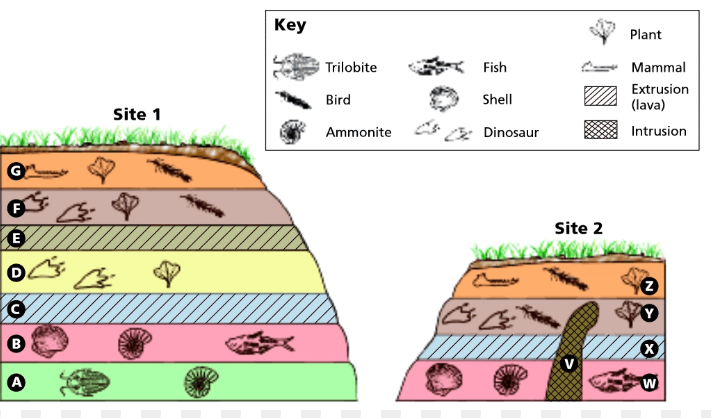
At site 1, which of the following is correct.
Layer G is the oldest
Layer D is older than layer C
Layer E is younger than lyer F
Layer C is younger than layer B
60

61

62

63

64

65
Multiple Choice
Grouping all the organisms together that have the same trait is called a?
Phylogenetic Tree
Cladogram
Clade
Category
66
Multiple Choice

Which organism has the traits: Hair, Carnivorous and retractable claws only.
Cat
Horse
Wolf
Leopard
67
Multiple Choice
Which organism has hair, but is not carnivorous?
Cat
Horse
Wolf
Leopard
68

69
Multiple Choice
Adaptation in which a species evolves to resemble another species for protection
Camouflage
Mimicry
Niche
Natural Selection
70

71

72
Multiple Choice
Why were the Galapagos Islands so perfect for developing the theory of evolution by natural selection?
The islands were all the same
The islands had similar species that traveled to other islands
The islands were all beautiful
The islands were close to each other but had different environments
73

Different beak sizes because each island had a different food source
74
Multiple Choice
Each of the Galapagos Islands has finches with different beak sizes. What environmental factor created the selection for beak sizes on the different islands?
Different predators
Different food sources available
Similar food sources available
Disease
75

76

77
Match
Scientists
Proposed the theory of natural selection.
Developed the theory of inheritance of acquired characteristics.
Proposed the theory of populations outgrowing their environment.
Proposed the theory of punctuated equilibrium in evolution.
Proposed the theory of changes in the Earth
Thomas Malthus
Hutton and Lyell
Thomas Malthus
Hutton and Lyell
78

79
Multiple Choice
Which of the following best describes the process by which certain traits become more common in a population due to their beneficial effects on the survival and reproduction of organisms?
Adaptation
Artificial Selection
Natural Selection
Genetic Drift
80

81

82
Multiple Choice
The random selection of traits in organisms without human interference
Natural selection
Artificial Selection
survival of the fittest
83

84

85

86

87

88

89

90

91

92
Multiple Choice

Which graph is used to explain why human birth weight is best when born around 7 pounds?
Graph A
Graph B
Graph C
93
Multiple Choice
Trait that shows both extremes are better suited in an environment ex: bird beaks
Stabilizing Selection
Disruptive Selection
Natural Selection
Directional Selection
94

95
Multiple Choice
What mechanism of evolution is primarily responsible for the introduction of new genetic material into a population?
Genetic Drift
Mutation
Natural Selection
Gene Flow
By Whitney Ratliff
Show answer
Auto Play
Slide 1 / 95
SLIDE
Similar Resources on Wayground

90 questions
rage quit lesson
Presentation
•
KG
89 questions
Intro to Machine Sewing Slides
Presentation
•
9th - 12th Grade
92 questions
Forces Notes Part 2
Presentation
•
9th - 12th Grade
92 questions
ch. 26 Plant Growth and Development
Presentation
•
KG - University
88 questions
Seedless plants
Presentation
•
9th Grade - University
87 questions
Unit 1: Macromolecules and Enzymes
Presentation
•
9th - 12th Grade
90 questions
IA Review
Presentation
•
9th - 12th Grade
90 questions
Descubre 3 Repaso Vocab 4,5,6
Presentation
•
9th - 12th Grade
Popular Resources on Wayground
10 questions
Safety Day 2026 – Student Review

Quiz
•
9th Grade
21 questions
Continents and Oceans
Quiz
•
6th Grade
20 questions
Parts of Speech
Quiz
•
5th Grade
16 questions
Subject & Predicate
Quiz
•
5th Grade
25 questions
Multiplication Facts
Quiz
•
5th Grade
12 questions
Map Skills
Quiz
•
3rd Grade
22 questions
Continents and Oceans
Quiz
•
5th Grade
15 questions
Rounding Decimals
Quiz
•
5th Grade
Discover more resources for Biology
20 questions
Cell organelles and functions
Quiz
•
10th Grade
20 questions
Cell Transport
Quiz
•
9th - 12th Grade
25 questions
photosynthesis and cellular respiration
Quiz
•
9th Grade
20 questions
Cell Cycle
Quiz
•
9th Grade
8 questions
DNA vs. RNA
Presentation
•
9th - 12th Grade
14 questions
Ecological Succession: Primary and Secondary
Quiz
•
9th Grade
20 questions
Macromolecules
Quiz
•
10th Grade
20 questions
Characteristics of Life
Quiz
•
9th - 10th Grade